A registered nurse in the UK starts on an NHS Band 5 salary of £32,073 per year in 2026, rising steadily with experience and specialisation. According to NHS, nursing is among the UK's most employable degree types.
It is a career with genuine job security, a clear progression pathway and a level of purpose that very few professions can match. But before any of that, there is one question almost every aspiring nurse asks first.
Do my grades actually get me there?
This guide answers that question honestly, specifically and completely, whether you are a school leaver checking your A Level options, a mature student returning to education, or someone who left school years ago and is only now finding your way into nursing.
Why Checking Nursing Entry Requirements Matters Before Applying
Applying for any nursing degree or certificate without checking the entry requirements is like starting to bake without learning the recipe. You might wing it and make it work, but the chances of baking the cake successfully are slim.
Therefore, you shouldn’t skip this step because:
1. It reveals options you never knew existed
Many nursing students assume that because they do not meet the standard A Level requirements for nursing, the door is firmly closed. In reality, the UK has a range of well-established alternative pathways into nursing that are widely accepted by universities and fully recognised by the NMC (Nursing and Midwifery Council) for registration purposes.
Access to Higher Education Diplomas, BTECs (Business and Technology Education Council), Functional Skills qualifications and mature student entry routes all exist precisely because nursing needs people from every background and walk of life. You just need to know they exist before you give up.
2. It saves you time
The UCAS (Universities and Colleges Admissions Service) application process in the UK is detailed, time-consuming and emotionally draining. It involves writing personal statements, gathering references and researching universities.
Submitting an application to a programme you do not yet qualify for wastes an entire application cycle that you could have spent building the qualifications you actually need.
3. It boosts your confidence
Receiving a rejection email because of a qualification gap you could have identified earlier can be discouraging. Knowing exactly where you stand gives you the power to act strategically and identify which additional certificates you need to become a nurse, boosting your confidence.
4. It protects your finances
There are costs involved when applying for nursing studies. These include application fees, travel expenses for interviews, time taken off work or home responsibilities, and emotional energy.
Applying without checking requirements risks all of that on a foundation that was never solid to begin with.
Grades You Need for Nursing Entry Requirements in the UK
Before you decide to switch to nursing or pursue a nursing career in the UK, the grades required depend on your location.
For instance, if you are in the UK, you generally need 96–128 UCAS (Universities and Colleges Admissions Service) points. Ninety-six UCAS points are equivalent to CCC at A Level, while 144 points are equivalent to AAA.
You also need:
-
GCSE (General Certificate of Secondary Education) English Language and Maths at grade C/4 or above
-
Functional Skills Level 2 in English and Maths, which is accepted as a GCSE equivalent by most universities and the NMC (Nursing and Midwifery Council)
If your grades are not there yet, an Access to Higher Education Diploma in Health or Nursing takes one year and meets the entry requirements of most UK nursing programmes. Students preparing for entry requirements can also explore pre-nursing support and nursing preparation courses designed for mature and international applicants.
However, if you are not in the UK, these are the grades you need by location:
A. Kenya
-
KCSE with an overall grade of C+ or above, including English and Biology at grade C or above
-
IELTS 6.5 to 7.0 for the UK, Australia and New Zealand
-
UK route: an Access to HE Diploma covers entry if your grades fall below university requirements
-
Australia and New Zealand route: a Foundation Studies programme is the recognised next step
B. Nigeria
-
Five WAEC or NECO credits at C6 or above, including English Language and Biology
-
IELTS 6.5 to 7.0 or OET Grade B for UK, Australia and New Zealand registration
-
UK route: an Access to HE Diploma is the fastest alternative if your results do not meet university entry requirements
-
Australia and New Zealand route: a Foundation Studies programme or English language preparation course is required first
C. South Africa
-
NSC with a Bachelor's pass — 50% or above in four subjects, including English
-
Life Sciences and Physical Sciences strengthen your application
-
Most UK and New Zealand universities accept NSC English as evidence of language proficiency; Australia may still require IELTS
-
Matric results below UK thresholds? A Foundation Year at a UK university bridges the gap
D. Australia
-
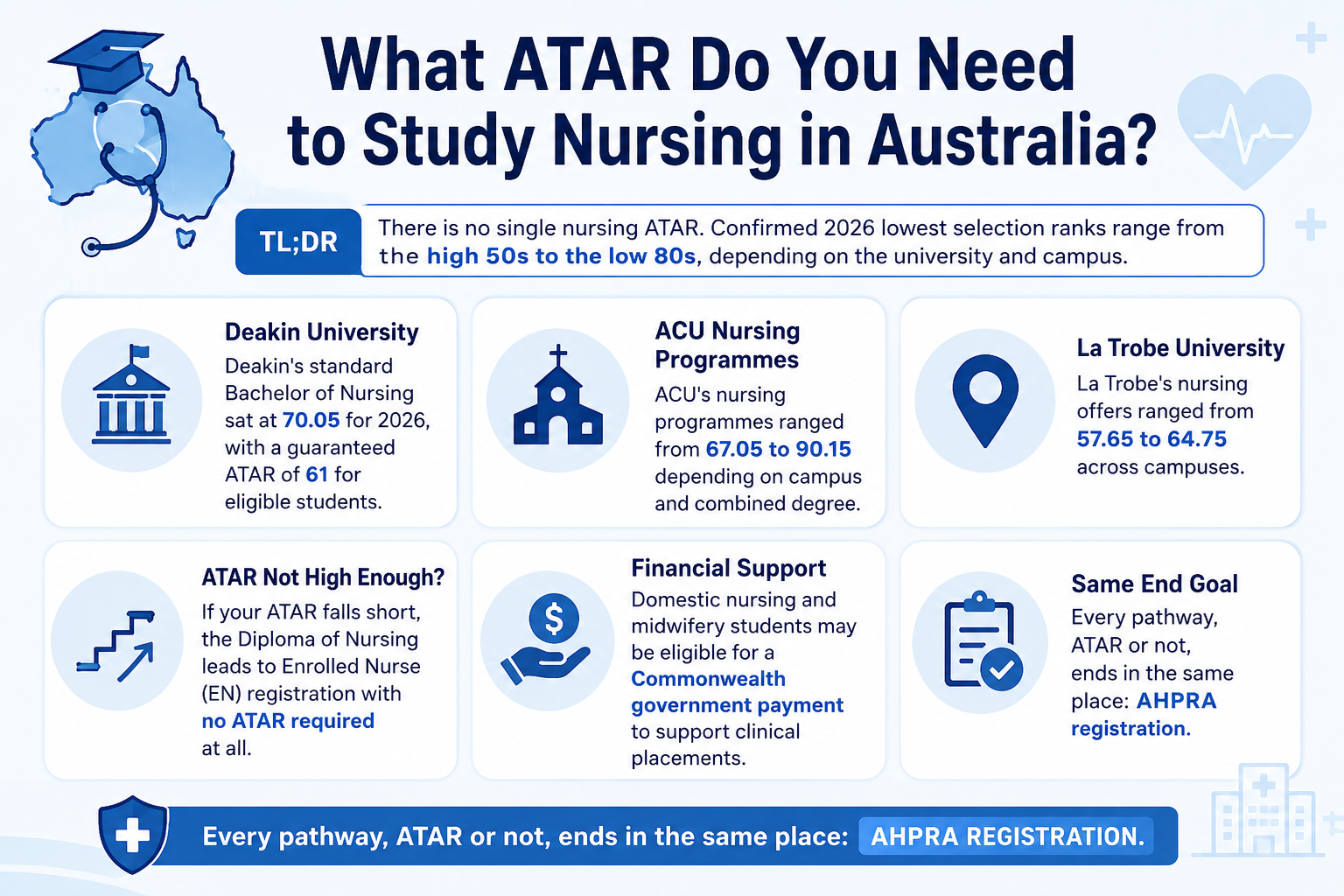
ATAR between 65 and 85, depending on the university and state
-
IELTS 7.0 or OET Grade B for English proficiency
-
ATAR below the threshold? A Diploma of Nursing through TAFE is a recognised pathway, often allowing direct entry into Year 2 of a Bachelor of Nursing
-
Some universities also offer a Foundation Studies programme for additional preparation
E. New Zealand
-
NCEA Level 3 with University Entrance — 14 credits at Level 3 across three approved subjects, plus literacy and numeracy standards
-
IELTS 6.5 or OET Grade B
-
No NCEA Level 3? A Certificate in Health Science at Level 4 or 5 is the recognised pathway into a Bachelor of Nursing at most polytechnics
Remember, meeting the UCAS points requirement makes you eligible to apply, but it does not guarantee an offer. If you select a highly competitive nursing course, you should aim for higher points to strengthen your position in the applicant pool.
Summary of the Grades You Need for Nursing Entry Requirements in the UK
|
Location |
Grade Requirement |
English Requirement |
Additional Notes |
|
United Kingdom |
96 to 128 UCAS points. GCSE English and Maths at grade C/4 or above |
IELTS 6.5 to 7.0. Functional Skills Level 2 accepted by most universities and the NMC |
Requirements vary by university. Always verify directly before applying |
|
Kenya |
KCSE recognised, but most UK universities require a foundation programme before direct nursing entry. Strong grades in English and Biology are essential |
IELTS 6.5 to 7.0. Some universities accept KCSE English at grade B or above instead of IELTS |
Do not assume direct entry. Verify with your chosen university and UK ENIC |
|
Nigeria |
Five WAEC or NECO credits at C6 or above, including English Language and Biology |
IELTS 6.5 to 7.0 or OET Grade B |
Some universities may require a foundation programme. Verify with UK ENIC |
|
South Africa |
NSC Bachelor's pass. Fifty per cent or above in four subjects, including English. Life Sciences and Physical Sciences strengthen your application |
Most UK and New Zealand universities accept NSC English. Australia may still require IELTS |
Matric results below UK thresholds? A Foundation Year at a UK university is the recognised next step |
|
Australia |
ATAR 65 to 85, depending on the university and state |
IELTS 7.0 or OET Grade B. All components must meet minimum scores |
Register with AHPRA after graduation to practise in Australia |
|
New Zealand |
NCEA Level 3 with University Entrance. Fourteen credits at Level 3 across three approved subjects plus literacy and numeracy standards |
IELTS 6.5 or OET Grade B |
Register with the Nursing Council of New Zealand after graduation |
Mature Student Nursing Entry Requirements in the UK
Becoming a nurse does not necessarily mean starting your nursing studies at a young age. If you decide later in life to change your career path to nursing, the UK offers several routes for mature nursing students.
You need:
-
GCSE Maths and English at grade C/4 or above
-
Alternatives to A Levels such as:
-
Relevant T Levels (worth up to 168 UCAS points at Distinction, equivalent to three A Levels at top grades)
-
Access to Nursing Diplomas
-
BTEC Level 3 Diplomas, Scottish Highers, OCR Cambridge Technicals or the International Baccalaureate
-
Functional Skills Level 2 in Maths and English in place of GCSEs, although you should check with your chosen university first because requirements vary
If you enrol in a Higher Education Diploma (Nursing) as a mature student, you become eligible to apply for a nursing degree or a Degree-Level Nurse Apprenticeship through UCAS.
You can also earn up to 144 UCAS tariff points depending on your grades, with 45 distinctions equivalent to three grade As at A Level.
One advantage of a Higher Education Diploma (Nursing) is that it can be completed full-time in 9 months or part-time over up to 18 months.
If you take an Advanced Learner Loan to fund it, the loan may be written off once you complete a subsequent higher education course, though this is subject to specific conditions and eligibility criteria that can change. Verify the current policy directly at gov.uk before making any financial decisions based on this.
5 Common Myths About Nursing Entry Requirements in the UK, Australia and New Zealand
There are many misconceptions about what it takes to qualify for nursing programmes in the UK, Australia and New Zealand. Some of these myths discourage capable students from applying even when they still have valid pathways into nursing.
Myth 1: You need to be a top performer to study nursing
While you do need the necessary grades to study nursing, universities offer different nursing courses. Therefore, you should always check the requirements before deciding not to apply.
Myth 2: You always need previous healthcare experience
Healthcare experience might strengthen your application, but it is not always necessary for entry-level nursing courses.
Myth 3: You need to be young to get into nursing
Most universities welcome applicants from all walks of life. They understand that many people change careers later in life.
Therefore, regardless of your age, there is usually a nursing pathway that suits your circumstances.
Myth 4: If you failed your GCSEs, you cannot become a nurse
Failing GCSEs should not automatically end your chances of becoming a nurse in the UK. You can improve your qualifications through:
-
GCSE resits
-
College pathways
-
Mature student nursing courses
-
Access to Higher Education Diplomas covering subjects you previously failed
Many students also strengthen their applications through additional academic support and pre-nursing preparation courses.
Myth 5: If you fail once, you cannot become a nurse
Failing once does not automatically mean the end of your nursing journey. You can reapply, resit exams or gain relevant experience through volunteering before applying again.
Remember, nursing universities look beyond grades. They also want applicants who demonstrate:
-
compassion
-
communication skills
-
emotional resilience
-
professionalism
-
willingness to learn
-
commitment to patient care
FAQs About Nursing Entry Requirements
1. What are the nursing entry requirements UK universities typically ask for?
Most UK nursing programmes require between 96 and 128 UCAS points and a minimum of five GCSEs at grade C/4 or above, including English Language, Mathematics and usually a Science subject.
2. Can mature students meet UK nursing degree entry requirements without A Levels?
Yes. The Access to Higher Education Diploma in Health or Science is the most widely accepted alternative to A Levels for mature nursing applicants in the UK and usually takes approximately 9–18 months to complete.
3. What are the nursing entry requirements in Australia and what ATAR score do you need?
Most Australian nursing programmes require an ATAR between 65 and 85, although this varies between universities and states.
4. What are the entry requirements for an international nursing degree in the UK?
International applicants typically need 96 to 128 UCAS points and five GCSEs including English Language and Mathematics. For English proficiency, the NMC requires IELTS Academic with a minimum of 7.0 in all four components, or OET Grade B in all components. Always verify requirements directly with your chosen university and the NMC before booking, as thresholds can vary and change.
5. What happens if you do not meet nursing entry requirements yet?
Not meeting the requirements right now does not mean nursing is out of reach. Depending on where your grades stand, your options may include retaking GCSEs, completing a one-year Access to Higher Education Diploma, studying a foundation year at university or improving your IELTS or OET score with targeted exam coaching.
Final Thoughts
Your grades are not your destiny. They are your starting point.
Whether your A Levels hit the mark, your GCSE results were not what you hoped for, or you left school years ago and are only now finding your way back to nursing, the path forward still exists.
The UK has more routes into nursing than most people realise, and the students who succeed are rarely the ones who had everything figured out from the start. They are the ones who identified what they needed, made a plan and refused to give up.
The nursing profession needs people who care enough to do exactly that. The fact that you are reading this suggests you may already be one of them.
If you are not quite where you need to be yet, UKNurses can help you build the grades, confidence and qualifications needed for nursing school.
Our expert pre-nursing tutoring supports students across the UK, Australia and New Zealand in building the grades, qualifications and confidence needed to meet nursing entry requirements and secure a place in nursing school.
Your nursing career starts with one step. Whatever the gap, there is still a way forward, so connect with an expert at UKNurses and take the next step towards your nursing career with confidence.