
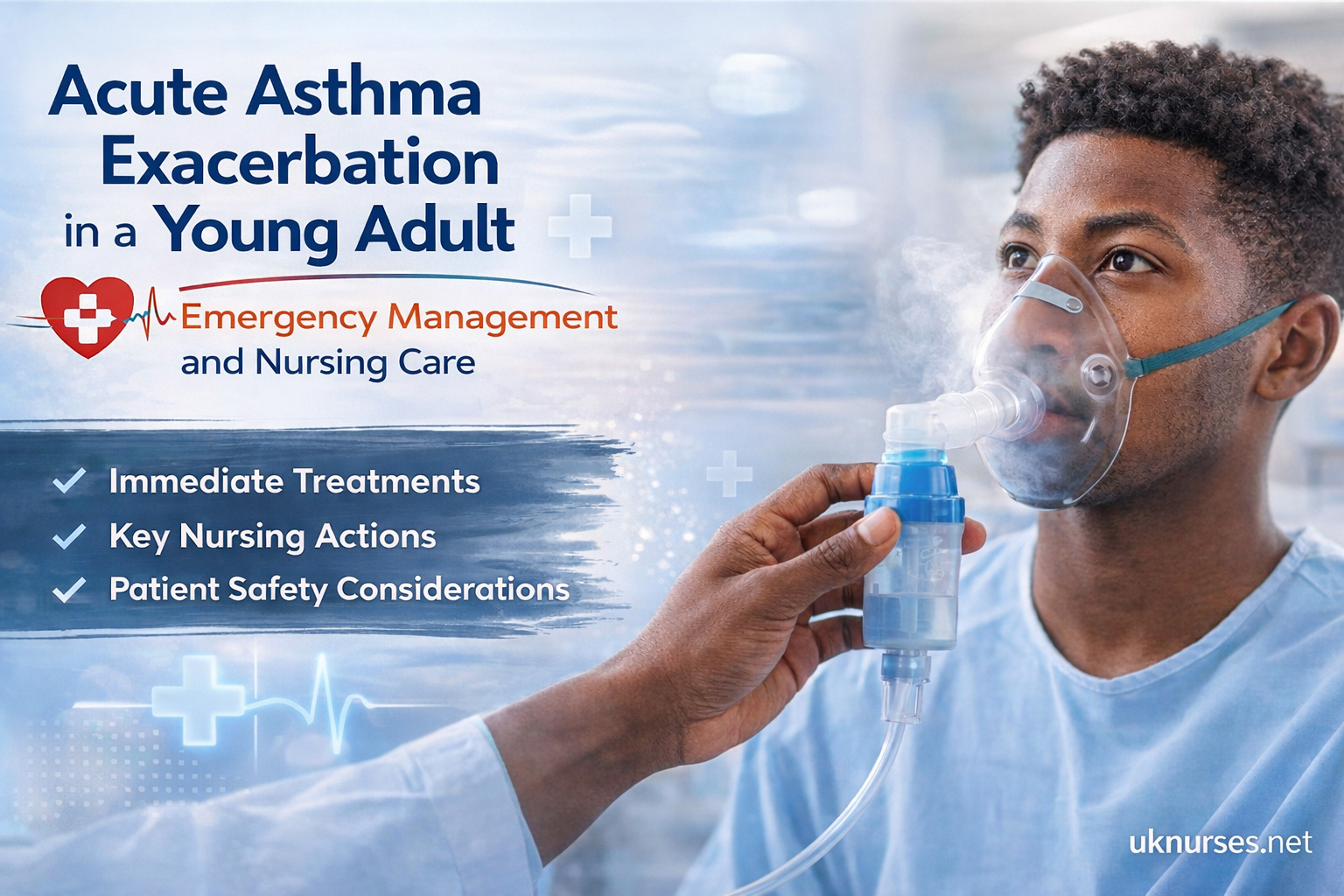
Clinical Case Study: Acute Asthma Exacerbation in a Young Adult: Emergency Management and Nursing Care
Coursework Summative Assessment
Acute Asthma Exacerbation in a Young Adult
Steps 1 & 2: Consider the patient situation and collect cues/information
You are the nurse taking over the ongoing care of Rahman-Okoro, a 21-year-old
university student who identifies as non-binary (they/them). P (Unonymous-NMC (2018) Privacy, has been brought into the
Emergency Department (Majors) after collapsing outside their university campus.
Background Information
P is in their second year of a nursing degree and holds two part-time jobs to support
themselves and contribute to their younger siblings’ living costs. They became estranged
from their parents after starting gender-affirming hormone therapy six months ago and
currently live alone in shared student accommodation. P reports feeling constantly
stressed and fatigued about the upcoming end-of-year exams.
They have a known history of moderate persistent asthma, diagnosed at age 8, and eczema.
P uses a salbutamol inhaler (100 micrograms/dose) PRN and a budesonide/formoterol
(Symbicort 200/6) inhaler twice daily, although they admit to missing doses in the past week
due to exhaustion and cost. There is no known drug allergy. They are a non-smoker and
consume minimal alcohol. No history of illicit drug use. Their GP review one month ago
noted increasing night-time wheeze and recommended a step-up in preventer inhaler therapy,
which had not yet been actioned.
Presenting Situation
Earlier today, while running late for an in-person exam after finishing a night shift at a
restaurant and bar, P suffered sudden shortness of breath and chest tightness, became
dizzy, and collapsed. Paramedics found them tachypnoeic with an audible wheeze. En route,
their best Peak Expiratory Flow measurement was 35%. They received nebulised salbutamol
5 mg and oxygen at 4 L/min via nasal cannula, with partial relief, and 40 mg of oral
prednisolone. They arrived at the ED Resus 35 minutes ago and have since been transferred
to the Majors for ongoing care and monitoring.
The medical team have documented the confirmed medical diagnosis as an acute severe
asthma exacerbation.
Current Observations
Parameter
Respiratory rate
Reading
28 breaths/min
90 %
Oxygen saturation
(4 Litres Oxygen)
Heart rate
112 beats/min
Blood pressure
118/76 mmHg
Temperature
37.2 °C
Peak expiratory flow (PEF) 250 L/min
ABG (on 2 L/min O₂)
Serum potassium
pH 7.33; PaCO₂ 5.0 kPa; PaO₂ 7.0 kPa; HCO₃⁻ 22 mmol/L
3.4 mmol/L (3.5–5.0)
Serum sodium
139 mmol/L (135–145)
WBC
9.5 × 10⁹/L (4.0–11.0)
5 mg/L (< 10)
C-reactive protein (CRP)
Current Status
P remains tachypnoeic with expiratory wheeze audible throughout both lung fields.
They are unable to complete a sentence in one breath and use words to report feeling
“panicky and light-headed.” Nebulised bronchodilators are continuing every 20 minutes as
prescribed. They are on oxygen at 4 L/min via nasal cannula, maintaining saturations
between 93–95%. Intravenous access is secured; normal saline is running at 75 mL/hr, and
intravenous hydrocortisone 100 mg has been given. No antibiotics have been prescribed. The
registrar plans to review after the next nebuliser.
P friend KK, a fellow nursing student, is present at the bedside and offers
emotional support. KK reports that P has barely slept or eaten properly for days.
KK becomes visibly tearful when discussing their family situation and finances. They
express fear of “failing everything” and “ending up in hospital again.”
Consider the clinical situation and apply the Levett
Jones Clinical Reasoning Cycle (CRC) to demonstrate clinical decision-making and person
centred care.
Featured: University of Essex, Birmingham Newman University, University of Winchester, Wrexham university, Deakin University, Auckland University of Technology, University of Canterbury, Griffith University...
At UKNurses.net, we specialise in providing expert nursing academic support, crafting and guiding students in mastering care cases such as the scenario of acute asthma exacerbation. Whether you are in need of nursing exam preparation, nursing coursework help, or dissertation help nursing, our dedicated tutors are here to assist students within NMC mandate and outside, including UK, Wales, Australia, Ireland, Scotland and New Zealand. Let the experienced nurses team of nursing tutors help you enhance your academic knowledge and improve your clinical practice.
Request nursing study help/nursing research/nursing assignment help today at UKNurses.net and advance your nursing career!