How to use this resource: A collection of past assessment tests, provided for personal practice. For personalised support, Get Matched →
Reflective Nursing Assignment Case Study B: Alcohol Dependency, Rolfe’s Reflective Model and NMC Code
Need Guidance With Your Reflective Nursing Assignment?
Reflective nursing assignments require students to demonstrate more than description of a clinical situation. They must critically reflect on experiences, connect practice with evidence-based literature, apply reflective models and demonstrate how nursing actions support safe, person-centred care.
This Case Study B reflective assignment focuses on Dave, a 35-year-old man experiencing alcohol dependency and the impact of alcohol use on health, relationships, employment and wellbeing.
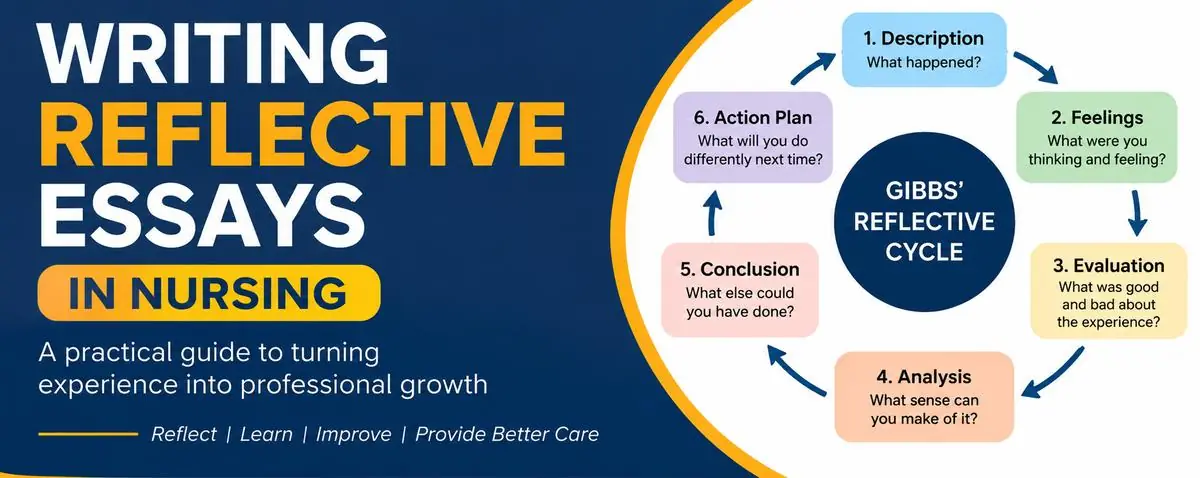
Students are required to use Rolfe et al.’s (2001) reflective model (What? So What? Now What?) to critically explore learning, professional development, health promotion, multidisciplinary working and links to the NMC Code (2018).
At UKNurses, experienced nursing professionals provide academic guidance to nursing students across the UK, Australia, New Zealand, Ireland, Scotland and Wales. We support students with reflective writing, nursing case study analysis, evidence integration and professional practice assignments.
Get Matched with a UKNurses expert for personalised nursing academic guidance.
Case Study B: Alcohol Dependency Reflective Nursing Assignment
Dave is a 35-year-old gentleman working as a taxi driver who has been dependent on alcohol for the last ten years. He drinks to help him cope with his personal problems, including health issues and money worries.
Recently, he has increased his drinking to almost nine units per day, normally in the evening, but sometimes in the morning.
On the days he drinks in the morning, he calls in sick to work and also neglects other responsibilities at home. This is leading to a lot of arguments with his wife.
He tells you all this while in for a routine check-up and says:
"I know I should do something about my drinking as it’s affecting everything – my relationships, my work, my health… I’ve spent a lot of my savings on alcohol. The thing is drinking really helps me cope with all my worries, it helps me to forget about them for a little while at least, so I feel better."
Activity
‘Activity’: State in full what activity you selected in (not included in word count).
What?
Examining the Activity and Relationship to Module Aim (LO3)
In this section you should briefly describe and examine the nature of the selected activity and how you approached engaging with this activity and the related learning resources.
You should consider your own prior understanding and knowledge gaps.
(100–200 words)
So What?
Reflective Analysis of Learning and Experience (LO1 & LO2)
In this section there should be a reflective discussion related to what you learned from undertaking the week 2 selected activity and any associated learning from week 1 and 2.
This should include an account of the experience of undertaking the activity with a discussion of new understanding.
You should illustrate:
- How the wider determinants of health, illness and wellbeing relate to local, national and global patterns of disease (LO1)
- How it relates to the principles of global citizenship (LO2)
The reflective discussion should show clear use of Rolfe’s reflective model and relate to the selected activity.
You must write in the first person and ensure that your writing is fully supported by current academic literature.
This may include:
- Policy papers
- Research papers
- Academic commentaries
- Opinion pieces
(Approximately 300–400 words)
Now What?
Impact on Practice and Future Actions (LO4 & LO5)
In this section there should be a reflective discussion related to any impacts on and actions for practice following completion of the activity.
Your discussion should include:
- How and why you might approach change
- Effective team working
- Shared decision-making (LO4)
- Choice of health information materials
- Suitability of information materials for different groups and communities (LO5)
The reflective discussion should show clear use of Rolfe’s reflective model and relate to the selected activity.
You must write in the first person and ensure that your writing is fully supported by current academic literature.
This may include:
- Policy papers
- Research papers
- Academic commentaries
- Opinion pieces
(Approximately 300–400 words)
NMC Code Reflection (LO6)
Prioritise People, Practise Effectively, Preserve Safety and Promote Professionalism and Trust
Identify two themes of the NMC Code (NMC, 2018) that this reflective account links to.
Critically interpret the relevance of your chosen themes within your answer.
You may also choose to discuss specific sub-themes.
(Minimum 100 words)
Rolfe et al.’s (2001) Reflective Model
Rolfe et al.’s (2001) reflective model is based upon three questions:
- What?
- So what?
- Now what?
Below is a list of questions that you may choose to answer in response to the three elements.
What?
Consider:
- What was the nature of the activity I chose?
- What do others say it is (definition)?
- What were my reasons for choosing it?
- What did I know before?
- What were my learning needs/gaps?
- What was I trying to achieve?
- What actions did I/others take in preparation or during the activity?
- What feelings or responses did it evoke in myself and others?
- What was good or bad about the experience?
So What?
Consider:
- What does this tell me, teach me, imply or mean about:
- Myself
- Nursing
- Patient care
- Attitudes and behaviours towards health
- Factors influencing health?
- What was going through my mind as I acted?
- What did I base my actions on?
- What related knowledge can I bring to the experience?
- What is my new understanding of the situation?
- What broader issues have I become aware of?
Now What?
Consider:
- What specific actions do I need to take to:
- Improve practice?
- Improve health outcomes?
- Improve communication?
- Resolve problems?
- Change or challenge practice?
- Share knowledge?
- What will help others understand how and why I will take this action?
- What broader issues need consideration for successful implementation?
- What might be the consequences of this action?
Reference
Adapted from:
Rolfe, G., Freshwater, D., Jasper, M. (2001). Critical reflection in nursing and the helping professions: A user’s guide. Basingstoke: Palgrave Macmillan.
Need support writing your Case Study B reflective account, applying Rolfe’s model or linking your reflection to the NMC Code?
Get Matched with a UKNurses expert for personalised nursing academic guidance.