How to use this resource: A collection of past assessment tests, provided for personal practice. For personalised support, Get Matched →
Quality Improvement and Evaluation Assignment Brief
Assignment Title
A Proposed Project Plan to Implement and Evaluate a Specific Patient Service Innovation
Total word count: 3,000 words
Pass mark: 40%
Assignment Task
Students are required to develop a proposed quality improvement project that aims to improve patient-centred care. Appropriate topics may include:
- Management of long-term conditions
- Patient safety
- Nursing responsibilities
- Service delivery
- Patient experience
- Other relevant quality concerns within healthcare practice
The assignment should explain how a specific service innovation will be planned, implemented and evaluated.
Important Guidance
Students are encouraged to demonstrate how they would engage with patients, carers and frontline staff when identifying problems and developing appropriate solutions.
Students should include a selection of quality improvement tools in the appendices. Appropriate tools may include:
- Gantt charts
- Process maps
- Fishbone diagrams
- SWOT analyses
- SMART objectives
- Patient journey maps
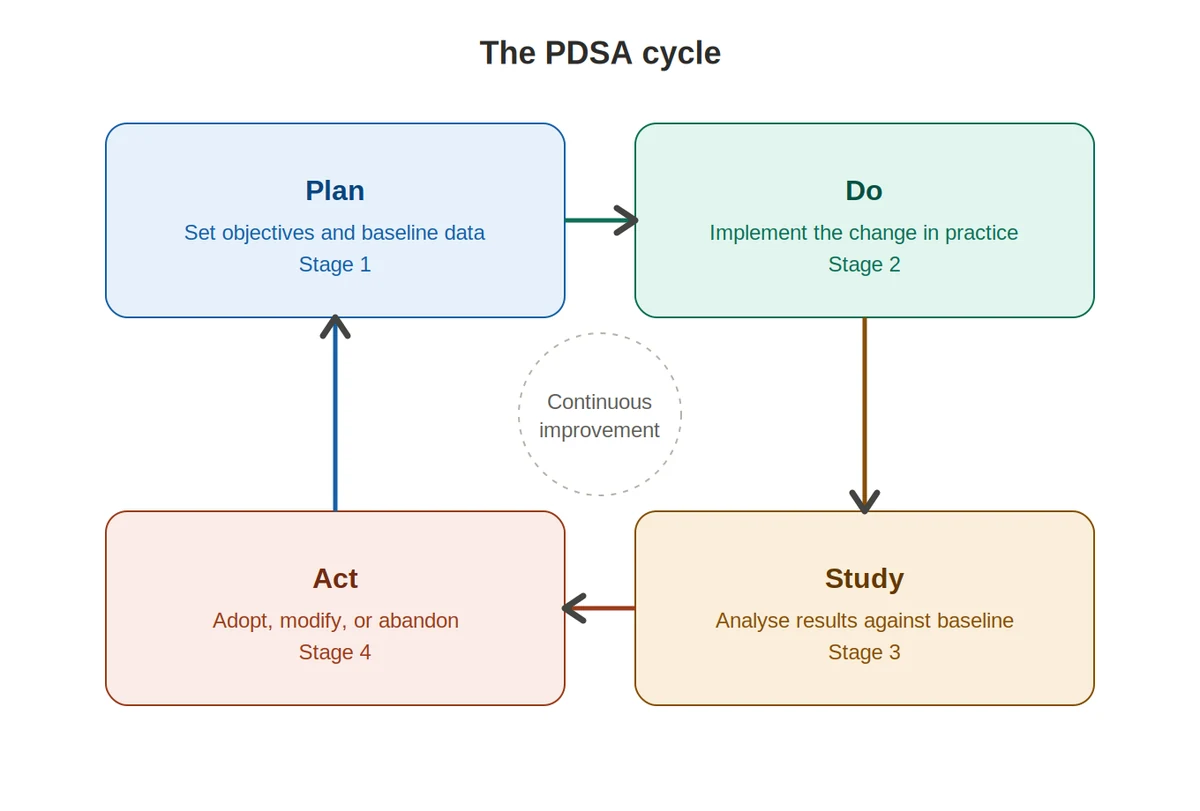
Students are encouraged to use the Plan–Do–Study–Act cycle to structure the quality improvement project. However, using the PDSA cycle is not compulsory.
The assignment must follow the Level 6 academic writing and marking requirements.
Assignment Structure
1. Introduction — Approximately 300 Words
Introduce the selected topic or quality issue affecting patient care.
Define quality improvement and explain how quality improvement principles will be used to address the identified problem.
The introduction should establish:
- The nature of the patient-care issue
- The healthcare context in which it occurs
- Why the issue requires improvement
- How quality improvement may contribute to better patient outcomes
2. Background and Evidence — Approximately 700 Words
Conduct a focused literature review of research relating to the selected topic. A maximum of three research articles should be examined.
At least one of the selected research articles must be critically appraised using an appropriate Critical Appraisal Skills Programme tool.
This section should:
- Present relevant research concerning the identified issue
- Critically evaluate the quality and relevance of the evidence
- Explain why the issue continues despite existing NHS policies and guidance
- Synthesise the findings from the selected literature
- Identify the key evidence supporting the proposed improvement
- Explain the potential effect of the proposed project on patient care
Relevant current policies and clinical guidelines should also be considered. Students should consult applicable NICE guidance and demonstrate how evidence-based practice supports the quality improvement proposal.
3. Project Plan — Approximately 200 Words
Clearly state the proposed quality improvement idea. The innovation may include, but is not limited to:
- A clinical checklist
- An educational intervention
- A patient information poster
- A staff training programme
- A new protocol
- A care pathway
- A communication tool
- An audit and feedback intervention
Describe the clinical environment in which the project will take place, such as a hospital ward, outpatient department, community setting or care home.
State how long the project will run. A Gantt chart showing the proposed project timeline should be included in the appendix.
Students may use the Plan–Do–Study–Act methodology to structure the project:
- Plan
- Do
- Study
- Act
4. Plan — Approximately 400 Words
Explain how the quality improvement project will be prepared.
Objectives
Develop specific, measurable, achievable, relevant and time-bound objectives for the project. Full SMART objectives may be included in the appendix.
Scope of the Project
Define the boundaries of the proposed project, including:
- Target patient or service-user population
- Clinical setting
- Project duration
- Staff groups involved
- Activities included and excluded
Team and Service-User Participation
Identify the individuals who will participate in the project and explain their roles.
This may include:
- Patients and service users
- Family members and carers
- Registered nurses
- Healthcare assistants
- Doctors
- Pharmacists
- Allied healthcare professionals
- Ward or service managers
- Quality improvement personnel
Explain who will complete each task, when it will be completed and why their involvement is necessary. Patients, service users, healthcare professionals and managers should be involved appropriately in the planning process.
Risk Analysis
Identify possible risks or barriers to the proposed project, such as:
- Limited staff engagement
- Resistance to change
- Staffing shortages
- Resource limitations
- Financial restrictions
- Competing clinical priorities
- Lack of time
- Insufficient training
Explain how each identified risk will be reduced or managed.
Governance and Accountability
Explain how the project will comply with relevant legislation, professional standards, organisational policies and governance requirements.
Identify who will be accountable for the project and who will collect, store, review and monitor project data.
Ethical Considerations
Discuss the ethical implications of the quality improvement work, particularly regarding:
- Patient confidentiality
- Privacy and data protection
- Informed consent
- Patient autonomy
- Avoidance of harm
- Fair access to the intervention
Communication Plan
Explain how communication will occur among project team members, stakeholders, service users and managers.
Baseline Data Collection
Identify the data that will be collected before implementing the project to establish the existing situation.
Explain how the baseline information will help define the problem and allow later comparison.
Audit and Process Mapping
Outline any audits, qualitative assessments or quality improvement tools that will be used to understand the current problem.
Examples include:
- Clinical audits
- Process mapping
- Patient journey mapping
- Staff feedback
- Patient feedback
- Observation of practice
Data Collection Methods
Explain whether quantitative data, qualitative data or a combination of both will be used to measure success.
5. Do — Approximately 400 Words
Describe how the proposed intervention will be implemented in a controlled clinical setting. The implementation plan should be clear, precise and realistic.
Implementation Plan
Explain how the project will be introduced and rolled out in practice.
Identify:
- Who will be involved
- What activities will be completed
- When each activity will occur
- What resources will be required
- Whether staff training will be necessary
Critically evaluate the implementation stage rather than only describing it. Consider possible barriers such as staff resistance, time pressures, workload demands and competing clinical priorities.
Feedback and Challenges
Discuss the challenges or initial observations that may arise during implementation.
Explain how feedback will be collected and incorporated into the project. Feedback may be gathered through:
- Staff meetings
- Patient discussions
- Questionnaires
- Brief surveys
- Observation
- Informal feedback
- Midpoint review meetings
Data Audit
Explain what data will be required before, during and after implementation.
Consider whether the evaluation will use:
- Quantitative data
- Qualitative data
- A mixed-method approach
- A balanced or mixed scorecard
State when the project will be evaluated.
Discuss how initial challenges, unexpected outcomes or deviations from the project plan will be recorded and managed.
Explain whether modifications may be required in response to real-time feedback.
Fishbone diagrams and SWOT analyses may be included in the appendix.
6. Study — Approximately 400 Words
Critically appraise and apply appropriate methods for measuring and evaluating the project’s outcomes.
Analyse the proposed results to determine whether the intervention has produced an improvement.
This section should:
- Compare post-intervention data with baseline findings
- Compare the results with the project’s original predictions
- Explain how the success of the project will be determined
- Consider whether previous audits should be repeated
- Discuss the use of a mixed scorecard where appropriate
- Identify factors that could reduce the validity of the results
- Explain what could go wrong during evaluation
- Propose strategies to minimise evaluation problems
Both quantitative and qualitative evidence should be used where appropriate. Examples include:
- Compliance percentages
- Patient outcome data
- Error or incident rates
- Waiting times
- Patient feedback
- Staff surveys
- Interview or focus-group findings
Explain how the data will be analysed and interpreted meaningfully.
Critically assess whether the results are:
- Statistically significant
- Clinically significant
- Meaningful to patients
- Sustainable in routine practice
7. Act — Approximately 400 Words
Explain how it will be determined whether the PDSA cycle and the overall quality improvement intervention have been successful.
Discuss how achievements will be recognised and celebrated when the intervention produces positive results.
Explain how learning and guiding principles from the project will be captured. For example, feedback may be collected using a questionnaire. The chosen approach should be justified.
Based on the evaluation findings, decide whether the intervention should be:
- Adopted
- Modified
- Abandoned
Provide an evidence-based rationale for the selected decision.
Discuss the next steps, including whether the intervention should be:
- Scaled up to other wards or departments
- Embedded within organisational policy
- Incorporated into staff training
- Repeated through another improvement cycle
- Tested with a larger patient population
Reflect on the project’s sustainability and its potential long-term effects on patients, staff and the wider organisation.
8. Conclusion — Approximately 200 Words
Summarise the proposed quality improvement project and its main components.
Place quality improvement within the wider context of healthcare practice. Consider real-world challenges such as:
- Staffing shortages
- Financial pressures
- Increased workload
- Limited resources
- Competing organisational priorities
- Resistance to change
Provide a rounded conclusion that integrates the importance of quality improvement in strengthening patient-centred care and improving patient outcomes.
Word-Count Allocation
Introduction: 300 words
Background and Evidence: 700 words
Project Plan: 200 words
Plan: 400 words
Do: 400 words
Study: 400 words
Act: 400 words
Conclusion: 200 words
Total: 3,000 words
References
The reference list is not included in the word count.
Use Harvard referencing consistently throughout the assignment, including accurate in-text citations and a complete reference list.
Students may consult the Open University’s Harvard referencing guide for additional support.
Example:
O’Sullivan, O.P., Chang, N.H., Baker, P. and Shah, A. (2020) ‘Quality improvement at East London NHS Foundation Trust: the pathway to embedding lasting change’, International Journal of Health Governance.
Appendices
The appendices are not included in the word count.
Relevant supporting documents may include:
- Process maps
- Patient journey maps
- Fishbone analyses
- SWOT analyses
- Gantt charts
- SMART goals
- Data-collection tools
- Audit templates
- Questionnaires
- Communication plans
- Risk assessments
- Any other document supporting the proposed project
All appendices should be referred to appropriately within the main assignment.