How to use this resource: A collection of past assessment tests, provided for personal practice. For personalised support, Get Matched →
Research Proposal Assignment Brief
Assignment Task
Prepare a research proposal that clearly explains the study you intend to undertake. Your proposal should establish the importance of the selected topic, identify the research question the study will answer, and explain how relevant evidence will be collected, identified, and analysed.
The proposal must be presented in five sections or slides, supported by detailed explanatory notes. The complete notes should contain approximately 1,500 words, with a permitted 10% allowance. The acceptable word-count range is approximately 1,350 to 1,650 words unless your university provides different instructions.
Your proposal should demonstrate a logical connection between the research background, research question, aim, objectives, methods, ethical considerations, and expected outcomes.
1. Introduction and Background
Guiding Question
What is your proposed research topic, and what background information explains its importance?
Introducing the Research Topic
Begin by clearly introducing the topic you intend to investigate. Define the main issue, problem, practice concern, or population that will form the focus of the proposed research.
Background and Context
The background should demonstrate why the topic deserves investigation. Relevant evidence may include:
-
National or international healthcare policies.
-
Current professional guidelines.
-
Statistical evidence showing the scale of the problem.
-
Peer-reviewed research findings.
-
Relevant nursing, healthcare, or behavioural theories.
-
Evidence of variation, inequality, or inconsistency in current practice.
Research Problem or Knowledge Gap
Do not simply describe the topic. Use the available evidence to identify a specific research problem or knowledge gap. Explain what researchers, practitioners, or policymakers do not yet understand adequately.
The discussion should lead logically towards the proposed research question. For example, the background may show that an intervention is widely recommended but that limited evidence exists concerning its effectiveness within a particular population or clinical setting.
Section Requirements
Your introduction and background should:
-
Introduce the proposed research topic clearly.
-
Define the central issue being investigated.
-
Present relevant clinical, professional, or academic context.
-
Use policy, statistics, theory, and research evidence.
-
Identify limitations or inconsistencies in existing knowledge.
-
Explain why further investigation is necessary.
-
Establish the significance of the topic to nursing or healthcare practice.
2. Research Question, Aim, and Objectives
Guiding Question
What is your main research question, and why is it important?
Research Question
State one clear, focused, and answerable research question. The question should arise directly from the problem or gap discussed in the background section.
Avoid research questions that are too broad, vague, or unrealistic. A well-developed question clearly identifies what will be investigated and may specify the population, intervention, experience, outcome, context, or time frame.
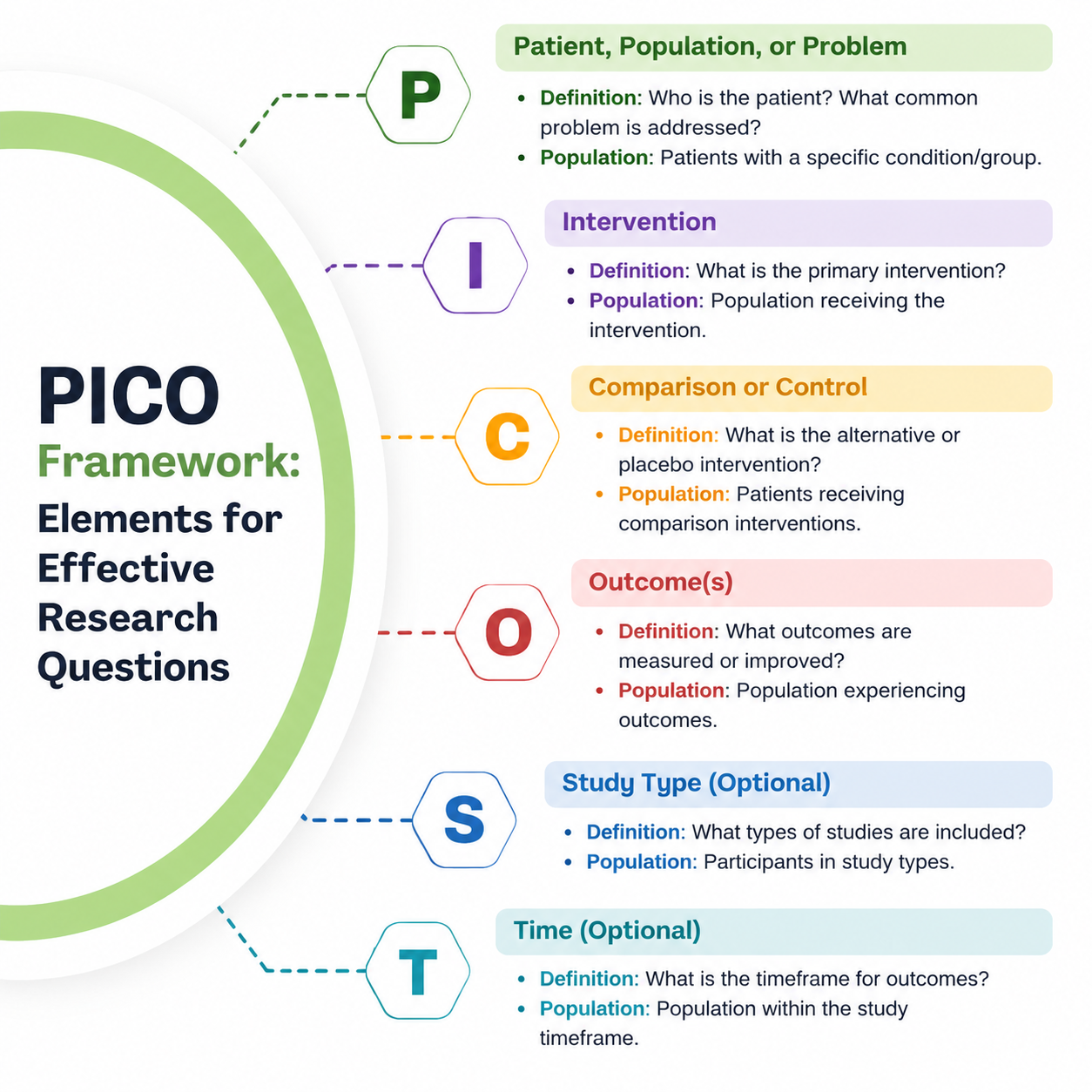
Frameworks such as PICO, PICOT, PEO, or SPIDER may be used where appropriate to formulate the research question.
Importance of the Research Question
After presenting the research question, explain why answering it would be valuable. The justification should consider potential contributions to:
-
Patient care.
-
Nursing knowledge.
-
Healthcare policy.
-
Clinical education.
-
Service improvement.
-
Future research.
Research Aim
Provide one overall research aim. The aim should describe the main purpose of the study in a single, clear statement.
A useful format is:
The aim of this proposed study is to examine, explore, evaluate, or determine…
Research Objectives
Provide specific objectives describing the steps required to achieve the aim. Most proposals will include approximately three to five objectives.
Objectives may include:
-
Reviewing existing evidence concerning the selected topic.
-
Identifying the effects, experiences, or perceptions being investigated.
-
Comparing different interventions or approaches.
-
Evaluating relationships between selected variables.
-
Analysing patterns or themes within the evidence.
-
Developing recommendations for practice or future study.
Each objective should begin with an appropriate action verb, such as:
-
Identify.
-
Examine.
-
Explore.
-
Compare.
-
Evaluate.
-
Analyse.
-
Recommend.
Section Requirements
This section should:
-
State one focused research question.
-
Explain why the question is important.
-
Present one clear overall research aim.
-
Include specific and achievable objectives.
-
Maintain alignment between the question, aim, and objectives.
-
Demonstrate that the proposed project is manageable.
3. Research Methods
Guiding Question
How will you identify, collect, and analyse the evidence required to answer the research question?
This section should provide a clear and justified explanation of the proposed research methodology. The chosen methods must be suitable for the research question and realistic within the available time and resources.
Research Design
Identify the proposed research design. Possible designs include:
-
Systematic literature review.
-
Integrative literature review.
-
Scoping review.
-
Qualitative study.
-
Quantitative study.
-
Mixed-methods study.
-
Cross-sectional survey.
-
Experimental or quasi-experimental study.
-
Case study.
-
Secondary-data analysis.
Explain why the selected design is appropriate. For example, a qualitative design may be suitable for exploring experiences, while a quantitative design may be appropriate for measuring relationships, differences, or intervention outcomes.
Evidence or Data Sources
State whether the project will use:
-
Primary data.
-
Secondary evidence.
-
A combination of primary and secondary evidence.
For a literature-based proposal, identify the databases that will be searched. Relevant databases may include:
-
CINAHL.
-
MEDLINE.
-
PubMed.
-
Cochrane Library.
-
PsycINFO.
-
Scopus.
-
Web of Science.
-
British Nursing Index.
Search Terms and Search Strategy
Explain how the search terms will be developed. Search terms should reflect the main concepts within the research question and may include:
-
Synonyms.
-
Alternative spellings.
-
Related clinical terminology.
-
Medical subject headings.
-
Keywords derived from a research-question framework.
Boolean operators should be used appropriately:
-
AND narrows the search by combining different concepts.
-
OR broadens the search by combining similar terms.
-
NOT excludes irrelevant concepts.
Provide an example search combination where appropriate.
Inclusion and Exclusion Criteria
Explain the criteria that will determine which evidence or data will be included or excluded.
Criteria may address:
-
Publication dates.
-
Participant age or population.
-
Healthcare setting.
-
Country or geographical context.
-
Research design.
-
Language.
-
Peer-review status.
-
Availability of full text.
-
Relevance to the research question.
The criteria should be justified rather than selected arbitrarily.
Data-Collection Procedures
For a primary study, describe:
-
How participants will be identified.
-
How participants will be recruited.
-
How participants will be invited to participate.
-
The proposed sampling approach.
-
The proposed sample size.
-
The research setting.
-
The data-collection instrument.
Possible data-collection instruments include:
-
Questionnaires.
-
Surveys.
-
Interviews.
-
Focus groups.
-
Observation schedules.
-
Clinical records.
-
Organisational records.
For a secondary study, explain:
-
How the database search will be conducted.
-
How search results will be screened.
-
How duplicate records will be removed.
-
How full-text sources will be assessed.
-
How relevant information will be extracted.
-
How the source-selection process will be documented.
Proposed Method of Analysis
Describe how the collected evidence or data will be analysed.
Possible analytical approaches include:
-
Descriptive statistics.
-
Inferential statistical tests.
-
Thematic analysis.
-
Content analysis.
-
Narrative synthesis.
-
Framework analysis.
-
Meta-analysis, where appropriate.
Explain how the chosen analytical method will help answer the research question and achieve the research aim and objectives.
Section Requirements
This section should:
-
Identify and justify the proposed research design.
-
Explain the type of evidence or data that will be used.
-
Identify relevant databases or data sources.
-
Present suitable search terms and search procedures.
-
Explain the inclusion and exclusion criteria.
-
Describe the data-collection or evidence-selection process.
-
Identify the proposed method of analysis.
-
Demonstrate that the methods are realistic and appropriate.
4. Ethical Considerations
Guiding Question
What ethical issues are relevant to the proposed research, and how will they be addressed?
Research must be conducted honestly, safely, and responsibly. The ethical discussion should be proportionate to the proposed research design.
Primary research involving direct contact with participants will normally require a more detailed ethical discussion than a literature-based project.
Ethical Principles
Relevant ethical principles may include:
-
Respect for autonomy.
-
Beneficence.
-
Non-maleficence.
-
Justice.
-
Confidentiality.
-
Privacy.
-
Voluntary participation.
-
Informed consent.
-
Anonymity.
-
Secure data management.
Informed Consent and Voluntary Participation
For primary research, explain how participants will receive sufficient information about the project before agreeing to participate.
Participants should be informed about:
-
The purpose of the research.
-
What participation will involve.
-
The expected time commitment.
-
Potential risks or discomfort.
-
Potential benefits.
-
How their information will be used.
-
Their right to refuse participation.
-
Their right to withdraw without penalty.
Participation must be voluntary and free from coercion.
Confidentiality, Privacy, and Anonymity
Explain how personal information will be protected. Identifying details should be removed or replaced with participant codes where appropriate.
Researchers should distinguish between:
-
Confidentiality, where the researcher may know the participant’s identity but does not disclose it.
-
Anonymity, where the participant cannot be identified from the collected data.
Data Protection and Storage
Electronic data should be stored securely using:
-
Password-protected devices.
-
Encrypted university systems.
-
Restricted-access folders.
-
Approved institutional storage systems.
The proposal should explain:
-
Who will have access to the data.
-
How long the data will be retained.
-
How the data will be destroyed.
-
How relevant data-protection requirements will be followed.
Risk of Harm
Potential emotional, social, professional, physical, or psychological risks should be considered.
Explain how the study will minimise:
-
Distress.
-
Discomfort.
-
Coercion.
-
Unequal power relationships.
-
Professional embarrassment.
-
Disclosure of sensitive information.
-
Reputational or employment-related harm.
Ethical Use of Secondary Evidence
Where the project uses secondary evidence, ethical responsibilities still apply.
The researcher should:
-
Represent sources accurately.
-
Avoid plagiarism.
-
Provide accurate citations.
-
Avoid manipulating findings.
-
Avoid taking evidence out of context.
-
Report conflicting evidence honestly.
-
Respect the intellectual property of original authors.
Ethical Approval
The proposal should identify whether approval is required from:
-
A university ethics committee.
-
A healthcare organisation.
-
A research governance office.
-
A National Health Service body.
-
Another relevant authority.
Section Requirements
This section should:
-
Identify the ethical principles relevant to the study.
-
Explain how informed consent will be obtained where applicable.
-
Address voluntary participation and withdrawal.
-
Explain how privacy, confidentiality, and anonymity will be protected.
-
Describe how research data will be stored securely.
-
Identify possible risks or limitations.
-
Explain how participant harm will be minimised.
-
Address the responsible use of secondary evidence.
-
Identify the required ethical approval process.
5. Conclusion and Expected Outcomes
Guiding Question
What outcomes do you expect from the proposed research?
Summary of the Proposal
Conclude the proposal by summarising the purpose and importance of the planned study. Reconnect the discussion to the research question, aim, and objectives.
Expected Outcomes
Explain what the research is expected to establish, clarify, or contribute.
Do not present predetermined findings as though the research has already been completed. Instead, describe realistic anticipated outcomes.
Expected outcomes may include:
-
Improved understanding of a clinical or professional issue.
-
Identification of barriers affecting patient care.
-
Evaluation of an intervention or educational strategy.
-
Recognition of gaps within current policies or services.
-
Recommendations for nursing practice.
-
Recommendations for staff education or service development.
-
Identification of priorities for future research.
Connection Between Methods and Outcomes
Explain how the proposed methods and analysis will enable the study to answer the research question.
The conclusion should demonstrate that:
-
The research design fits the research question.
-
The evidence-collection procedures support the objectives.
-
The proposed analytical method can generate relevant findings.
-
The expected outcomes are realistic.
-
The study can contribute meaningfully to nursing or healthcare.
Potential Contribution
Explain how the findings may contribute to:
-
Nursing knowledge.
-
Clinical practice.
-
Patient education.
-
Healthcare policy.
-
Service development.
-
Professional education.
-
Future research.
Presentation Requirements
Structure and Format
The completed proposal should:
-
Contain five clearly organised sections or slides.
-
Present concise points in the main slide content.
-
Include detailed explanations in the accompanying notes.
-
Contain approximately 1,500 words across the notes.
-
Remain within the permitted 10% word-count allowance.
Academic Evidence
The proposal should:
-
Use reliable and relevant academic sources.
-
Support factual claims with evidence.
-
Include accurate in-text citations.
-
Provide a complete reference list.
-
Follow the referencing style required by the university.
Organisation and Writing Style
The proposal should:
-
Maintain a logical progression between all five sections.
-
Use clear and formal academic language.
-
Use appropriately cautious language when discussing expected findings.
-
Avoid unsupported claims.
-
Demonstrate consistency between the question, aim, objectives, methods, and expected outcomes.
Quality Expectations
Research Context
A strong research proposal will demonstrate:
-
A clearly defined and well-supported research context.
-
A meaningful and manageable research problem.
-
Appropriate use of policy, statistics, theory, and research evidence.
-
Clear identification of a research or practice gap.
Research Focus
The proposal should include:
-
A focused and answerable research question.
-
A clear overall research aim.
-
Specific and achievable objectives.
-
Logical alignment between the question, aim, and objectives.
Methodological Quality
The proposal should demonstrate:
-
A research design that fits the research question.
-
Specific and realistic evidence-identification or data-collection procedures.
-
Appropriate inclusion and exclusion criteria.
-
A clear explanation of the proposed analytical method.
-
A realistic plan that can be completed within the available resources.
Ethical and Academic Quality
The proposal should demonstrate:
-
Careful consideration of ethical responsibilities.
-
Responsible management of evidence and data.
-
Effective use of academic literature.
-
Accurate citation and referencing.
-
Concise, coherent, and well-organised academic writing.
Final Submission Checklist
Introduction and Background
Before submitting, confirm that:
-
The research topic has been clearly introduced.
-
The main issue has been defined.
-
The research problem or gap is supported by evidence.
-
Relevant policies, statistics, theories, and studies have been considered.
-
The significance of the topic to nursing or healthcare has been explained.
Research Question, Aim, and Objectives
Confirm that:
-
The research question is focused and answerable.
-
The importance of the research question has been explained.
-
The aim clearly describes the purpose of the research.
-
The objectives explain how the aim will be achieved.
-
The question, aim, and objectives are logically aligned.
Research Methods
Confirm that:
-
The proposed research design has been identified and justified.
-
Databases, search terms, or data sources have been specified.
-
Inclusion and exclusion criteria have been explained.
-
Data-collection or evidence-identification procedures are clear.
-
The proposed method of analysis has been described.
-
The selected methods can answer the research question.
Ethical Considerations
Confirm that:
-
Relevant ethical principles have been discussed.
-
Informed consent has been addressed where applicable.
-
Privacy, confidentiality, and anonymity have been considered.
-
Data-protection procedures have been explained.
-
Potential risks have been identified.
-
Measures for reducing harm have been described.
-
Ethical approval requirements have been identified.
Conclusion and Expected Outcomes
Confirm that:
-
The expected outcomes are connected to the research question.
-
The conclusion reconnects to the aim and objectives.
-
The contribution to nursing research, policy, or practice has been explained.
-
Expected findings have not been presented as predetermined results.
Referencing and Presentation
Confirm that:
-
All factual claims have appropriate citations.
-
Every cited source appears in the reference list.
-
The required referencing style has been followed.
-
The required word count has been met.
-
The five-section or five-slide format has been followed.
-
The slide content is concise.
-
The explanatory notes contain sufficient academic detail.
Need Guidance Developing Your Research Proposal?
Developing a research proposal requires more than selecting an interesting topic. You must identify a defensible research gap, formulate a focused question, and select methods capable of producing relevant and trustworthy evidence.
UKNurses provides personalised academic guidance for nursing students completing:
-
Research proposals.
-
Literature reviews.
-
Dissertations.
-
Evidence-based practice projects.
-
Data-analysis assignments.
Support may include guidance with:
-
Topic development.
-
Research questions.
-
PICO and related frameworks.
-
Literature searching.
-
Research methodology.
-
Ethical considerations.
-
Critical appraisal.
-
Thematic analysis.
-
Academic structure.
Get Research Proposal Support
Use this resource as a framework to plan your proposal and adapt each section to your research topic, module instructions, and academic requirements.