Let's accept some facts.
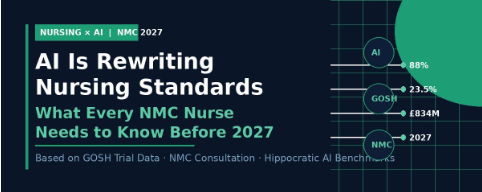
AI just outperformed registered nurses on drug safety tests. Not in a Silicon Valley lab. In benchmarks conducted with over 1,000 licensed nurses and 130 licensed physicians evaluating real healthcare AI agents.
On identifying over-the-counter medications unsafe for patients with specific conditions, the AI scored 88%. Nurses scored 45%.
But the headline buries the real story.
The real story is about who decides what happens next, health management looking for budget shortcuts, or nurses who actually understand the ward. Whether you hold an NMC PIN, practise under AHPRA in Australia, or are still building your career, decisions being made right now will shape your profession for the next two decades.
This article breaks down exactly what is happening, what the evidence says, and most importantly, what you need to do about it.
The Hippocratic AI Benchmarks: What the Headlines Got Right and Wrong
In March 2024, Hippocratic AI published benchmarks from its Polaris model, tested by over 1,000 US-licensed registered nurses and 130 US-licensed physicians.
The AI outperformed human nurses across four specific knowledge tasks:
-
Identifying a medication's effect on lab values: 79% (AI) vs 63% (nurses)
-
Identifying OTC medications unsuitable for patients with specific conditions: 88% (AI) vs 45% (nurses)
-
Correctly comparing lab values to reference ranges: 96% (AI) vs 93% (nurses)
-
Detecting toxic doses of OTC drugs: 81% (AI) vs 57% (nurses)
The hidden truth on these impressive starts is that these benchmarks test isolated knowledge recall, not clinical nursing practice. The AI agents are designed for low-risk, non-diagnostic tasks, i.e patient check-ins, chronic disease follow-ups, and post-discharge calls. They have not been tested on the full scope of what a registered nurse does.
Critically, the company's own agents are programmed to escalate immediately to a human nurse when a patient shows signs of clinical deterioration, distress, or anything outside a defined scope.
That is not an incidental detail.
That is a design requirement because the gap between knowledge recall and clinical judgement remains unbridgeable by current AI.
The cost difference is also worth naming directly. Hippocratic AI's agents are priced at approximately £7 per hour. An NHS Band 5 registered nurse earns between £15.89 and £19.35 per hour under the 2026/27 Agenda for Change pay scales, before London weighting, unsocial hours enhancements, employer National Insurance, and pension contributions.
Every finance director can see that gap on a spreadsheet. That is the risk.
The risk is not that AI is being enhanced. The risk is that the numbers make the decision before the evidence does, that budget pressure, not patient safety, becomes the deciding factor in how AI gets deployed across the NHS.
From the Ward to the Boardroom: How AI Is Transforming NHS Workflows
The GOSH Trial — The Largest NHS AI Study to Date
The most significant NHS AI implementation to date was not about replacing nurses. It was about getting them away from the keyboard and back to the bedside.
Great Ormond Street Hospital (GOSH) led an NHS England-sponsored study of an AI scribing tool called TORTUS across nine NHS sites in London, covering hospitals, GP practices, mental health services, and ambulance teams. Over 17,000 patient encounters were evaluated between June 2024 and February 2025.
The results:
-
23.5% increase in direct patient interaction time during appointments
-
8.2% reduction in overall appointment length
-
51.7% reduction in documentation time per clinician
-
35% reduction in clinicians feeling overwhelmed by note-taking
-
13.4% increase in patients seen per shift in A&E at St George's University Hospital
-
92% of patients consented to the AI scribe and reported better engagement
GOSH has since rolled out TORTUS across its outpatient services as part of its published AI Strategy for 2025 to 2028. All notes are reviewed and signed off by the clinician before being saved. The AI makes no clinical decisions. No patient data is held or used to train the model.
Economic modelling from the trial estimates that national rollout could unlock up to £834 million annually through reduced documentation time and increased patient throughput.
The £900 Million Infrastructure Signal
A £900 million Healthcare AI Solutions framework, published by NHS Shared Business Services in May 2026, creates a national procurement route for AI across diagnostics, predictive analytics, operational efficiency, robotics, and clinical decision support. It runs until 2035.
This is not pilot territory. This is NHS-wide infrastructure investment, and it is already underway.
The Workforce Context You Cannot Ignore
There are currently more than 29,000 nursing vacancies across the NHS, with a vacancy rate of around 6% down from a peak of approximately 12%, but still representing tens of thousands of unfilled posts. The NHS spends close to £2 billion annually on agency and bank nurses alone.
The Royal College of Nursing has been explicit: new nurse numbers are falling in every English region. The NHS Long Term Workforce Plan aims to grow the nursing workforce from approximately 350,000 to 550,000 by 2036/37, but that requires sustained investment and consistent political will.
This is the context in which AI tools are being valued. Not as innovation for its own sake, but as a workforce pressure valve. Which is exactly why nurses need to be in the room when those decisions are made.
What Every NMC Nurse Must Know Right Now
This is where it becomes directly personal for every nurse, midwife, and nursing associate on the NMC register.
Over 12,500 responses to the NMC's Code and revalidation review survey showed that registrants are calling for clearer standards on the safe use of artificial intelligence in practice and stronger guidance on professional boundaries when using social media and digital tools.
Professor Donna O'Boyle, Acting Executive Director of Professional Practice at the NMC, stated that the findings make clear nurses want the Code to account for "the rapidly-evolving world of digital technology, including artificial intelligence."
The confirmed NMC timelines are:
-
A public consultation on the revised Code and revalidation process is planned between July and October 2026.
-
An updated Code and revalidation process is expected to come into effect in October 2027.
Within 18 months, your professional standards document will contain AI guidance. How you demonstrate engagement with digital tools in clinical settings may become part of your revalidation requirements. If you are not paying attention to this now, you will be catching up when your revalidation is due.
The Picture in Australia
Australia is facing a projected shortfall of more than 100,000 nurses by 2030. Every state currently reports ongoing nursing shortages across public, private, aged care, and community health settings. Streamlined AHPRA processes introduced in 2025 brought in 16,622 internationally qualified nurses in a single year — and still did not meet the pace needed.
AI is being positioned as part of the solution. But Australian nurses — particularly those in aged care and regional settings — face the same structural risk as their NHS counterparts: AI being deployed as a cost-cutting measure rather than clinical support. Unlike the NMC, the Nursing and Midwifery Board of Australia and AHPRA have not yet published specific guidance on AI use in clinical nursing practice. Financial decisions are being made before the professional framework exists. That is the gap.
What the RCN Has Said — and Why It Matters
Responding directly to the GOSH trial results in October 2025, the RCN's UK Head of Nursing Practice, Stephen Jones, made the position explicit:
"The goal of AI must be freeing up nursing time, allowing staff to deliver more care where it's needed, rather than spending time on outdated administrative tasks. For that to be a reality, nursing professionals must be involved in development and implementation... AI has great potential to modernise services, but ministers shouldn't be completely seduced by it alone. It must enhance personal nursing care, not replace it."
That is not a press release platitude. It is a precise diagnosis of the exact risk this technology creates if nurses are not in the decision-making rooms.
What the Data Cannot Capture
The Hippocratic AI benchmarks test knowledge in controlled conditions. They do not — and cannot — replicate what happens when:
A patient's observations are borderline, but something about their colour, their breathing pattern, or the way they respond to your question tells you to act before the monitor alarms.
A family arrives on the ward at midnight and what they need is not a protocol.
A medication is technically within range, but you know this patient, and something does not look right.
These are not edge cases. These are what nursing is. The Nuffield Trust's 2025 survey found that almost nine in ten healthcare professionals cited medico-legal risk as a key concern with AI, regardless of whether they were currently using it. That concern is rational and grounded.
There is also a well-documented risk that when AI handles administrative tasks and frees clinical capacity, hospital administrators use that capacity to increase nurse-to-patient ratios rather than reduce workload. The result is not less pressure, it is the same volume of work with a harder patient mix. The only protection against that outcome is nurses being present when procurement, implementation, and governance decisions are made.
What You Need to Do Right Now
This is not a call for resistance. It is a call for professional ownership.
If You Work In The NHS:
Ask your Trust's Chief Nursing Information Officer or digital nursing lead what AI tools are currently being piloted or procured. Trusts are required to publish AI strategies publicly — GOSH's 2025 to 2028 strategy is a useful benchmark for what good governance looks like. Use your Trust's Freedom to Speak Up channels if AI tools are being deployed without adequate clinical governance or nursing input.
If You Are an NMC Registrant:
Monitor NMC. The public consultation on the revised code opens in September 2026. This is your professional standards document and you have a right to shape it. Consider documenting your professional engagement with digital tools in your current revalidation reflective accounts. The new code is likely to make this explicit.
If You Are An Australian Nurse:
Contact the Australian Nursing and Midwifery Federation at your state branch and ask what position they are developing on clinical AI standards. Raise it through workplace clinical governance committees, especially in aged care settings where oversight is weakest. When NMBA consultation opens, respond to it.
The Bottom Line
AI is not coming for nursing. But it is absolutely coming for the parts of nursing that should not require a registered nurse in the first place. The documentation that consumes hours every shift. The routine follow-up calls. The administrative drag that keeps nurses away from patients.
The GOSH trial proved this at scale. When AI handles documentation, nurses spend 23.5% more time with patients. That is not a threat to the profession. That is a result worth fighting for.
But the same technology, deployed without nursing governance, used to thin out safe staffing ratios or substitute for human contact where clinical judgement and compassion are required, becomes something else entirely.
The difference between those two outcomes is not the technology. It is whether nurses are in the room when the decisions get made.
And being in that room starts with staying informed, staying qualified, and staying ahead. Whether you are preparing for your NMC CBT, working through your OSCE, or building the research skills to contribute to clinical governance, https://uknurses.net/ exists to support exactly that. Our expert nursing tutors are NMC, AHPRA and NCNZ aligned and ready to help you take the next step.
Book your free 30-minute consultation today, no commitment required.
Sources
-
Hippocratic AI Polaris paper and NVIDIA partnership press release, March 2024-hippocraticai.com/polaris
-
GOSH-led TORTUS AI Scribe Trial, NHS England-sponsored, results published July–September 2025-gosh.nhs.uk
-
GOSH AI Strategy 2025–2028-gosh.nhs.uk/about-us/our-strategy/our-ai-strategy-for-2025-2028
-
NHS SBS £900m Healthcare AI Solutions Framework, May 2026- digitalhealth.net
-
NHS nursing vacancy data, Q3 2024/25 Statista / nurses.co.uk / RCN
-
Royal College of Nursing statement on AI, October 2025- rcn.org.uk
-
NMC Code and Revalidation Review initial findings November 2025, consultation timeline September 2026-nmc.org.uk / nursinginpractice.com
-
MHRA National Commission on AI in Healthcare, 2026 gov.uk
-
Nuffield Trust nurse vacancy and AI risk data, 2025 nuffieldtrust.org.uk
-
Australian Health Workforce Advisory Committee nursing shortage projections- aihw.gov.au
-
AHPRA international nurse registration 2025 data ahpra.gov.au
-
Health Innovation Network ambient voice technology review, March 2026- thehealthinnovationnetwork.co.uk