You already did the hard part.
You went to nursing school. You completed your training. You passed your professional exams. You may even have years of experience caring for patients.
So when you hear that Canada needs nurses, the obvious question is:
“Why would I need to start nursing all over again?”
The answer is: you may not.
Canada has a pathway for internationally educated nurses (IENs), allowing qualified nurses trained outside Canada to have their education, registration and professional background assessed against Canadian requirements.
But there is a catch.
Being an experienced nurse does not automatically make you eligible to practise in Canada.
Your education must be assessed. Your documents may need verification. You may need to demonstrate language proficiency. Depending on your circumstances and province, you could be asked to complete competency assessments, additional education, examinations or other registration requirements.
And nursing registration is only one side of the move.
You also need the correct immigration or work status to live and work in Canada.
That is why the smartest way to approach the Canadian IEN route is not:
“How quickly can I get to Canada?”
It is:
“What exactly does my target province require, how much will it cost me, and what happens if my credentials are not considered equivalent?”
This guide walks you through that process.
What Is an Internationally Educated Nurse?
An internationally educated nurse, or IEN, is a nurse who completed nursing education outside Canada. You may also see terms such as:
-
internationally trained nurse
-
foreign-trained nurse
-
internationally educated registered nurse
The terminology can vary, but the basic idea is the same.
If you qualified as a nurse outside Canada and want to practise in Canada, you generally need to satisfy the registration requirements of the province or territory where you intend to work. Your previous nursing experience still matters.
However, regulators are not simply asking how many years you have worked. They assess whether your education, knowledge, skills and professional history meet the standards required for nursing practice in that jurisdiction.
A nurse with 10 years of experience can therefore still be asked to complete additional requirements.
Can an Internationally Educated Nurse Work in Canada?
Yes, potentially.
But you cannot simply arrive in Canada with your foreign nursing licence and begin working as a registered nurse.
Nursing is a regulated profession. You need registration with the appropriate provincial or territorial nursing regulator before practising as an RN in that jurisdiction.
The process can involve:
Choose a province → identify the regulator → complete the required assessment → verify documents → meet language requirements → complete competency or education requirements if required → complete examinations → obtain registration → seek employment.
At the same time, you need immigration status that allows you to live and work in Canada. This creates two separate questions:
-
Can I become registered as a nurse?
Your provincial or territorial regulator decides this. -
Can I legally live and work in Canada?
Canadian immigration authorities decide this.
Remember, you need to plan for both.
Step 1: Choose Your Province Before Starting
One of the biggest mistakes IEN applicants make is searching for a generic “Canada nursing registration process.”
Canada does not have one single provincial registration process. Your target province determines which regulator you deal with and can affect the assessment, education, examination and registration steps you need to complete.
Examples include:
-
College of Nurses of Ontario
-
British Columbia College of Nurses and Midwives
-
College and Association of Registered Nurses of Alberta
-
College of Registered Nurses of Manitoba
Other provinces and territories have their own regulators. Do not assume that a requirement listed for Ontario applies to Alberta or British Columbia.
What Should You Compare?
Before choosing a province, compare:
|
Factor |
What to check |
|
Registration |
Which regulator handles IEN applications? |
|
Assessment |
Is NNAS required for your pathway? |
|
Education |
Could additional education be required? |
|
Language |
Which tests and scores are accepted? |
|
Examination |
Is NCLEX-RN required? |
|
Employment |
What nursing vacancies exist? |
|
Cost |
What will assessment, registration and education cost? |
|
Immigration |
Which immigration pathways could fit your profile? |
Coach's advice: Do not choose a province simply because someone calls it “the easiest.” Your education, experience and registration history can produce a very different outcome from another applicant's.
Step 2: Confirm Your Nursing Category
Canada regulates other nursing designations, including licensed practical nurses (LPNs), registered practical nurses (RPNs) in some jurisdictions and registered psychiatric nurses (RPNs) in specific provinces.
For immigration purposes:
-
registered nurses and registered psychiatric nurses are classified under NOC 31301
-
nurse practitioners under NOC 31302
-
licensed practical nurses under NOC 32101.
Your NOC classification can matter for immigration, but it does not give you a nursing licence. Professional registration and immigration classification are separate.
Step 3: Check Your Regulator's IEN Requirements
Once you choose your province, go directly to the regulator's website. Look for its internationally educated nurse or internationally educated applicant requirements.
You may need to provide evidence relating to:
-
identity
-
nursing education
-
nursing registration
-
employment history
-
professional standing
-
language proficiency
-
examinations
-
jurisprudence
-
criminal record checks
-
competency
-
additional education
Do not build your application around an old checklist from a recruitment agency or social media post. Start with the current requirements published by your regulator.
This matters because IEN pathways are changing.
For example, NNAS currently provides different pathways and services depending on the applicant and participating regulatory body. Its 2026 pathway tool also shows province-specific routes rather than one identical process across Canada.
Step 4: Understand NNAS
The National Nursing Assessment Service (NNAS) is an important part of the IEN process for many applicants. NNAS provides credential assessment services for internationally educated nurses applying to participating Canadian nursing regulators.
The process can involve information from your:
-
nursing school
-
nursing regulator
-
employers
-
identity documents
-
professional history
The important point is that you are not always responsible for simply uploading everything yourself. Some documents need to come directly from the organisation that issued or holds them.
For example, you may have your nursing certificate and transcript, but your school may still need to submit information directly through the required process.
This is one reason document collection can take longer than expected.
Has NNAS Changed?
Yes. NNAS now offers an Expedited Service for eligible applicants applying through participating regulatory bodies. NNAS states that eligible applicants can receive an Advisory Report within five business days after all required documents are received.
The service does not apply to every applicant or every regulatory pathway. So be careful with older advice claiming that every NNAS application automatically takes 12 weeks.
Your actual timeline depends on the service and pathway available to you, whether all required documents are received, and what your regulator requires after assessment.
Step 5: Prepare Your Documents Early
Document collection is one of the areas where you have the most control.
So start early. Depending on your pathway, you may need documentation covering:
-
Identity: Passport or other accepted identification.
-
Nursing education: Diploma or degree, transcripts and other education records.
-
Nursing registration: Evidence from your nursing regulator or licensing authority.
-
Employment: Professional employment information where required.
-
Professional standing: Evidence of registration history or good standing where required. If you have worked or studied in several countries, gathering documents can become more complicated.
Do not wait until you have started the application before contacting your former nursing school, regulator and employers. A delay from one institution can hold up the rest of your application.
Step 6: Review Your Assessment Outcome
Your assessment will not necessarily produce a simple “yes” or “no”. Your regulator may determine that you meet some requirements but need additional steps before registration.
Depending on your circumstances, this could include:
-
further documentation
-
language evidence
-
competency assessment
-
additional education
-
examination
-
jurisprudence
-
other regulatory requirements
Your foreign nursing degree is not automatically treated as identical to a Canadian nursing qualification. The question is whether your education and professional preparation meet the standards required for nursing practice in your target jurisdiction.
What Does Additional Education Mean for an IEN?
This is one of the most misunderstood parts of the process.
If a regulator says you need additional education, that does not automatically mean you need another full nursing degree.
The requirement could involve specific nursing courses, theoretical education, clinical education, competency-based education or a bridging programme.
The exact requirement depends on your assessment and regulator.
Before paying tuition, ask:
-
What exactly do I need to study?
-
How long will it take?
-
Which institutions offer it?
-
Is the programme accepted for my registration pathway?
-
Are clinical placements required?
-
What are the tuition costs?
-
What happens after completion?
Do not enrol in a programme simply because it is advertised as an “IEN bridging course.” Confirm with your regulator that it addresses the requirement identified in your application.
Step 7: Meet the Language Requirement
English or French language evidence may form part of nursing registration.
Depending on the regulator and your circumstances, accepted evidence can include tests such as:
-
IELTS Academic
-
CELBAN
-
PTE Academic
-
OET
There is no single “IELTS score for Canada nurses.” The accepted test, score and component requirements depend on the regulator and your circumstances.
Before booking a test, check:
-
Which tests are accepted?
-
What overall score is required?
-
Are minimum component scores required?
-
Can previous education satisfy the requirement?
-
Can previous practice count?
-
How recent must the result be?
University English Requirements Are Different
If you originally studied nursing in English, do not automatically assume that your university admission evidence will satisfy nursing registration.
A university decides whether you meet its admission requirements.
The nursing regulator decides whether you meet its professional registration requirements.
Those are separate decisions.
Step 8: Complete Competency Assessment or Additional Requirements
Some IEN applicants may need to demonstrate their competence through a practical, written or other assessment.
The purpose is to determine whether your knowledge and skills meet the competencies expected for safe nursing practice. Your previous experience is valuable, but it does not automatically exempt you from assessment.
If you are asked to complete one, establish:
-
what will be assessed
-
where it takes place
-
how much it costs
-
how long it takes
-
what preparation is required
-
what happens if you do not meet the required standard
Do not book expensive travel or education before you understand exactly what your regulator requires.
Step 9: Take the NCLEX-RN
The NCLEX-RN is the entry-to-practice examination for registered nurses in Canada. For IENs, it can form part of the registration process where required by the applicable pathway.
However, passing NCLEX-RN does not by itself make you a registered Canadian nurse.
You may still need to complete requirements involving:
-
credential assessment
-
language
-
competency
-
additional education
-
jurisprudence
-
criminal record checks
-
professional registration
Think of NCLEX-RN as one part of registration, not the entire process.
Is NCLEX-RN Difficult for International Nurses?
It can be challenging. Your nursing education and clinical experience can give you a strong foundation, but the examination tests your ability to apply nursing knowledge and make clinical decisions.
Do not rely solely on years of clinical experience. Prepare specifically for the examination format and its clinical reasoning demands.
Step 10: Complete Jurisprudence and Other Checks
Some regulators require jurisprudence education or an examination. This can cover areas such as:
-
scope of practice
-
consent
-
documentation
-
privacy
-
professional boundaries
-
legal responsibilities
-
regulatory standards
You may also need:
-
criminal record checks
-
identity verification
-
proof of registration
-
evidence of good standing
-
professional history
The exact requirements depend on your province and registration pathway, so use your regulator's checklist rather than assuming every IEN completes the same steps.
Step 11: Obtain Nursing Registration
Once you have completed the requirements identified by your regulator, you can proceed toward registration. The regulator may require evidence of:
-
education
-
registration
-
language proficiency
-
examination results
-
jurisprudence
-
criminal record checks
-
professional standing
-
additional education
-
other required documents
Once registered, you can seek nursing employment within the scope and conditions of your registration. But there is still another piece.
Nursing Registration Does Not Give You a Work Permit
This distinction is critical. Your nursing regulator answers:
“Can this person practise nursing?”
Immigration authorities answer:
“Can this person legally live and work in Canada?”
You need both. Do not confuse professional registration with immigration status.
How Can an IEN Immigrate to Canada?
There is no single immigration pathway for every internationally educated nurse.
Potential options can include:
-
Express Entry
-
Provincial Nominee Programmes
-
Canadian Experience Class
-
Atlantic Immigration Program
-
other applicable immigration routes
Your eligibility depends on factors such as:
-
age
-
education
-
language results
-
work experience
-
Canadian work experience
-
occupation
-
province
-
immigration status
-
CRS score
-
programme-specific requirements
Nursing and Express Entry in 2026
Nursing remains included in Canada's 2026 Express Entry healthcare and social services category.
For this category, candidates generally need at least 12 months of eligible full-time work experience, or an equivalent amount of part-time experience, within the previous three years in an eligible occupation. The experience can be in Canada or abroad. Registered nurses, nurse practitioners and licensed practical nurses are among the listed occupations.
However, category eligibility does not guarantee an invitation to apply for permanent residence. Candidates must still meet the applicable Express Entry requirements and rank competitively in the pool.
Your NOC code is therefore useful, but it is not immigration approval.
Can Nursing Help You Get Permanent Residence?
Potentially. A possible pathway could look like:
Credential assessment → nursing registration → work authorization → nursing employment → qualifying work experience → immigration eligibility → PR application
But your actual sequence may differ. Do not choose an immigration programme simply because someone tells you that “nurses get PR easily.”
Nursing can strengthen your profile and may place you within specific immigration categories, but no nursing qualification or job guarantees permanent residence.
What Does It Cost to Become an IEN in Canada?
There is no reliable single price for every IEN. Potential costs include:
-
credential assessment
-
document preparation
-
translations
-
language testing
-
regulator application fees
-
registration fees
-
competency assessment
-
additional education
-
NCLEX-RN
-
jurisprudence
-
criminal record checks
-
travel
-
accommodation
-
immigration fees
-
medical examinations where required
The biggest variable may be additional education. If your assessment identifies only a few remaining requirements, your costs may be relatively manageable.
If substantial education or clinical training is required, the cost can increase considerably. This is why generic claims such as “it costs CAD $X to become a nurse in Canada” can be misleading. Your assessment outcome determines much of your actual cost.
How Much Do Nurses Earn in Canada?
Nursing salaries vary by province, employer, specialty, experience and employment arrangement. Rather than relying on broad salary estimates, check current provincial wage grids and job postings for your target location.
Statistics Canada's latest available first-quarter 2026 data reported 17,125 vacancies for registered nurses and registered psychiatric nurses, with an average offered hourly wage of approximately CAD $37.35. Licensed practical nurse vacancies stood at 7,480, with an average offered hourly wage of approximately CAD $32.55
These are vacancy-survey figures, not guaranteed salaries for individual nurses. Your actual income can vary because of:
-
experience
-
specialty
-
union agreements
-
employer
-
overtime
-
shift premiums
-
full-time or part-time status
-
province
Where Are the Nursing Jobs in Canada?
Canada continues to have a large regulated nursing workforce.
In 2023, 477,980 regulated nurses were eligible to practise in Canada, including 321,971 RNs, 8,999 nurse practitioners and 140,285 LPNs/RPNs.
Statistics Canada also reported approximately 21,000 RN/RPN vacancies and 10,000 LPN vacancies in the first quarter of 2025. The latest first-quarter 2026 figures show vacancies have since fallen, with approximately 17,125 RN/RPN vacancies and 7,480 LPN vacancies.
The important takeaway is that demand exists, but demand does not mean every IEN will receive a job immediately.
Your prospects can depend on:
-
registration status
-
province
-
specialty
-
experience
-
location
-
employer
-
current vacancies
-
willingness to work outside major cities
Should an IEN Choose Ontario, Alberta or British Columbia?
There is no universally best province.
Instead, compare each province according to your own situation.
|
Province/region |
What to consider |
|
Ontario |
Large healthcare system and nursing workforce, with its own IEN requirements |
|
British Columbia |
Significant healthcare system, but living costs can be high in some locations |
|
Alberta |
Large healthcare system and its own registration pathway |
|
Manitoba |
Worth investigating for IENs interested in regional opportunities |
|
Atlantic Canada |
Worth considering if you are flexible about location and immigration pathways |
The best province is the one where your qualifications, registration pathway, employment plans, finances and immigration profile work together.
Should an Experienced Nurse Study Nursing Again in Canada?
Not necessarily. If you are already a qualified nurse, investigate the IEN pathway before paying for another nursing degree.
You may be able to use your existing education and experience. However, additional Canadian education can become necessary if your regulator identifies gaps in your preparation.
The key question is not:
“Do I need another nursing degree?”
It is:
“What does my target regulator require based on my assessment?”
That answer should guide your decision.
IEN Pathway vs Studying Nursing From the Beginning
|
Factor |
IEN pathway |
Study nursing in Canada |
|
Starting point |
Existing nursing qualification |
No Canadian nursing qualification |
|
Main process |
Assessment and registration |
Canadian nursing education |
|
Tuition |
May be lower initially |
Potentially substantial |
|
Timeline |
Can vary considerably |
Often more structured after admission |
|
Additional education |
May be required |
Built into programme |
|
Clinical education |
May be required |
Included in programme |
|
Immigration |
Separate process |
Separate process |
|
Best suited to |
Qualified nurses |
People starting nursing education |
For many qualified nurses, investigating IEN registration first makes more sense than immediately starting another nursing degree.
Common IEN Mistakes to Avoid
1. Assuming experience guarantees registration
Experience is valuable, but it does not automatically make your education equivalent to Canadian requirements.
2. Choosing a province too late
Your target province determines the regulator and can affect your pathway.
3. Treating NNAS as the entire process
NNAS may be an important assessment stage, but it is not the same as final provincial registration.
4. Assuming every IEN follows the same timeline
NNAS now has different service pathways, including an expedited option for eligible applicants. Your total registration timeline still depends on your regulator and individual requirements.
5. Assuming additional education means one short course
The requirement could be more substantial.
6. Booking IELTS before checking the regulator
Check accepted tests and scores first.
7. Passing NCLEX-RN and assuming you are finished
Other registration requirements may remain.
8. Paying an agency before understanding your pathway
Know what your regulator requires before paying someone to sell you a solution.
9. Assuming nursing guarantees PR
It does not.
10. Choosing a province because someone calls it “easy”
Your best province depends on your individual profile.
Red Flags When Using a Nursing or Immigration Agency
Be cautious if someone tells you:
1. “You are a nurse, so PR is guaranteed.”
No occupation guarantees permanent residence.
2. “You will be registered in three months.”
Your timeline depends on your documents, assessment and regulator requirements.
3. “NNAS takes five days, so you will be working in Canada in five days.”
That confuses an expedited assessment service with the complete registration process. The five-business-day NNAS service applies to eligible applicants once required documents have been received. (National Nursing Assessment Service)
4. “You do not need an English test.”
Maybe, but your regulator decides what evidence you need.
5. “You only need this one bridging course.”
Confirm the requirement with your regulator before paying tuition.
6. “Just take IELTS 7.”
There is no universal IEN IELTS requirement across Canada.
7. “Come to Canada first and we will sort out registration later.”
Be cautious. Understand your professional and immigration pathway before making an expensive international move.
Your IEN Canada Checklist
Before spending significant money, make sure you can answer these questions.
Province
-
Which province do I want to practise in?
-
Which regulator handles RN registration?
-
Does my pathway require NNAS?
Education
-
What documents must my school provide?
-
Has my nursing education been assessed?
-
Could I need additional education?
Registration
-
Do I need NCLEX-RN?
-
Is jurisprudence required?
-
Do I need a criminal record check?
-
What evidence of good standing is required?
Language
-
Which tests are accepted?
-
What scores are required?
-
Are component minimums required?
Money
-
What will assessment and registration cost?
-
Could I need additional education?
-
What will language testing and NCLEX-RN cost?
-
What will relocation and immigration cost?
Immigration
-
What work authorization would I need?
-
Which PR pathways could apply?
-
What work experience is required?
-
What language requirements apply?
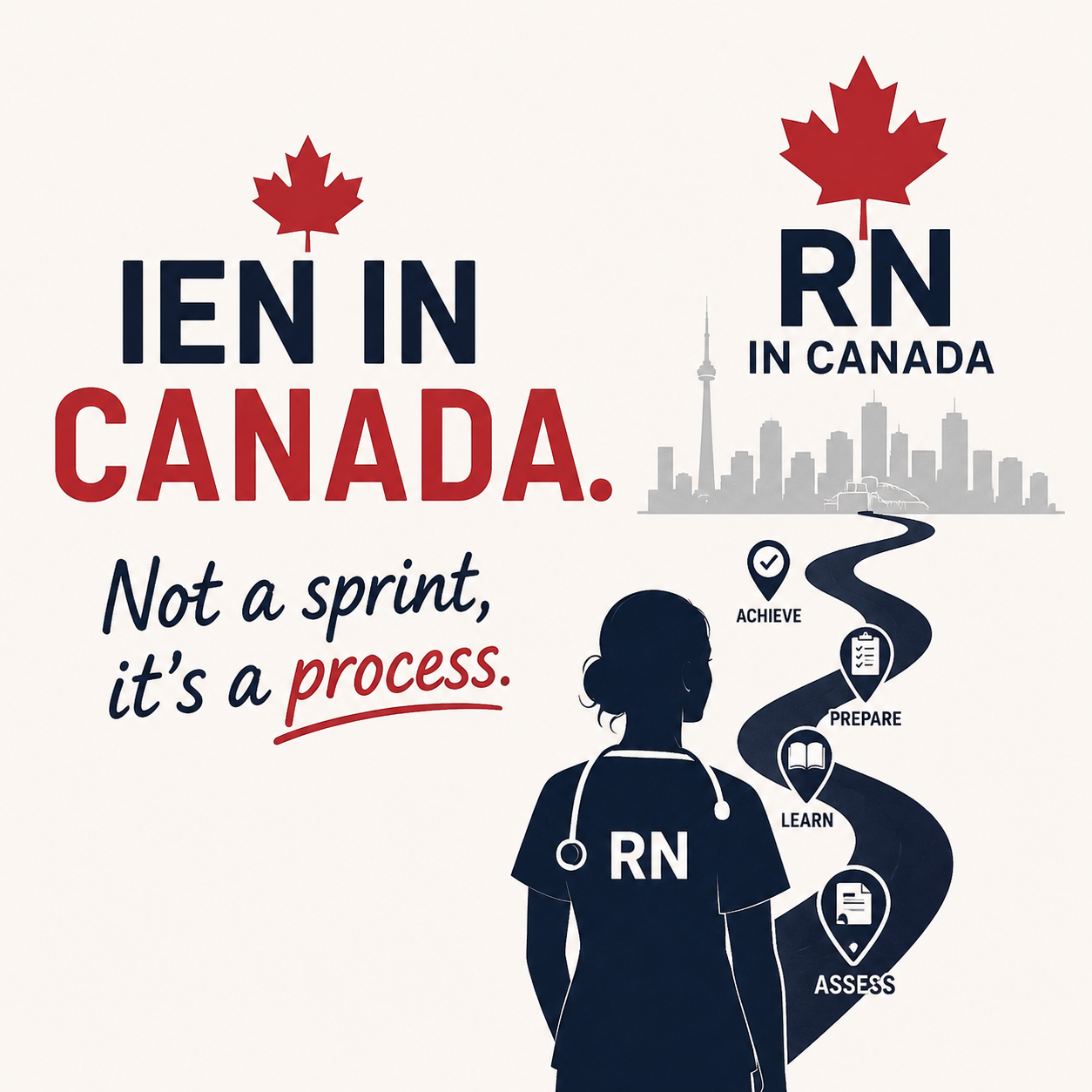
A Practical IEN Canada Roadmap
Your journey may look like this:
1. Choose where you want to practise
Select a target province or territory.
2. Identify the regulator
Read its current IEN requirements.
3. Gather your documents
Contact your nursing school, regulator and employers early.
4. Complete the required assessment
Use NNAS or another applicable assessment pathway where required.
5. Review the outcome
Find out whether you need additional education, competency assessment or other requirements.
6. Meet language requirements
Submit accepted evidence if required.
7. Complete additional education or competency assessment
Only where your regulator requires it.
8. Complete NCLEX-RN
Where applicable.
9. Complete remaining registration requirements
This may include jurisprudence, criminal record checks and professional standing.
10. Obtain nursing registration
You can then practise within the conditions of your registration.
11. Secure appropriate immigration/work status
Registration does not give you permission to work in Canada.
12. Find nursing employment
Target employers and locations that fit your experience.
13. Review PR options
Assess the immigration pathways for which you may qualify.
Finally, Do Not Start Over Until You Know You Have To
If you are already a qualified nurse, your first instinct may be to search for a Canadian nursing degree.
Pause.
Before spending years and potentially a significant amount of money on another qualification, find out what your existing nursing education and experience can do for you.
The IEN pathway exists for nurses educated outside Canada.
Your journey may involve credential assessment, document verification, language evidence, competency assessment, additional education, NCLEX-RN and provincial registration. It may also involve a separate immigration process.
That sounds complicated because it is.
But complicated does not mean impossible.
Work backwards from your goal:
Where do I want to practise? → Which regulator handles registration? → What does it require from IENs? → What does my assessment reveal? → What will registration cost? → Which immigration pathway could fit my situation?
Once you have those answers, you can make a much better decision about whether Canada is right for your nursing career.
Do not let a recruiter's promise decide your future.
Let your qualifications, assessment results, finances and career goals guide your decision.
Need Help With Your Nursing Career Pathway?
Moving from an internationally educated nurse to registration in Canada can involve several stages, from credential assessment and language requirements to NCLEX-RN preparation and registration.
UKNurses can support nurses with registration planning, NCLEX-RN preparation, IELTS/OET preparation and broader nursing career pathway guidance.
If Canada is your goal, understanding your pathway before spending money can save you time, money and unnecessary frustration, so get in touch with us today.
Frequently Asked Questions
1. Can I work as a nurse in Canada if I qualified in another country?
Yes. Internationally educated nurses (IENs) can pursue nursing registration in Canada, but you must meet the registration requirements of the province or territory where you intend to practise. The process typically involves having your nursing education and credentials assessed, meeting language requirements, completing any required examinations or additional education, and obtaining registration with the appropriate nursing regulatory body.
2. Do I need to study nursing again in Canada?
Not necessarily. Being educated outside Canada does not automatically mean you need to repeat your entire nursing degree or diploma. Your education, training and experience will be assessed as part of the IEN registration process. Depending on the outcome, you may be required to complete additional courses, assessments, clinical training or other requirements before you can become registered.
3. Do all internationally educated nurses (IENs) need NNAS?
No. The process depends on your nursing designation, the province or territory where you want to practise, and the requirements of the relevant nursing regulatory body. NNAS may be part of the process for many IENs, but it is not appropriate to assume that every internationally educated nurse follows exactly the same pathway. Always check the requirements of your target regulator before starting your application.
4. How long does the NNAS process take?
There is no single timeline for every IEN. The time required can depend on your documents, the institutions that need to verify them, the assessment pathway you use and the requirements of the regulatory body involved. NNAS also offers an expedited service for eligible applicants through participating regulatory bodies, so some applicants may have a significantly shorter assessment timeline. You should allow additional time for the rest of the nursing registration process after the assessment.
5. Can internationally educated nurses take the NCLEX-RN?
Yes, some internationally educated nurses can take the NCLEX-RN as part of the Canadian nursing registration process. However, eligibility is determined by the nursing regulatory body in the province or territory where you are applying. You must first meet the regulator's requirements before you can be authorized to take the examination.
6. What English test do I need to become a nurse in Canada?
The language requirements depend on the nursing regulator and your individual circumstances. Depending on the jurisdiction and pathway, accepted evidence of language proficiency may include tests such as IELTS Academic, CELBAN, PTE Academic or OET, as well as other forms of evidence in certain circumstances. Before booking an English test, check the current requirements of the nursing regulator where you intend to practise.
7. Can an internationally educated nurse get permanent residence in Canada?
Yes, an internationally educated nurse may be eligible for permanent residence in Canada, but nursing registration and immigration are separate processes. Your eligibility will depend on factors such as your education, work experience, language ability, immigration programme and other requirements. Options can include federal programmes such as Express Entry or provincial immigration programmes, but being a nurse does not automatically guarantee permanent residence.
8. Are nurses still eligible for the healthcare Express Entry category in 2026?
Yes. Nurses are included among the occupations eligible for Canada's 2026 Express Entry healthcare and social services category. Registered nurses and registered psychiatric nurses, nurse practitioners and licensed practical nurses are among the listed occupations. However, candidates must still meet the applicable Express Entry requirements and the specific eligibility requirements for the category, including the required work experience. Immigration policies can change, so applicants should confirm the current requirements with Immigration, Refugees and Citizenship Canada (IRCC) before applying.
Sources
Canada.ca: Express Entry Category-Based Selection
Canada.ca: 2026 Express Entry Categories
Canadian Nurses Association: Nursing Statistics
Statistics Canada: Job Vacancies, First Quarter 2026
Statistics Canada: Skill Underutilization Among Immigrant Women With a Nursing Education
NNAS: Start Your Nursing Journey in Canada
NNAS: IEN Pathways to Nursing Licensure
NNAS: Applicant Handbook
Important: Nursing registration is regulated provincially or territorially, while immigration is handled federally. Requirements, fees and procedures can change. Always confirm current requirements with your target regulator, NNAS where applicable and Immigration, Refugees and Citizenship Canada (IRCC).