NCLEX PREP Mistakes TO AVOID
Build confidence by mastering NCLEX test taking strategies that work
Key takeaways
· The NCLEX-RN tests entry-level nursing judgment, not just memorised facts.
· Practice answering for the patient in the case, using their current findings and risks.
· Understand the scoring directions for each Next Generation NCLEX (NGN) item.
· Review missed questions by topic and reasoning error, not just your overall percentage.
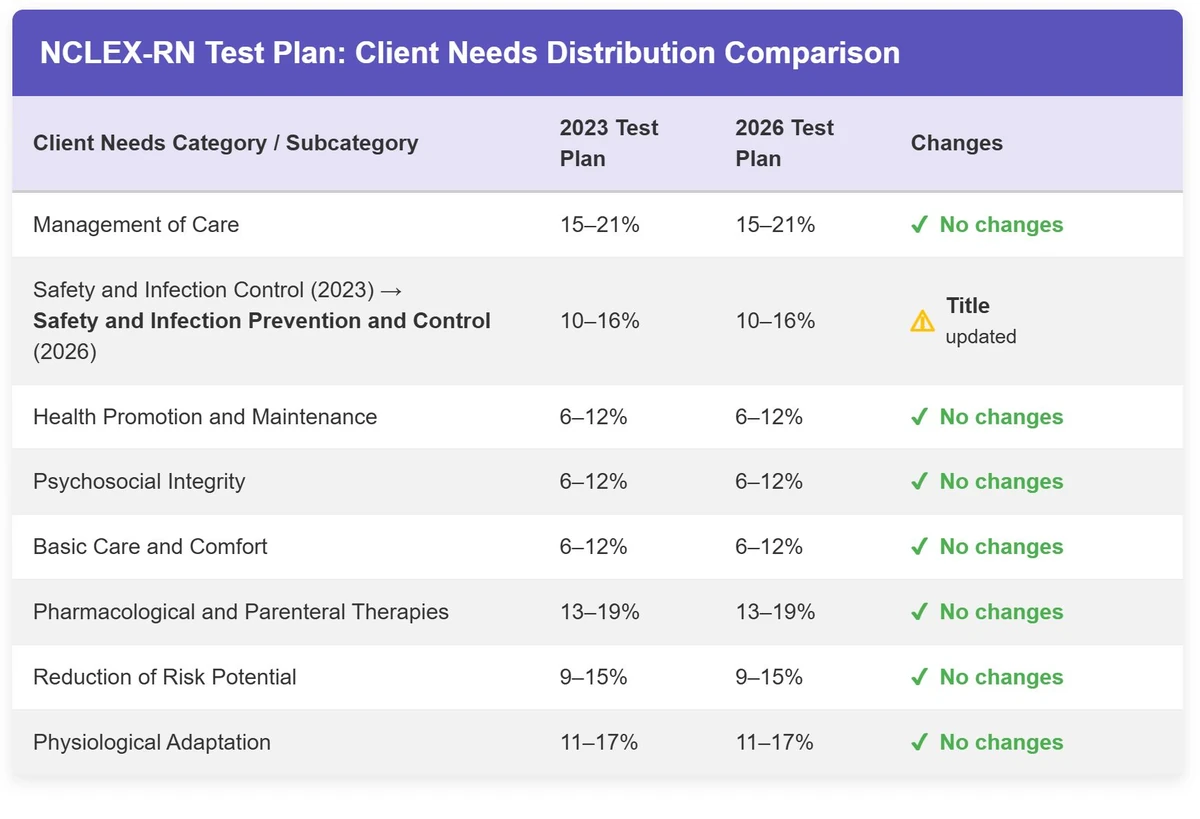
· Use the 2026 NCLEX-RN test plan to guide your preparation.
Common NCLEX Mistakes to avoid
Mistake 1: Answering NGN case studies for a generic patient
Next Generation NCLEX case studies follow a clinical situation through six judgment processes: recognise cues, analyse cues, prioritise hypotheses, generate solutions, take action and evaluate outcomes.
The safest answer must fit the person described and not an imagined textbook patient.
Try this,
Before selecting an option, identify the patient’s most urgent cue, its likely meaning and what has changed.
If the patient has worsening breathing, an answer suitable for a stable patient may be unsafe.
Ask, “Which chart finding supports this answer?”
If you cannot point to a relevant cue or nursing principle, reconsider your choice.
Mistake 2: Selecting too many answers on NCLEX SATA questions
Select-all-that-apply (SATA) questions are not a guessing contest. There is no reliable rule that three answers must be correct.
Read the instructions because NCLEX item types can use different partial-credit models, including plus/minus, zero/one and rationale scoring.
For an item scored with the plus/minus method, correct selections add credit and incorrect selections subtract credit, with an item score that does not fall below zero.
Other formats have their own rules. Do not apply one scoring formula to every multiple-response item.
Try this,
Evaluate each option independently. Ask whether it is supported by the patient data, whether it is within the nurse’s role or whether it answers the precise question.
Choose an option because it is clinically justified, not because your answer looks too short.
For the current explanation of partial credit, read the official NCLEX FAQs
Mistake 3: Skimming the patient record instead of following the trend
NGN case studies may contain nurses’ notes, observations, laboratory results, prescriptions and other chart tabs. However, when asked to evaluate care, or compare the patient’s current condition with the baseline and the expected response, a singly story might not be adequate for making judgements.
Try this:
Identify what improved, what worsened and what still requires action.
Use the reference ranges provided in the question when relevant, but interpret results within the clinical picture.
Recheck the chart before answering an evaluation question.
Mistake 4: Using question banks without fixing knowledge gaps
A question bank shows you where your understanding breaks down. It does not automatically bridge your learning gap.
Repeating the same subject without learning the underlying concept can produce familiar questions but little improvement on your rationale.
Build a simple weekly NCLEX-RN study plan:
· Group missed questions into precise topics, such as insulin timing, fluid balance, isolation precautions or delegation.
· Study the underlying content with a reliable nursing text and the current test plan.
· Complete practice questions on that specific topic, then review every rationale, including answers you guessed correctly.
· Return to the topic after a few days to check whether you can apply the concept to a new scenario.
Research on nursing education and exam preparation supports examining the relationship between programme performance, practice assessments and licensure outcomes, but no single study method guarantees a pass.
Related reading: integrative review of NCLEX predictors
Further research: nursing education research
Mistake 5: Treating test-taking strategies as shortcuts
Prioritisation frameworks are useful, but they are guides?
They are not rules that replace patient assessment.
“Assess before acting” may apply to a stable patient, while immediate intervention may be required for a life-threatening problem. Similarly, airway, breathing and circulation help organise priorities, but only when used with the case details.
Try this:
Read for words such as first, priority, immediate and most appropriate. Decide whether the patient is stable, what needs attention now and which action is safe within nursing scope. Then choose the strongest option.
For additional practice with question analysis, see the academic coaching guide.
A practical NCLEX-RN preparation routine
You do not need a perfect study streak. What you need is a repeatable process.
On most study days, combine focused content review, timed or untimed clinical-judgment questions, and a short error log. During this time, record why you missed each question: missed cue, weak content, misread instructions or prioritisation error.
Once a week, review recurring themes and adjust your next study block. Include breaks, sleep and realistic practice conditions.
If your scores remain stuck, individual feedback can help you identify errors that are difficult to spot alone.
Learn about UKNurses NCLEX-RN coaching and how one-to-one preparation can target your weaker areas.
NCLEX-RN frequently asked questions
How many questions are on the NCLEX-RN in 2026?
The NCLEX-RN has 85 to 150 items and a maximum testing time of five hours, including breaks. It is computer adaptive, so candidates may receive different numbers of items.
What does it mean if my NCLEX stops at 85 questions?
An exam ending at the minimum item count does not reveal whether you passed or failed. The stopping point alone is not a reliable result indicator.
Is the Next Generation NCLEX still used in 2026?
Yes. The NGN clinical-judgment format continues under the 2026 RN test plan, which took effect on 1 April 2026. The new test plan updates content and activity statements rather than replacing the exam format.
How are NCLEX select-all-that-apply questions scored?
The NCLEX uses different scoring approaches for item formats that allow partial credit. Plus/minus applies to applicable unspecified-selection items, while zero/one and rationale scoring apply to other formats. Always follow the item directions.
How long should I study for the NCLEX-RN?
There is no universal number of weeks. Your study period should reflect your baseline knowledge, available study time and results on quality practice questions. A targeted plan is better than a rigid timetable copied from another student.
What is the best way to study for the NCLEX-RN on the first attempt?
Use the current NCSBN test plan, practise patient-specific clinical judgment, review rationales and address repeated content weaknesses. Mix focused revision with realistic practice and reflection.
Can internationally educated nurses take the NCLEX-RN?
Yes, if they meet the eligibility requirements of their intended nursing regulatory body. NCLEX registration does not replace board-specific education, credential or licensing requirements.
Can I take the NCLEX-RN from the UK?
NCLEX is administered at authorised test centres, including international locations. Check the current appointment locations and eligibility rules with the official NCLEX programme and your chosen nursing regulatory body.
How many times can I retake the NCLEX-RN?
Candidates generally must wait at least 45 days between attempts; additional restrictions vary by nursing regulatory body. Confirm the current rules for your jurisdiction before re-registering.
Can I use AI or ChatGPT to prepare for NCLEX?
AI can help explain concepts or generate revision prompts, but it can make clinical errors. Check explanations against NCSBN guidance, trusted nursing materials and qualified instructors.
Should I get an NCLEX-RN tutor?
Tutoring may be useful if you have recurring knowledge gaps, struggle to interpret NGN cases or cannot identify why your answers are wrong. No legitimate tutor can guarantee an NCLEX pass.
Prepare for NCLEX-RN with UKNurses
The goal is not to memorise every possible question. It is to build the clinical reasoning and confidence to respond safely to unfamiliar situations. If you want structured guidance, UKNurses can help you plan your preparation around the areas that need the most attention.
Explore NCLEX-RN coaching,
Questions before you start? WhatsApp UKNurses