You passed your CBT (Computer Based Test). You cleared your English language test, submitted your NMC (Nursing and Midwifery Council) application, paid your fees and abve all have been nursing for years.
Now the OSCE (Objective Structured Clinical Examination) is the one thing standing between you and your NMC PIN (Personal Identification Number).
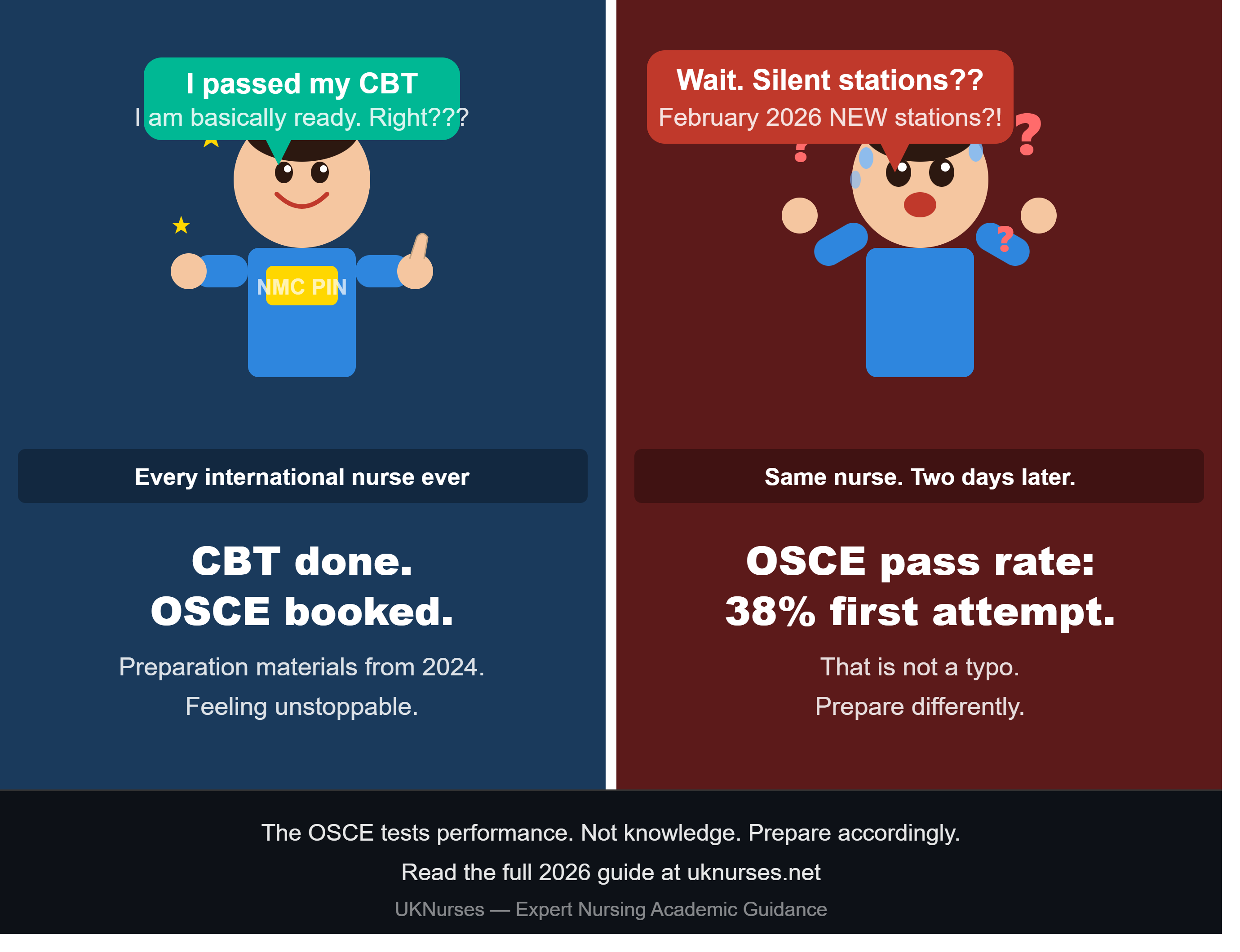
Before I go further, here is the number nobody puts at the top of their preparation guide: first-attempt pass rates for the NMC OSCE sit between 38% and 54% depending on the centre. That means at some test centres, more than six in ten candidates who have already done everything right still do not pass the first time.
Therefore, this guide tells you exactly why and what to do about it before your exam date.
Important: In February 2026, the NMC updated its OSCE station bank. Any preparation resource published before then is missing content that could appear in your exam.
TL;DR
-
-
-
-
-
-
10 stations. Approximately 3 hours. Four APIE, four Clinical Skills, two Silent Skills.
-
Pass rates range from 38% at some centres to 54% at others.
-
New stations were introduced from 23 February 2026. Older preparation materials are incomplete.
-
The NMC does not publish a simple numerical pass mark.
-
You lose marks for what you do not say out loud, not just what you do wrong clinically.
-
Certain unsafe acts trigger automatic station failure regardless of everything else you did correctly.
-
The OSCE is a performance exam. You can know everything and still fail if you have not practised performing under observation.
-
-
-
-
-
What the NMC OSCE Actually Tests
Most candidates walk into OSCE preparation thinking, 'I need to practise my clinical skills.' That is correct, but it only represents half of the picture, which most nurses already have.
The NMC OSCE is designed to answer one specific question: can this nurse provide safe, person-centred care in a UK clinical environment?
That question covers far more than technical skill. Every station assesses whether you can:
-
Communicate professionally with a patient in a UK ward context
-
Obtain informed consent before touching a patient
-
Prioritize patient safety above speed
-
Recognize clinical deterioration and escalate using the correct framework
-
Maintain infection prevention standards throughout, not just when you remember
-
document appropriately and evaluate the care you have given
-
work within the NMC Code even when an examiner is watching your every move
The critical insight is this: a technically perfect clinical procedure can still lose marks if communication or patient safety is compromised anywhere during the station. The examiner cannot score clinical reasoning they cannot hear. If you are thinking it but not saying it, those marks do not exist.
|
What the OSCE Tests |
What the OSCE Does NOT Test |
|
Safe clinical judgement |
Whether you were the best nurse in your country |
|
Communication and consent |
Memorising textbooks |
|
Professional behaviour |
A perfect English accent |
|
NMC Code-aligned practice |
Local hospital policies from your home country |
|
Patient safety under observation |
Speed alone |
OSCE at a Glance
|
Feature |
NMC OSCE (2026) |
|
Who takes it? |
Internationally qualified nurses completing the NMC Test of Competence |
|
Total stations |
10 |
|
Station types |
APIE, Clinical Skills, Silent Skills |
|
Typical duration |
Approximately 3 hours |
|
Current fee |
£794 |
|
Resit fee |
£397 (up to seven failed stations) |
|
Assessment focus |
Safe, effective, person-centred nursing practice aligned with the NMC Code |
|
Results timeline |
Within 5 working days of your exam date |
|
Outcome |
Required for NMC registration where applicable |
The 10 NMC OSCE Stations Explained
The NMC OSCE has 10 stations across three types. You rotate through all of them in a simulated hospital ward, with a trained actor playing your patient and a qualified NMC assessor scoring your performance in real time.
Type 1: APIE Stations (The Scenario Stations)
APIE stands for Assessment, Planning, Implementation and Evaluation. These four stations follow a single patient through one clinical journey, delivered in sequence. What you identify during the assessment stage directly informs your care plan, guides the interventions you deliver and determines what you evaluate at the end of the patient's journey.
This is where examiners look hardest at clinical reasoning, patient communication and escalation decisions. They want to see you think like a UK nurse, not just act like one.
Key skills tested across APIE stations:
-
Taking a structured patient history
-
Conducting a systematic physical assessment
-
Developing a care plan aligned with NMC standards
-
Implementing care safely and communicating throughout
-
Evaluating patient response and escalating appropriately
New from February 2026: The Suspected Deep Vein Thrombosis (DVT) station has been added to the APIE domain. This station requires candidates to assess DVT risk using the Wells Score, communicate clinical findings clearly and escalate appropriately.
Type 2: Clinical Skills Stations (The Practical Stations)
Four hands-on skill stations, typically grouped into two pairs with shared reading time between each pair. Although these stations assess familiar nursing procedures, candidates frequently lose marks because they fail to demonstrate safe practice through effective communication, consent and safety checks rather than a lack of technical ability.
The verified 2026 clinical skills checklist includes:
-
A-E (Airway, Breathing, Circulation, Disability, Exposure) patient assessment
-
Vital signs monitoring and NEWS2 (National Early Warning Score 2) interpretation
-
IM (intramuscular) and SC (subcutaneous) injections
-
ANTT (Aseptic Non-Touch Technique) application
-
Blood glucose monitoring
-
Wound assessment and dressing
-
Oxygen therapy administration
-
IV (intravenous) flush and phlebitis assessment
-
Urinary catheter removal and urine sample collection
New from February 2026: Anti-embolism stockings application and pre-operative checklist completion have been added to the clinical skills domain.
Type 3: Silent Skills Stations (The One That Catches Almost Everyone)
Two stations, professional values and behaviours assessed without direct instruction. You are observed and not told you are being scored. Therefore, many candidates do not realise they are in assessment mode until it is too late.
What examiners are scoring in silent stations:
-
Infection prevention and control behaviours. Handwashing, PPE (Personal Protective Equipment) use, correct disposal
-
Patient dignity and privacy. Are you pulling the curtain? Are you knocking?
-
Consent. Are you explaining what you are doing before you do it?
-
Professional communication. How you speak to the actor playing your patient
-
The NMC Code behaviours. Dignity, honesty, safety, professionalism
New from February 2026: The Deteriorating Patient and Patient Confidentiality scenarios have been added to the Professional Values and Behaviours domain. The Deteriorating Patient station requires NEWS2 scoring and SBAR (Situation, Background, Assessment, Recommendation) escalation, even within a silent station context.
The New February 2026 Stations in Full
|
Domain |
New Station |
What It Tests |
|
APIE |
Suspected DVT |
Wells Score assessment, clinical communication, escalation |
|
Clinical Skills |
Anti-embolism Stockings |
Safe application, patient communication, documentation |
|
Clinical Skills |
Pre-operative Checklist |
Systematic safety checking, consent, NMC Code compliance |
|
Professional Values |
Deteriorating Patient |
NEWS2 scoring, SBAR escalation, urgent communication |
|
Professional Values |
Patient Confidentiality |
Information governance, professional boundaries, NMC Code |
|
Evidence-Based Practice |
Cholesterol and Coffee |
Critically appraising research evidence |
|
Evidence-Based Practice |
Honey and Propolis in HSV Treatment |
Evidence appraisal and safe clinical decision-making |
|
Evidence-Based Practice |
Osteoporosis and Exercise |
Evidence-based lifestyle advice and patient education |
If your preparation materials predate February 2026, you are walking into stations you have never seen. That is an avoidable risk.
If you want structured preparation that covers every 2026 station update, our OSCE coaching team works specifically with internationally trained nurses preparing for their NMC OSCE. Book a free consultation at uknurses.net to find out where your preparation currently sits.
Read more: OET vs IELTS for Nurses
What Examiners Are Watching For at Every Stage
|
During the Station |
Examiners Are Assessing |
|
Before touching the patient |
Hand hygiene, identity verification, informed consent |
|
During assessment |
Clinical reasoning, communication, prioritisation |
|
During procedures |
Safe technique, infection prevention, patient dignity |
|
Throughout the station |
Professional behaviour, confidence, NMC Code compliance |
|
At the end |
Documentation, evaluation and appropriate escalation |
How the OSCE Is Marked
The NMC does not publish a simple numerical pass mark. Instead, each station is assessed against structured marking criteria built around safe nursing practice. Candidates must demonstrate competence across multiple domains:
-
Communication
-
Clinical reasoning
-
Infection prevention
-
Documentation
-
Patient safety
-
Professional behaviour.
Examiners use structured checklists at every station. Each item on the checklist corresponds to a specific clinical skill or professional task. A missed step is a missed mark.
Red Flag Criteria — The Automatic Station Fails
Certain unsafe acts trigger an immediate station failure regardless of how well you performed in every other part of that station.
|
Type |
What It Is |
Consequence |
|
Red flag error |
Unsafe clinical act: skipping consent, medication calculation error, missing sepsis signs, breaching infection control |
Automatic station fail |
|
Standard error |
Incomplete communication, missed documentation step, minor sequencing error |
Marks deducted do not automatically fail the station |
Red flag behaviours in 2026 include:
-
Failing to obtain informed consent before any clinical procedure
-
Missing a medication calculation or administering the wrong dose
-
Breaching infection prevention protocols — including hand hygiene failures
-
Failing to recognise and escalate a deteriorating patient
-
Breaching patient confidentiality
You must pass all 10 stations. There is no averaging across stations, so a near-perfect performance across nine stations does not compensate for a red flag failure in one.
Read more: NMC Registration for Overseas Nurses
Why Most Candidates Fail And It Is Not What You Think
The nurses who fail the OSCE almost never do so because of poor clinical knowledge. They fail because of preparation habits that no one warned them about.
|
Rank |
Common Mistake |
Why It Costs Marks |
|
1 |
Not verbalising clinical reasoning |
Examiners cannot award marks for thinking they cannot observe |
|
2 |
Missing consent |
Breaches patient-centred care and the NMC Code simultaneously |
|
3 |
Infection prevention failures |
Can trigger red flag criteria — marks lost before the skill begins |
|
4 |
Poor time management |
Strong candidates rush critical safety checks near the end of a station |
|
5 |
Outdated preparation materials |
Candidates encounter February 2026 stations they have never seen before |
The most common pattern looks like this: a nurse performs a clinical skill correctly but says almost nothing to the patient while doing it. No explanation. No consent sought mid-procedure. No check-in. The skill was textbook. The communication was absent. The marks were lost.
The fix is straightforward but requires deliberate practice: narrate everything you are doing before you do it, while you are doing it, and after you have done it. Not for the examiner, but for the patient, because that is what safe nursing looks like.
Preparing for the OSCE is fundamentally different from preparing for the CBT. The CBT tests what you know. The OSCE tests how you perform under observation. You cannot replicate that by reading. You have to practise out loud, under time pressure, with feedback from someone who knows what NMC examiners are looking for.
Our UKNurses OSCE coaches have supported nurses from over 20 countries, including candidates who had already failed once and needed to understand exactly where their marks were lost. If that is where you are right now, contact us and we will tell you precisely what to focus on before your next sitting.
Read more: How to Pass the NMC CBT First Time
Current OSCE Test Centres in the UK
The NMC OSCE is held at one of four approved UK centres. Northumbria University in Newcastle closed its OSCE delivery on 19 February 2026, with transfer guidance provided for affected candidates.
|
Centre |
Location |
|
Ulster University |
Northern Ireland |
|
University of Northampton |
Northampton, England |
|
University of Leeds |
Leeds, England |
|
Oxford Brookes University |
Oxford, England |
First-attempt pass rates by centre sit at approximately:
-
54% at Ulster University
-
42% at University of Northampton
-
41% at Leeds Teaching Hospitals NHS Trust
-
38% at Oxford Brookes University.
These figures reflect self-prepared candidates across structured preparation consistently produces better outcomes than self-study alone.
Booking opens after the NMC confirms your eligibility for the Test of Competence. You book and pay directly through your approved test provider. Results are emailed within five working days of your exam date.
How to Prepare and What Actually Works
The OSCE is a performance exam, not a knowledge exam. The preparation that works is the preparation that puts you under exam conditions before exam day.
|
Time Available |
Best Preparation Focus |
|
2 weeks |
Daily mock stations. Identify and fix one specific weakness per day. |
|
1 month |
Structured rotation across all station types. Weekly full mock circuit. |
|
2 to 3 months |
Full structured preparation. Written and verbal practice. Communication coaching. |
|
Busy working schedule |
Short focused daily practice. Audio narration while commuting. Weekly reviewed mock station. |
Four preparation principles that make the measurable difference:
-
Practise verbalising, not just doing. Every clinical skill you practise should be narrated out loud from start to finish. Not because examiners enjoy commentary, but because the habit of narrating what you are doing and why is exactly what saves your marks when nerves kick in on the day.
-
Practise under time pressure, not just in your own time. Every OSCE station has a fixed time limit. Practising without a timer builds the wrong habit. Practising with one builds the right one.
-
Prepare for the silent stations explicitly. Most preparation plans focus on APIE and clinical skills. Silent stations require a different kind of practice, professional behaviour under observation, not just clinical competence. Walk through your hand hygiene, consent approach and patient communication as deliberately as you practise wound dressing or IV flush.
-
Get feedback from someone who knows the marking criteria. Reading about the OSCE is the starting point, not the preparation plan. One session with a coach who can tell you specifically what an NMC examiner would and would not have marked is worth more than a week of solo practice.
Before Exam Day Checklist
-
Confirm your booking details with your test centre at least one week before your exam
-
Review the latest NMC candidate guidance on nmc.org.uk directly
-
Practise under timed conditions, one full mock station per day in the week before your exam
-
Prepare your travel and accommodation well in advance, especially for centres outside your region
-
Bring required identification documents, check your test centre's specific requirements
-
Arrive at least 30 minutes early to allow time for registration and orientation
-
On the day, focus on communication and professionalism in every station not just clinical skill
Read more: IELTS Exam Guide for Nurses
What Happens After the OSCE
Results are emailed within five working days of your exam date.
If you pass all 10 stations, you continue with the remaining NMC registration steps required for your PIN.
If you do not pass every station, you may be eligible to resit only the stations you failed. The resit fee is £397 for up to seven failed stations. Many candidates pass on their second attempt after receiving specific feedback on where their marks were lost and addressing those areas with structured support.
The most important thing to do after an unsuccessful sitting is not to rebook immediately. It is to understand exactly what went wrong before you practise the same mistakes in preparation for the resit.
Common Myths About the NMC OSCE
Myth 1: Passing the CBT means you will pass the OSCE.
The CBT tests knowledge. The OSCE tests performance. They are different skills. Many excellent clinical nurses pass the CBT comfortably and then fail the OSCE because nobody told them that knowing something and demonstrating it under observation are two completely different things.
Myth 2: You only lose marks for clinical mistakes.
Communication, consent, infection control and professional behaviour are assessed continuously. You can perform every clinical step correctly and still fail a station because you did not explain what you were doing to the patient, did not obtain consent before a procedure, or missed a hand hygiene step at the start.
Myth 3: Watching YouTube videos is enough preparation.
Watching is passive. The OSCE is active. Watching someone else perform a station tells you what it looks like. It does not build the habits, timing and narration skills you need when a trained assessor is watching you. Structured practice under exam conditions is what prepares you for an exam that is itself about practice under exam conditions.
Myth 4: All preparation resources are equally current.
The February 2026 station updates changed the OSCE. Any resource published before 23 February 2026 is missing DVT assessment, anti-embolism stockings, the pre-operative checklist, patient confidentiality scenarios, and multiple Evidence-Based Practice stations. Check the publication date of everything you are using.
You Have Already Done the Hard Part; Now Get Expert Help
The candidates who pass the OSCE first time are not the ones who know the most. They are the ones who prepared for the OSCE as a performance assessment, using structured practice, real feedback and deliberate focus on the communication and professionalism examiners assess from the moment they enter the station.
You have already passed the CBT. You have cleared your English language requirement, invested significant time, money and commitment in getting to this stage.
Book a free consultation with a UKNurses OSCE specialist today. Tell us where you are in your preparation and we will tell you exactly what to focus on before your exam date, including whether your preparation materials are current enough to reflect the February 2026 station updates.
FAQs About the NMC OSCE
1. How many stations are in the NMC OSCE?
Ten stations, four APIE, four Clinical Skills and two Silent Skills stations.
2. What is a silent station in the OSCE?
A station where professional values and behaviours are assessed without direct instruction. You are observed by an examiner but not told you are being scored. These stations assess the NMC Code behaviours including dignity, consent, infection prevention and professionalism.
3. What is a red flag in the OSCE?
A red flag is an unsafe clinical act that results in automatic failure of that station, regardless of performance elsewhere in the same station. Red flags include failing to obtain consent, medication errors, infection prevention breaches and missing a deteriorating patient.
4. What happens if I fail one station in the OSCE?
You fail that station. You must pass all 10 stations to pass the OSCE overall. If you fail stations, you may be eligible to resit only the stations you failed at the reduced resit fee of £397.
5. What are the new OSCE stations added in 2026?
From 23 February 2026: Suspected DVT in the APIE domain; Anti-embolism stockings and Pre-operative checklist in Clinical Skills; Deteriorating Patient and Patient Confidentiality in Professional Values; and three Evidence-Based Practice stations covering Cholesterol and Coffee, Honey and Propolis in HSV treatment, and Osteoporosis and Exercise.
6. How long does the NMC OSCE take?
Approximately three hours for all 10 stations.
7. How much does the NMC OSCE cost?
£794 for the full exam. £397 for a resit of up to seven failed stations.
8. Where can I sit the NMC OSCE in the UK?
Ulster University, University of Northampton, University of Leeds and Oxford Brookes University. Northumbria University closed its OSCE centre on 19 February 2026.
9. What are the pass rates for the NMC OSCE?
First-attempt pass rates range from 38% at Oxford Brookes University to 54% at Ulster University. These numbers show that candidates who are self-prepared consistently achieve better results.
10. Can I resit just the stations I failed?
Yes, subject to current NMC resit policy and timeframes. Check directly with the NMC and your test centre for the most current resit rules.
11. How long should I prepare for the OSCE?
A minimum of four to eight weeks of structured, active preparation is recommended. Candidates who prepare with mock stations and coaching consistently outperform those who prepare through reading alone.
12. Is the OSCE harder than the CBT?
They test different things. The CBT tests knowledge under timed written conditions. The OSCE tests performance under observation. Most internationally trained nurses find the OSCE more demanding because it requires demonstrating competence in an unfamiliar UK clinical environment in a performance format that may feel very different from clinical practice in their home country.
13. Which OSCE station do candidates find most difficult?
The silent stations and the APIE evaluation station are consistently cited as the most challenging. Silent stations catch candidates who have not explicitly prepared for observed professional behaviour. The evaluation station requires genuine clinical reasoning rather than task completion.
14. How soon can I book my OSCE after passing the CBT?
Once the NMC confirms your eligibility to proceed to the Test of Competence Part 2, you book through your approved test provider. Timelines vary depending on NMC processing and centre availability, so check nmc.org.uk for current guidance.
Disclaimer: This guide is intended for educational purposes and should not replace the official guidance published by the NMC. OSCE stations, assessment criteria, fees and registration requirements may change. Always refer directly to nmc.org.uk and your approved OSCE test centre for the most current information.
Sources
- NMC (Nursing and Midwifery Council) | Test of Competence Part 2 OSCE. Accessed July 2026.
- ONT UK | UK Nursing OSCE 2026: Updated Exam Format, Stations and Marking Criteria. February 2026.
- ONT UK | Latest UK Nursing OSCE Skills Checklist Based on NMC Standards 2026. February 2026.
- Mentor Merlin | NMC OSCE New Stations 2026. January 2026.
- Mentor Merlin | NMC OSCE Exam in the UK for Nursing Career in 2026.
- Global Pathways | NMC OSCE Preparation Guide 2026. May 2026.
- Medax Group | NMC OSCE Marking Criteria 2026. June 2026.
- RevisionTown | OSCE Exam 2026 Guide: Dates, Fees, Format, Stations, Registration and Preparation Plan. June 2026.