Choosing an NCLEX preparation resource can feel overwhelming. Search online for the "best NCLEX prep course" and you'll find dozens of articles recommending different platforms, often with conflicting advice. One website says UWorld is the clear winner, another recommends Archer Review, while others promote Kaplan, SimpleNursing or GoodNurse as the best choice.
The problem is that many of these comparisons are written by the companies selling the products or by websites earning commission from referrals. That doesn't automatically make the advice wrong, but it does mean you should evaluate every recommendation carefully before spending your money.
This guide takes a different approach. Rather than telling you which platform to buy, it shows you how to evaluate NCLEX preparation resources using independent evidence, official guidance from the National Council of State Boards of Nursing (NCSBN), peer-reviewed research and the practical experiences of nursing students. By the end, you'll have a clear framework for choosing a resource that matches your exam, learning style and budget instead of relying on marketing claims.
TL;DR
-
Before comparing a single Qbank, confirm which exam and registration pathway applies to you. NCLEX-RN, NCLEX-PN, Canada’s REx-PN and Australia’s OBA pathway are not interchangeable.
-
Many highly visible “best NCLEX prep” comparisons are published by companies that sell one of the products discussed or by agencies using the comparison to attract potential clients.
-
No independent, peer-reviewed study directly compares UWorld, Archer Review, SimpleNursing, GoodNurse and Kaplan against one another.
-
NCSBN, the body that develops and administers the NCLEX, has no commercial interest in which preparation resource you choose.
-
Four studies discussed below support the value of validated academic and readiness measures in predicting NCLEX outcomes. However, these studies do not directly compare commercial Qbanks or prove that one prep brand is better than another.
-
The right resource depends on your exam, learning needs, knowledge gaps, budget and readiness data.
Why the Same Five NCLEX Prep Questions Come Up Every Intake
As UKNurses’ NCLEX coaching team, we speak with candidates at every stage of this decision. The conversation often starts the same way. Someone searches “UWorld vs Archer vs Kaplan vs SimpleNursing,” opens several comparison articles and finds a different winner on every page.
GoodNurse’s comparison content names GoodNurse as the winner. SimpleNursing’s comparison content promotes SimpleNursing. A recruitment agency’s “Archer vs UWorld vs SimpleNursing” article may appear educational while also directing readers towards another service.
That does not automatically make the products ineffective or the articles inaccurate. It means you should examine who published the comparison, how the products were assessed and whether the methodology is clear.
Before spending anywhere from $60 to $500 on a course, work through the decision in this order:
-
Confirm the exam and pathway that apply to you.
-
Separate independent evidence from marketing claims.
-
Review official NCLEX information.
-
Assess your learning needs and knowledge gaps.
-
Build a shortlist based on the support you actually need.
That is the framework this guide will help you follow.
Step 1: Confirm Your Exam and Pathway Before Comparing Resources
NCLEX-RN and NCLEX-PN are different examinations. The exam you need depends on the licence you are pursuing and, increasingly, the country or regulatory pathway involved.
Pursuing RN Licensure?
You will sit the NCLEX-RN. Every US state board requires it, and it is also the entry-to-practice examination used by nursing regulators across most of Canada.
The Canadian Council of Registered Nurse Regulators (CCRNR) adopted the NCLEX-RN in place of the former Canadian Registered Nurse Examination in January 2015. Quebec remains a major exception because it uses its own French-language examination.
Pursuing LPN or LVN Licensure in the United States?
You will sit the NCLEX-PN. Every US state board requires it, and it’s also the entry-to-practice exam used by nursing regulators across most of Canada
Canada uses a separate examination for practical nursing. The REx-PN is used by the College of Nurses of Ontario and the BC College of Nurses and Midwives for RPN and LPN licensure.
Alberta’s regulator has confirmed that it continues to use the CPNRE rather than the REx-PN. Because practical-nurse examination requirements differ between provinces and may change, confirm the current requirement directly with the regulator responsible for your intended registration.
Applying for Australian Registration as an Internationally Qualified Nurse?
The NCLEX-RN forms part of a different structure.
Since March 2020, the Nursing and Midwifery Board of Australia (NMBA), under AHPRA, has used the NCLEX-RN as the multiple-choice stage of its Outcome-Based Assessment pathway. It is paired with a separate practical OSCE delivered at test centres in Adelaide and, more recently, Melbourne.
This route is designed for internationally qualified nurses. It is not the standard registration pathway for most Australian-trained nursing graduates.
Testing From Outside the United States, Canada or Australia?
The NCLEX-RN is available through Pearson VUE test centres in several countries for candidates pursuing US or Canadian licensure.
The examination content and passing standard remain the same regardless of where you sit the examination. However, eligibility requirements, credential evaluation and registration processes vary by destination.
Depending on your route, you may need to work with organisations such as CGFNS, NNAS or WES. Visa requirements may also apply. Confirm your eligibility and registration pathway before purchasing an NCLEX course. A strong Qbank cannot correct an application or pathway error.
If you are comparing the NCLEX with registration routes in the UK, Australia or New Zealand, read that decision separately. Our guide to nursing registration pathways for the UK, Australia and New Zealand explains where the NCLEX does and does not apply.
Once you have confirmed your examination and pathway, the rest of this framework applies regardless of where you plan to test.
Step 2: Learn How to Identify Marketing-Led Comparisons
Quick answer: many widely shared NCLEX preparation comparisons are published by vendors, affiliates or agencies with a commercial interest in the products or services they promote.
That does not make every comparison unreliable. However, commercial involvement should encourage you to examine the evidence more carefully.
We reviewed several commonly shared comparisons and found recurring concerns:
-
GoodNurse’s article states that it was “voted by nursing students in 27 nursing colleges” and names GoodNurse as the winner over UWorld, Kaplan, SimpleNursing and ATI. The article does not provide a sample size, linked survey data, a methodology section or a list of the 27 colleges involved.
-
SimpleNursing’s Archer-versus-SimpleNursing page gives greater visual emphasis to its own Qbank size and features. It also presents pricing with different emojis, which may influence how readers interpret similar price ranges.
These examples do not prove that either product is ineffective. They show why product comparisons should disclose their methods, data sources and limitations.
A comparison published by an interested party should be treated as marketing unless its methodology, evidence and limitations are clearly explained.
Before trusting a “best NCLEX prep” article, ask:
-
Who published it?
-
Does the publisher sell one of the products?
-
Does the article explain how the products were assessed?
-
Are the claims supported by independent evidence?
-
Does the comparison distinguish facts from opinions?
-
Are prices, features and pass-rate claims current?
If the article cannot answer these questions, use it as one source of information rather than as the final basis for your decision.
Step 3: Use NCSBN Information As Your Official Starting Point
Quick answer: the NCLEX is developed and administered by NCSBN, not by a commercial preparation company.
That means NCSBN’s publications are the most appropriate source for official information about:
-
NCLEX test plans
-
Examination content
-
Candidate performance
-
Passing standards
-
Item formats
-
Registration and examination processes
A few important points from NCSBN’s published information include:
-
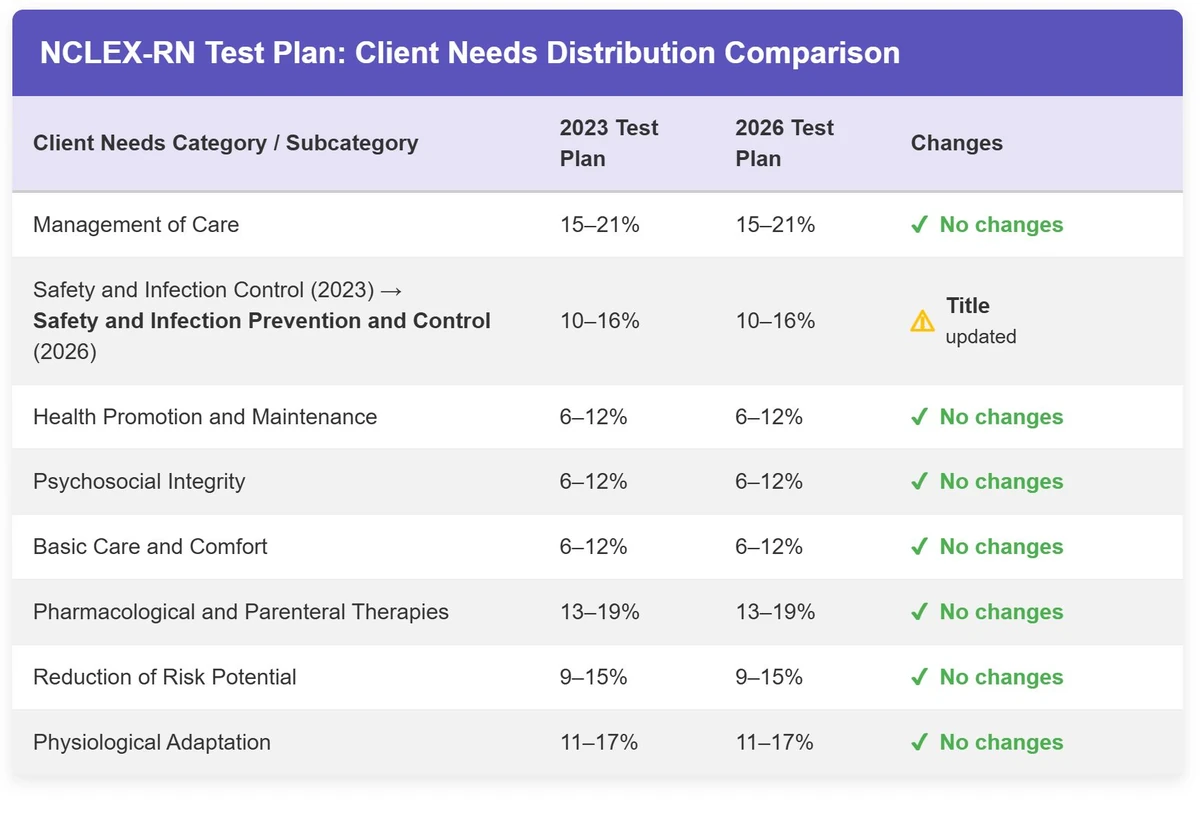
A new NCLEX-RN test plan took effect on 1 April 2026. It was approved at NCSBN’s Annual Meeting in August 2025 following practice-analysis and standard-setting work that continued through September 2025. The passing standard, item types and content categories remain in place through 31 March 2029. The changes include modest shifts in emphasis and terminology updates, such as “Safety and Infection Prevention and Control,” rather than a complete redesign of the examination.
-
National first-time pass rates for the NCLEX-RN have generally remained in the mid-to-high 80s in recent reporting periods. First-time, US-educated candidates recorded pass rates of around 87 to 88% in 2025, following higher rates in 2023 and 2024. Repeat test-takers passed at roughly half that rate.
-
Pass rates declined in Q1 2025 compared with Q1 2024 across several candidate categories. The decline was most noticeable among repeat test-takers and internationally educated candidates. NCSBN and independent nurse educators linked this to preparation for Next Generation NCLEX item formats rather than a fundamental increase in examination difficulty. First-time, US-educated candidates continued to pass at well above 85% during the decline.
These figures should be checked against the latest NCSBN reports before publication because pass rates and test-plan information are updated over time.
When a preparation company advertises a pass rate, such as “98%” or “99%+,” consider the following:
-
How many candidates were included?
-
Were they first-time or repeat test-takers?
-
Were all enrolled students included?
-
Was the data independently reviewed?
-
What period does the figure cover?
-
How does the result compare with national NCSBN data?
A pass rate that matches the national average does not prove that a product caused the result. A rate far above the national average is difficult to evaluate if the company does not disclose its sample, methodology or limitations.
Step 4: Understand What Research Says About NCLEX Readiness
Quick answer: independent research does not rank major NCLEX preparation brands.
However, the research discussed below supports the use of validated academic and readiness measures when assessing the likelihood of NCLEX success.
The following studies were identified as relevant:
-
A 2022 study in Nursing Education Perspectives, involving 92 BSN students, found that a science GPA above 3.50 and an ATI score of 60 or higher were strong predictors of first-time NCLEX-RN success. Kaplan diagnostic scores of 50 or higher and HESI scores of 950 or higher were also associated with passing.
-
A 2018 case study in the Journal of Nursing Regulation described a Pennsylvania nursing programme that increased its first-time NCLEX-RN pass rate from 64.86% to 94.29% over three years. This represented a 45% relative increase. The improvement was linked to admissions and progression policy changes, curriculum revision and faculty development rather than a change in preparation vendor.
-
A 2024 retrospective matched-cohort study involving 136 students, published in the Journal of Nursing Regulation, found that higher RN Fundamentals and Comprehensive ATI scores significantly increased the odds of passing.
-
Wolters Kluwer’s published validity study included more than 1,100 students across 23 nursing programmes. It found that students scoring 70% or higher on its Clinical Judgment Readiness Exam had a 99% likelihood of passing the NCLEX-RN on the first attempt. Some Wolters Kluwer products present this as a scaled score of 84%, so check which scale your platform uses before comparing results.
These findings support the value of validated readiness measures. They do not establish that one commercial Qbank is superior to another or that a readiness score guarantees an individual result.
The practical lesson is simple: Use your readiness data to identify what you need to improve. Do not choose a resource based only on brand popularity.
This principle may also help NCLEX-PN candidates, although the studies discussed above focus mainly on RN cohorts.
Your nursing programme matters here too. BSN, BScN and comparable curricula at established schools, including Johns Hopkins School of Nursing, Duke University School of Nursing and the University of Pennsylvania School of Nursing in the US, the Lawrence S. Bloomberg Faculty of Nursing at the University of Toronto and the UBC School of Nursing in Canada, and the University of Sydney’s Susan Wakil School of Nursing and Midwifery in Australia, build the foundational knowledge a Qbank then drills and tests. Check what predictive assessment your own programme already uses before assuming you need an entirely separate one.
Step 5: Use Student Experiences Carefully
Unpaid discussions on allnurses.com and Reddit’s r/NCLEX can provide useful insight into how candidates experience different resources.
However, these discussions are anecdotal, self-selected and not controlled research. They cannot show which product produces the highest pass rate.
Recurring themes include:
-
Candidates often describe combining a Qbank with a separate content-review resource.
-
Archer’s scoring curve is sometimes described as easier than UWorld’s for candidates with similar underlying readiness.
-
Some candidates report that UWorld questions feel more difficult than the actual NCLEX. Some find this discouraging early in their preparation, while others value the challenge.
These experiences may help you understand how a platform feels to users, but they should not be treated as proof that one resource is objectively better.
If you need help retaining a large volume of nursing content, our guide to nursing exam memorisation techniques explains how to use spaced repetition, active recall and mnemonics alongside your Qbank.
Step 6: Match the Resource to Your Learning Needs
Once you have confirmed your examination, reviewed official information and assessed your readiness, choose a resource based on the support you need.
Then consider the following:
1. Do you want challenging questions with detailed rationales?
UWorld is widely known for detailed explanations and challenging practice questions. It may suit candidates who learn by carefully reviewing why each option is correct or incorrect.
2. Do you need structured teaching and test-taking strategies?
Kaplan is known for structured review and decision-making approaches. It may suit candidates who want guidance on how to interpret questions and prioritise answers.
3. Do you want a lower-cost Qbank with CAT-style practice?
Archer Review is frequently selected by candidates seeking a large question bank and readiness assessments at a lower price.
Review the quality of your rationales and use your performance data to identify knowledge gaps rather than focusing only on percentage scores.
4. Do you learn best through videos and memory techniques?
SimpleNursing uses video-based teaching and mnemonic approaches. It may suit visual learners who need content review before completing large volumes of practice questions.
5. Are you interested in AI-supported learning?
GoodNurse offers AI-driven and interactive learning features. Independent evidence comparing its effectiveness with established NCLEX resources is still developing, so review the platform’s current features and evidence before purchasing.
6. Do you need individual support?
Some candidates understand what they are getting wrong but cannot identify why. In that situation, structured 1:1 NCLEX exam coaching may help you:
-
Interpret readiness results
-
Identify recurring clinical reasoning errors
-
Build a realistic study plan
-
Improve question analysis
-
Prepare for difficult NGN item types
Coaching should support your learning and clinical reasoning. It should not replace independent study or consistent question practice.
NCLEX Preparation Resource Comparison
|
Resource |
Best for |
Strengths |
Considerations |
|
UWorld |
Intensive practice |
Detailed rationales, challenging questions |
Higher cost |
|
Archer Review |
Budget-conscious learners |
Large question bank, readiness assessments |
Review rationales carefully |
|
Kaplan |
Students needing structure |
Test-taking strategies |
Depends on learning preference |
|
SimpleNursing |
Visual learners |
Video explanations, memory techniques |
Needs question practice alongside it |
|
AI NCLEX tools, including GoodNurse |
Students exploring adaptive learning |
Personalised practice |
Independent evidence is still developing |
The table is a starting point, not a ranking. The best choice depends on your learning needs and the features available when you purchase.
What Nurses Ask Before Choosing an NCLEX Prep Resource
“My programme already uses ATI or Kaplan diagnostics. Do I still need a separate Qbank?”
Usually, you may still need additional question practice. However, check what your programme’s diagnostic already measures.
Buying a second predictive examination that provides the same information as your ATI or HESI result may be an avoidable expense. A separate Qbank may be useful when you need more practice volume, different question styles or additional rationales.
“I’m a repeat test-taker. Does the advice change?”
The difference between first-time and repeat pass rates is large and persistent. A readiness assessment may be especially useful after an unsuccessful attempt. Identify the content areas, clinical reasoning errors or item types that affected your performance before choosing another resource.
Do not automatically repeat the same study plan. Use your previous results to identify what needs to change.
Common Mistakes in NCLEX Preparation
-
Choosing a Qbank based only on a “best of 2026” list without checking who published it.
-
Comparing raw percentage scores across different platforms without understanding their scoring methods.
-
Treating an advertised pass rate as proof that a product caused the result.
-
Buying several resources before identifying your knowledge gaps.
-
Relying on content review without completing enough practice questions.
-
Completing questions without reviewing the rationales.
-
Skipping a validated readiness assessment and relying only on confidence or anxiety.
More resources do not automatically mean better preparation. A focused plan that you follow consistently is often more useful than several subscriptions you rarely use.
Get Help Choosing Your NCLEX Preparation Resource
Choosing a Qbank is only the first step. Knowing what your scores mean and deciding whether you are ready can be more difficult.
UKNurses’ NCLEX coaching team provides 1:1 support with:
-
Resource selection
-
Readiness-score interpretation
-
Study planning
-
Clinical reasoning
-
Examination strategy
Book a free 30-minute consultation to discuss your preparation needs and identify the support that may be most useful.
Your goal is not to collect the most popular resources. Your goal is to understand the content, strengthen your clinical judgement and enter the examination with evidence that you are ready.
Frequently Asked Questions on Choosing an NCLEX-RN or NCLEX-PN Prep Resource
1.What is the difference between the NCLEX-RN and NCLEX-PN?
The NCLEX-RN is the licensure examination for Registered Nurses. It is required by every US state board and used by nursing regulators across most of Canada. The NCLEX-PN is used in the United States for LPN or LVN licensure. Both examinations are developed and administered by NCSBN and use computer-adaptive testing. However, they assess different scopes of practice.
2. Do I take the NCLEX-PN if I want to become a practical nurse in Canada?
No. Ontario and British Columbia use the REx-PN for RPN or LPN licensure. Alberta continues to use the CPNRE. Requirements differ between provinces. Confirm the current examination directly with the regulator responsible for your intended registration before choosing a preparation resource.
3. Does paying for NCLEX preparation improve my chances of passing?
Structured NCLEX preparation and targeted practice may improve readiness, especially when they include consistent study, feedback and focused review.
A 2023 SAGE study found that structured NCLEX preparation and targeted practice were associated with stronger examination readiness and improved passing outcomes. However, an association does not prove that paying for a specific commercial resource causes a higher pass rate. No preparation product can guarantee success.
4. Do Australian nursing graduates sit the NCLEX?
Generally, no. Most Australian-trained graduates register through AHPRA and the Nursing and Midwifery Board of Australia’s standard accredited-programme pathway. The NCLEX-RN is used within the Outcome-Based Assessment pathway for internationally qualified nurses.
5. Can I sit the NCLEX if I trained outside the United States, Canada or Australia?
Yes. The NCLEX-RN is available through Pearson VUE test centres in several countries for candidates pursuing US or Canadian licensure. Eligibility depends on your intended regulator and may involve credential evaluation through an approved organisation, such as CGFNS, NNAS or WES. See our nursing registration pathways guide if you are comparing this route with registration in the UK, Australia or New Zealand.
6. Which NCLEX preparation resource has the highest pass rate?
No major preparation company’s pass-rate claim can currently be compared using a single independent and consistently disclosed methodology. Compare advertised figures with NCSBN’s national data. First-time, US-educated candidates have recorded pass rates of roughly 85 to 91% across recent years. Do not assess a pass-rate claim without knowing the sample size, candidate group, time period and method used to calculate it.
7. Is UWorld or Archer better for NCLEX preparation?
Neither has been shown to be superior through independent comparative research. UWorld is known for challenging questions and detailed rationales. Archer is frequently selected as a lower-cost Qbank with CAT-style simulations and readiness assessments. The better choice depends on whether you need detailed rationale review, practice volume, affordability, CAT-style testing or a combination of these features.
8. Do I need more than one NCLEX preparation resource?
Not necessarily. Some candidates combine a Qbank with a separate content-review resource. However, using multiple resources is not a requirement for passing. Start with one resource that addresses your main need. Add another only if you can identify a clear gap that the first resource does not cover.
9. How do I know if I am ready to sit the NCLEX?
Use a validated readiness assessment or predictive score from your programme or preparation platform rather than relying only on how confident you feel. Research links validated academic and readiness measures with first-attempt NCLEX outcomes. Review your readiness result alongside your performance by content area, clinical judgement skill and question type. One score should inform your decision, not replace professional judgement or regulatory requirements. For active-recall strategies you can use immediately, read our guide to nursing exam memorisation techniques.
Keep Reading
-
Nursing exam memorisation techniques: recall methods to use alongside your chosen preparation resource.
-
Nursing registration pathways 2026: UK, Australia and New Zealand: confirm your route before spending money on examination preparation.
-
UKNurses free NCLEX study resources: a low-stakes way to assess your current knowledge.
-
1:1 NCLEX exam coaching: structured support when you know what you are getting wrong but cannot identify why.