Take a breath.
If you've spent the last few weeks scrolling nursing forums and watching people panic about "the new NCLEX," we get it. Every test plan cycle does this. Someone posts a scary headline, and within a day half of your cohort is convinced they need to start over.
They don't. And neither do you.
We read the entire 2026 NCLEX-RN® and NCLEX-PN® Test Plans, pulled the primary source documents straight from NCSBN, and cross-checked every claim in this article against them.
Here's the honest version: the exam that came into effect on April 1, 2026 isn't a completely new exam. It's the same exam, sharpened. Once you understand exactly where it sharpened, you'll know precisely where to focus your remaining study hours.
That's the purpose of this guide. Not to overwhelm you. To show you exactly what matters.
Key Takeaways
Here's everything you need to know in sixty seconds:
-
-
-
-
Effective date: April 1, 2026, for both NCLEX-RN and NCLEX-PN.
-
Approved: August 13 to 15, 2025, following the 2024 RN and PN Practice Analyses.
-
Structure: unchanged. Same client needs categories, weighting ranges, clinical judgment measurement model, item types, scoring rules and CAT format.
-
What changed: updated activity statements, one renamed category and stronger emphasis on unbiased, equitable care.
-
What it means: the exam now rewards candidates who can prioritise, delegate and think through multiple clinical problems more effectively.
-
-
-
If you only remember one sentence from this guide, make it this: You are not starting over. You're simply fine-tuning your clinical judgment.
2026 NCLEX at a Glance
|
Feature |
2026 Update |
|
Effective Date |
1 April 2026 |
|
Exam Format |
No change |
|
Computer Adaptive Testing |
No change |
|
Next Generation Item Types |
No change |
|
Clinical Judgment Model |
No change |
|
Client Needs Categories |
Same structure |
|
Biggest Update |
Sharper emphasis on prioritisation, delegation and equitable care |
2023 vs 2026 NCLEX: What's Different?
|
Area |
2023 |
2026 |
|
Overall Exam Structure |
Same |
No change |
|
CAT Format |
Same |
No change |
|
NGN Item Types |
Introduced |
Retained |
|
Clinical Judgment Measurement Model |
Yes |
Unchanged |
|
Activity Statements |
Previous wording |
Updated to reflect current nursing practice |
|
Safety Category |
Safety and Infection Control |
Safety and Infection Prevention and Control |
|
Equity Language |
Limited |
Greater emphasis on unbiased and equitable care |
What Hasn't Changed
Before you touch another flashcard or rewrite your study plan, let's start with the good news.
Most of the exam hasn't changed.
The Clinical Judgement Measurement Model Still Runs the Whole Exam
The Clinical Judgement Measurement Model (CJMM) remains the framework behind every Next Generation NCLEX case study.
Recognise Cues
↓
Analyse Cues
↓
Prioritise Hypotheses
↓
Generate Solutions
↓
Take Action
↓
Evaluate Outcomes
Think of this as the decision-making pathway the NCLEX wants to see every time you answer a case study. Even when questions look different, the thinking process remains exactly the same.
Coach's Insight: Candidates often ask whether they should learn a "new" clinical judgment model for 2026. The answer is no. Mastering the existing CJMM is still one of the highest-return study strategies you can invest in.
The Blueprint Didn’t Move
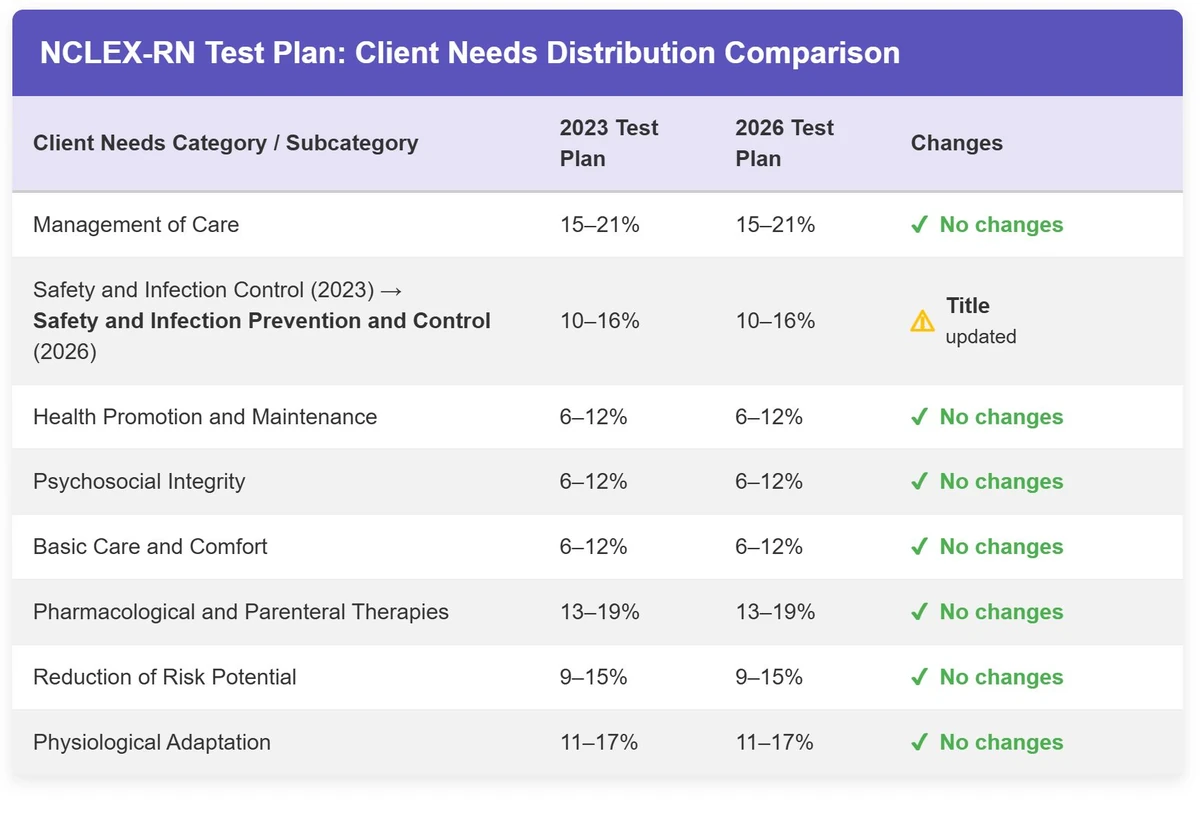
The four Client Needs categories remain exactly where they've been.
Physiological Integrity still carries the greatest weighting.
The computer-adaptive testing format hasn't changed.
Neither have the scoring methods:
-
0/1 Scoring
-
Plus/Minus Scoring
-
Rationale Scoring
So, if you've been studying using the 2023 blueprint, none of that work has been wasted.
What this means: You don't need new textbooks simply because the calendar changed to 2026. Most quality NCLEX resources published after the introduction of the Next Generation NCLEX remain relevant.
The Three-Year Review Cycle Is Completely Normal
Every three years, NCSBN reviews how newly licensed nurses actually practice during their first six months on the job.
Those findings become the next NCLEX Test Plan.
The 2026 revision comes directly from the 2024 RN and PN Practice Analyses. It's part of NCSBN's normal review cycle rather than a complete redesign of the examination.
Understanding this helps separate genuine updates from social media rumours that appear every testing cycle.
What Actually Changed
Here's where your attention should shift.
NCSBN didn't introduce entirely new content.
Instead, it refined how entry-level nursing competence is described and assessed, placing greater emphasis on prioritisation, delegation and decision-making in realistic clinical situations.
1. Activity Statements Now Reflect Real Clinical Practice
Activity statements describe the competencies behind every Client Needs category.
One example from the 2026 RN Test Plan reads: "Identify and collaborate with multidisciplinary team members when providing client care."
Earlier versions focused mainly on collaboration.
The updated wording expects you to first recognise which healthcare professionals should be involved before working with them.
That single addition reflects the broader direction of the 2026 update. Rather than asking whether you know information, the exam increasingly asks whether you can apply it in the correct clinical context.
Coach's Insight: When practicing case studies, don't jump straight to interventions. Pause first and ask yourself: "Who else needs to be involved?" That extra step mirrors how many 2026 questions are now framed.
2. One Category Received a New Name
Safety and Infection Control has become Safety and Infection Prevention and Control.
Although the wording change looks minor, it reflects a broader focus on preventing harm before it occurs rather than simply responding after something goes wrong.
What this means: Expect more scenarios where recognising early risk is just as important as managing an existing emergency.
3. Equity Is Now Woven Throughout the Exam
The updated Test Plan includes stronger language around providing unbiased, equitable care regardless of a client's:
-
Culture
-
Ethnicity
-
Sexual orientation
-
Gender identity
-
Gender expression
Rather than appearing in one isolated question, these concepts may now appear naturally across multiple case studies.
Coach's Insight: The NCLEX isn't testing political opinions. It's assessing whether every patient receives safe, professional nursing care regardless of background.
4. The Language Sounds More Like Today’s Workplace
Across the Test Plan, NCSBN updated wording to better match modern nursing practice.
Many older phrases have been replaced with terminology nurses actually use in hospitals and community settings today.
The clinical expectations remain the same. The language simply reflects current practice more accurately.
2026 NCLEX At A Glance
Coach's insight: The biggest mistake candidates are making is studying as though this is a brand-new exam. It isn't. Almost everything that helped candidates pass under the 2023 Test Plan still works. The difference is that the 2026 Test Plan expects you to apply that knowledge under greater clinical complexity.
|
Feature |
2023 Test Plan |
2026 Test Plan |
|
Effective date |
April 2023 |
April 1, 2026 |
|
Clinical Judgement Measurement Model |
✔ |
✔ No change |
|
Computer Adaptive Testing |
✔ |
✔ No change |
|
NGN item types |
✔ |
✔ No change |
|
Client Needs categories |
✔ |
✔ Same categories |
|
Clinical judgement scoring |
✔ |
✔ Same scoring |
|
Major focus |
Clinical judgement |
Clinical judgement with a stronger emphasis on prioritisation, prevention and equitable care |
What This Means
If you've already been preparing for the NGN NCLEX, you are not behind. You simply need to sharpen your ability to prioritise, delegate and adapt when patient conditions change.
Case Studies
Multi-client, multi-step case studies are where clinical judgement gets tested for real because they recreate the exact pressure you'll feel on your first real shift. The programmes and candidates adapting well aren't starting from zero. They're layering complexity onto what already works:
-
Adding a second or third client into an existing scenario
-
Practicing reprioritisation mid-case as new data appears
-
Building delegation decisions into direct care tasks
-
Simulating a client who begins to deteriorate in real time
-
Adding interruptions or competing demands mid-scenario
-
Reassessing the plan of care as new findings emerge
-
Sequencing interventions by clinical urgency, not textbook order
What This Means
If your practice questions only ever present one stable patient with a straightforward outcome, they are no longer reflecting the complexity you'll face on the current NCLEX. The strongest preparation now includes competing priorities, changing patient conditions, delegation decisions, and continuous reassessment. Instead of asking, "What's the correct answer?" begin asking, "What would I do first, and why?" That's the thinking the exam is designed to reward.
If You're an Internationally Educated Nurse
We coach a lot of internationally educated nurses (IENs) here at UKNurses.net, and we know this exam carries weight beyond the test centre. It's the gate between where you are and the career, sometimes the country, you've been working toward for years. That pressure is real, and it deserves to be said out loud, not just studied through.
Here's the good news: the exam itself hasn't gotten harder for you specifically. It's the same exam, unchanged in structure, whether you trained in the UK, Ireland, the Philippines, Nigeria, India or anywhere else. No separate, tougher version exists for IENs.
A few things worth locking in as you prepare:
-
Credential evaluation still comes first. Most US Boards of Nursing require a credentials evaluation, commonly through TruMerit (formerly CGFNS), before you can register.
-
English proficiency requirements remain unchanged. IELTS, OET, PTE Academic and TOEFL iBT are still the most common pathways, although some boards waive this requirement if you completed your nursing education in English.
-
Canada follows a different pathway. If you're planning to work there, you'll usually complete an assessment through the National Nursing Assessment Service (NNAS) before applying to your provincial regulator.
The biggest adjustment for many internationally educated nurses isn't clinical knowledge. It's adapting to how the NCLEX asks questions. In many countries, nursing education focuses on performing procedures correctly. The NCLEX assumes you already know how to perform them. Instead, it asks whether you can prioritise care, delegate appropriately, recognise deterioration early, and justify your clinical decisions.
This is why candidates who were excellent nurses in their home country sometimes struggle on their first attempt. They're answering from experience rather than from the decision-making framework the NCLEX expects. Once that shift happens, scores usually improve dramatically.
If English isn't your first language, don't underestimate the role of communication. Many incorrect answers aren't caused by clinical knowledge gaps but by misunderstanding subtle wording, qualifiers like "best," "priority," or "most appropriate," or overlooking one small detail in a lengthy case study. Learning to slow down and identify exactly what the question is asking is just as important as learning the clinical content.
If you're still working through your registration pathway, these guides can help:
-
Read: OET vs IELTS for Nurses to understand which English language test best fits your registration pathway.
-
Planning to work in England first? Our guide on NMC Registration for Overseas Nurses explains every step from eligibility to registration.
-
If you're considering Australia or New Zealand as alternatives, our articles on Nursing Qualifications in New Zealand.
No matter where you trained, remember this: the NCLEX isn't testing where you learned nursing. It's testing whether you can think like an entry-level nurse practicing safely in North America. That's a skill you can build with deliberate practice.
Where to Sit the Exam
You don't have to fly to the United States to take the NCLEX. Pearson VUE operates authorised international testing centres across multiple countries, making it possible for many candidates to sit the exam closer to home.
International testing locations include cities such as:
-
Sydney
-
Melbourne
-
Adelaide
-
Canberra
-
London
-
Manchester
-
Hong Kong
-
Manila
-
Tokyo
-
Johannesburg
-
New Delhi
-
Dubai
Testing centre availability varies throughout the year, so it's worth booking early if you're working toward a specific registration timeline or job offer. Some international centres fill several weeks in advance, particularly during peak graduate recruitment periods.
Before scheduling your exam, confirm that your chosen Board of Nursing has issued your Authorisation to Test (ATT). Without it, you won't be able to book an appointment, regardless of location.
Use the official NCLEX Testing Locations directory to find your nearest Pearson VUE centre, check availability and book your appointment.
Test Prep Resources
Reading the test plan is important. Practising how to think under exam conditions is what moves most candidates from "almost ready" to "ready".
The strongest preparation combines three things:
-
A structured question bank to strengthen clinical knowledge.
-
Case studies that force you to prioritise, delegate and reassess.
-
Feedback from someone who can identify why you chose the wrong answer, not simply tell you it was incorrect.
Two of the most widely used question banks include:
-
Kaplan NCLEX Prep, known for its Decision Tree strategy and readiness assessments.
-
UWorld NCLEX-RN QBank, recognised for detailed rationales and Next Generation NCLEX-style case studies.
Neither resource replaces deliberate practice. Candidates who improve the fastest review every incorrect answer, identify the reasoning error behind it, and then repeat similar questions until the decision-making process becomes automatic.
Instead of asking, "Did I get this question right?", ask:
-
What cue did I miss?
-
Why was my priority different from the examiner's?
-
What would make me recognise this situation faster next time?
Coach's Insight: The candidates who pass comfortably rarely complete the most questions. They spend more time reviewing their mistakes than answering new ones. One well-analysed case study teaches more than twenty questions rushed without reflection.
Enhanced Self-Audit
Before your exam, ask yourself these questions honestly.
✔ Can you prioritise care when two or three clients deteriorate at the same time?
✔ Can you explain why one intervention comes before another?
✔ Do you reassess after every intervention instead of assuming it worked?
✔ Can you justify delegation decisions using scope of practice?
✔ Are you comfortable changing your plan when new information appears?
✔ Can you recognise subtle deterioration before obvious emergency signs develop?
✔ Do you consistently identify the safest immediate action instead of simply the first available intervention?
✔ Are you comfortable caring for clients from different cultural, social and communication backgrounds?
If you answered "not yet" to several of these questions, don't panic. The 2026 NCLEX is designed to assess clinical judgement, and clinical judgement improves through deliberate practice, not memorisation. Knowing where your weaknesses are is the first step towards fixing them.
Life After Licensure
Passing the NCLEX opens far more than your first nursing job.
For many internationally educated nurses, it is the beginning of a long-term career that includes specialist practice, postgraduate education, leadership positions and international opportunities.
Once you're licensed, your focus shifts from passing an exam to building experience that supports future promotions, speciality certifications and advanced practice roles.
If career progression is already on your mind, these guides are worth reading next:
Whether your long-term goal is becoming a Clinical Nurse Specialist, Nurse Practitioner, Nurse Manager or educator, the habits that help you pass the NCLEX, prioritisation, communication and sound clinical judgement remain the foundation of your career.
The Bigger Picture
The 2026 NCLEX Test Plan is not asking you to become a different nurse.
It's asking you to demonstrate the judgement expected from a newly licensed nurse who can recognise what matters, decide what comes first and keep patients safe when several things happen at once.
The structure hasn't changed.
The blueprint hasn't changed.
The scoring hasn't changed.
What has changed is the expectation that you think like a practising nurse instead of someone answering textbook questions.
That's encouraging news because clinical judgement isn't something you memorise. It's something you build, practise and strengthen every time you work through a realistic patient scenario.
Ready to Take the Next Step?
Whether your NCLEX exam is still months away or just around the corner, preparing strategically will always outperform simply studying longer. The 2026 NCLEX isn't asking you to memorise more. It's asking you to think like a newly licensed nurse who can prioritise confidently, make safe clinical decisions and adapt when patient conditions change.
Every case study you complete, every rationale you review and every prioritisation decision you practise brings you one step closer to passing on your first attempt.
If you're unsure what to study next, finding clinical judgement questions challenging or looking for a more structured approach, UKNurses supports internationally educated nurses preparing for the NCLEX, NMC CBT, OSCE, NCNZ and AHPRA registration. Our coaching focuses on the clinical reasoning and decision-making skills these exams are designed to assess.
Explore our NCLEX, CBT, OSCE, AHPRA and international nursing resources to build a study plan that reflects how these exams are actually assessed. And if you're ready to stop guessing and start preparing with confidence, talk to a UKNurses coach about building case-based, multi-client practice into your next study block.
Your registration journey doesn't end with passing one exam. That's where your nursing career truly begins.
Frequently Asked Questions
-
Is the 2026 NCLEX a completely new exam?
No. The 2026 NCLEX is an updated test plan, not a redesigned exam. The computer-adaptive format, Client Needs categories, Clinical Judgment Measurement Model (CJMM), scoring methods and question types remain the same. The updates mainly refine competency statements and place greater emphasis on prioritisation, delegation and equitable care.
-
What changed in the 2026 NCLEX?
The biggest changes include updated activity statements, a renamed Safety and Infection Prevention and Control category, stronger language around unbiased and equitable care, and greater emphasis on recognising priorities in complex clinical situations. The exam structure itself has not changed.
-
Is the Clinical Judgement Measurement Model (CJMM) still used?
Yes. The CJMM remains the foundation of the NCLEX. Candidates are still expected to recognise cues, analyse findings, prioritise hypotheses, generate solutions, take action and evaluate outcomes throughout case studies and standalone questions.
-
Do internationally educated nurses take a different NCLEX?
No. Every candidate sits the same NCLEX-RN or NCLEX-PN regardless of where they trained. International nurses may have additional registration requirements, such as credential evaluation or English language testing, but the examination itself is identical.
-
Can I take the NCLEX outside the United States?
Yes. Pearson VUE operates authorised international testing centres in several countries, including Australia, the United Kingdom, India, the Philippines, South Africa, Japan and many others.
-
Should I change my study plan because of the 2026 updates?
Probably not. Most candidates do not need to start over. Instead, focus on strengthening clinical judgement, prioritisation, delegation, patient safety and multi-client case studies while continuing to review core nursing knowledge.
-
Which question banks are best for the NCLEX?
Kaplan and UWorld remain two of the most widely used preparation resources. The most effective approach combines high-quality question banks with structured review, case-based practice and detailed feedback on your clinical reasoning.
-
How often does the NCLEX test plan change?
The National Council of State Boards of Nursing (NCSBN) reviews and updates the NCLEX Test Plan approximately every three years using nationwide nursing practice analyses to ensure the exam reflects current entry-level nursing practice.
Sources
-
NCLEX-RN Test Plan, Effective April 2026. National Council of State Boards of Nursing (NCSBN). https://www.nclex.com/files/2026_RN_Test%20Plan_English-F.pdf
-
2024 RN and PN Practice Analyses. National Council of State Boards of Nursing (NCSBN). https://www.ncsbn.org/resources.page?year=&audience=&topic=nclex-exam&knownet=&type=&page=2
-
2026 NCLEX-RN Test Plan. National Council of State Boards of Nursing (NCSBN). https://www.ncsbn.org/publications/2026-nclex-rn-test-plan
-
2026 NCLEX-PN Test Plan. National Council of State Boards of Nursing (NCSBN). https://www.ncsbn.org/publications/2026-nclex-pn-test-plan
-
NCSBN Annual Meeting 2025 Exams Update, confirming the renamed Safety and Infection Prevention and Control category and updates incorporated into the 2026 RN Test Plan.
-
2026 NCLEX-RN Test Plan, activity statements on unbiased and equitable care. National Council of State Boards of Nursing (NCSBN). https://www.nclex.com/files/2026_RN_Test%20Plan_English-F.pdf
-
NCLEX Testing Locations. National Council of State Boards of Nursing (NCSBN). https://www.nclex.com/testing-locations.page