One thing we've noticed at UKNurses is first-year nursing students often ask the same question after a few weeks:
"Why didn't anyone tell me it would be like this?"
Not because they regret choosing nursing. Quite the opposite. They simply discover that the reality of first year looks very different from the university prospectus.
The brochures tell you about lectures, placements and graduating as a registered nurse. But they rarely tell you that your first placement can feel overwhelming, that drug calculations demand absolute accuracy, or reflective writing is an academic skill you have to learn like any other clinical competency.
That's what this guide is for.
Over the years, we've supported nursing students through assignments, placements, exams and those moments when confidence is lacking. One thing is clear: the students who settle in fastest are not always the smartest. They are the ones who know what to expect.
I'll walk you through what your first year of a nursing degree in the UK really looks like, from the classroom to clinical placement, the challenges that catch most students off guard and how to prepare for them before they become obstacles.
First Year: What It Actually Looks Like
UK nursing degrees run on a split model. You alternate between theory blocks at university and clinical placement in NHS settings, care homes and community services. You are not in lectures five days a week and the clinical hours are not optional extras.
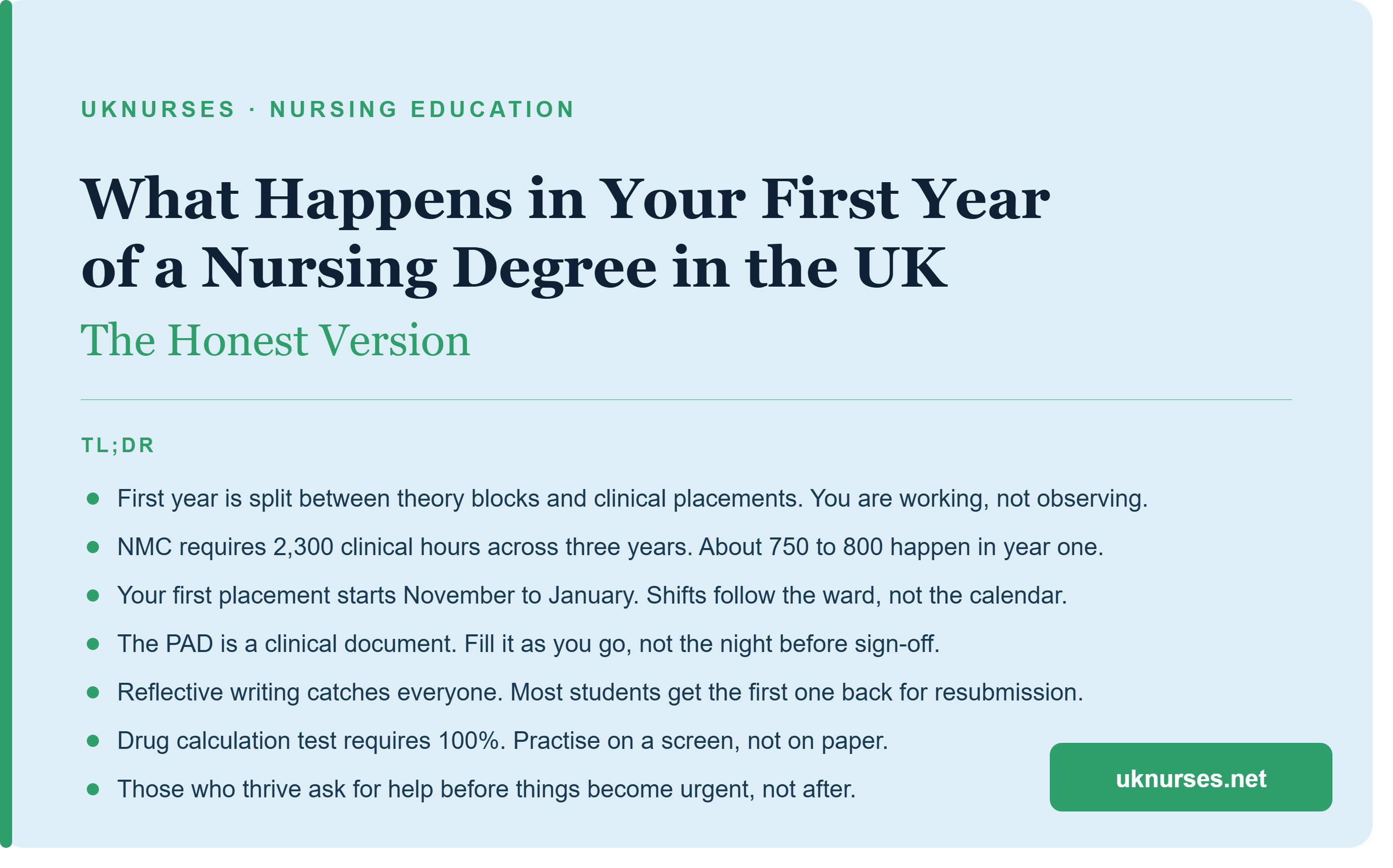
The NMC requires 2,300 clinical hours across the full three-year degree, which means roughly 750 to 800 hours in year one alone. So, in the first year, you are not observing, you are working.
For most September starters, the year breaks down like this:
|
Period |
What Is Happening |
|
September to October |
Induction, theory blocks, clinical skills lab |
|
November to January |
First clinical placement |
|
January to March |
Return to university, first assignments due |
|
March to May |
Second placement block |
|
May to June |
Exams, portfolio submissions, reflection deadlines |
Your shifts follow the ward pattern, not the university timetable. Early starts, late finishes, weekends and bank holidays.
For instance, The University of Sunderland confirms placement weeks run up to 37.5 hours, with shifts between 7 and 12 hours confirmed four weeks in advance.
Also, according to Sheffield Hallam, once placement starts, the ward timetable becomes your timetable. Expect early shifts, late shifts, weekends and, in some settings, nights. You learn around patient care, not lectures or convenience. Your placement provider allocates your shifts and you're expected to attend them because that's how practice learning works.
Neither university is being unkind, they are describing clinical nursing.
So if you have a family, sort your childcare before the allocation letter arrives, not after.
If you are heading to Australia, the structure looks different but the intensity does not. Deakin University in Victoria starts placements in Trimester 1 of first year, which means students enter clinical environments earlier and more consistently than the UK semester model typically allows. Deakin confirms 800 total placement hours across the degree, with metropolitan, regional and rural settings all possible from the start. Less settling-in time, faster exposure but the same accountability.
Read more: If you're still deciding whether nursing is the right path, start with our guide to the grades and entry requirements for nursing in the UK before diving into what happens after you enrol.
The First Placement: What Nobody Prepares You For
Here is what I have watched happen with almost every first-year student who comes through placement.
The first week, they shadow, sometimes looking for the sluice. They might even clean the utility room, treatment room and emergency trolley before the shift gets busy.
They try to remember how to take a manual blood pressure when someone is actually watching. They are helpful, diligent, but quietly overwhelmed.
By week three, most of them have found their rhythm.
Queen's University Belfast highlights this transition well. The real learning begins when you step onto placement. A clinical skills lab teaches you the skill. Placement teaches you how to use it when the ward is busy, priorities change every five minutes and patient care doesn't pause because you're still learning. That's why the first placement feels like such a leap.
Common first-year placements include:
-
Medical wards
-
Surgical wards
-
Community hospitals
-
Care homes
-
Community nursing teams
-
GP surgeries (depending on your field)
-
Hospices
-
Schools
The setting matters far less than how you approach it. Whether you're on a busy surgical ward or in a community clinic, your practice assessor is not expecting competence on day one. They are looking for someone who is safe, willing to learn and honest about what they do and do not know.
That means asking questions before you act and saying clearly when you've never performed a skill before. Nobody expects you to arrive knowing everything. However, they do expect you to recognise your limits and ask for supervision when you need it.
I've watched capable students make life much harder for themselves simply because they were too embarrassed to admit they had never inserted a catheter. Instead of asking for guidance, they tried to muddle through. That is where confidence becomes dangerous and you end up making mistakes. Confidence is built by learning under supervision, not by pretending you've already mastered the skill.
Yet placement is only one part of the assessment. The paperwork carries just as much weight.
Your Practice Assessment Document (PAD) is the formal record of your progress. If a skill, discussion, or episode of care is not documented, it cannot be signed off later simply because you remember doing it.
The University of Chester makes this expectation clear. Don't leave your PAD until the final week and expect your practice assessor to complete it retrospectively.
Similarly, the University of Surrey builds practice documentation into the programme from the very beginning because evidence should be recorded as your learning happens, not reconstructed at the end. Therefore, your assessor can only sign off what has been observed and documented.
A PAD that stays blank until the last Thursday of placement doesn't just create extra work. It creates unnecessary stress and can delay your progression.
If you're studying in Australia, the principle is exactly the same, even though the paperwork is different. Instead of a PAD, you'll complete clinical logbooks and NMBA competency records. Before placement even begins, universities such as Deakin also require compliance documents, including:
-
A police record check
-
A Working with Children Check
Miss those deadlines and your placement provider can refuse to accept you, regardless of how prepared you are clinically.
Therefore, treat your documentation with the same importance as your clinical skills. A missed signature, an incomplete PAD, or an overdue compliance check can hold you back just as quickly as poor performance on the ward.
Read More: One skill you'll use surprisingly early is SBAR. You may not lead every handover in your first year, but learning to communicate clearly and escalate concerns confidently will make placement much less intimidating.
Resource: Our Care Plan & Clinical Documentation coaching helps you master care plans, SBAR, reflective writing and professional documentation.
The Assignments: What You Are Actually Writing
First-year nursing assignments are not essays in the way you wrote them at A-level or college. They require evidence, academic referencing at a level most students have not worked at before and a type of critical analysis that looks deceptively simple until you try to do it.
You will typically submit four to six pieces across the year. These include:
-
A reflective account
-
An evidence-based essay linked to a clinical topic from placement
-
A case study or care plan analysis
-
A written communication assignment
Each assignment develops a different skill, but one stands out because it catches almost everyone off guard in first year: reflective writing.
The Reflective Writing Challenge
Reflective writing is not difficult because the language is complex. It is difficult because it asks you to think and write differently from anything you probably did at school.
You are:
-
Not writing a report
-
Not describing what happened on placement
-
Analysing how you felt
-
What you thought
-
What you would do differently
-
What the clinical evidence says about the situation you encountered.
Those are four different things happening simultaneously in the same piece of writing.
Most students write their first reflective essay as a detailed account of events. That is documentation, not reflection. It is also the primary reason first-year nursing essays come back for resubmission more than any other assignment type.
If your university uses Gibbs' Reflective Cycle, you'll work through description, feelings, evaluation, analysis, conclusion and an action plan.
Others use Driscoll's model with three simple questions: What? So what? Now what? Whichever framework you use, the challenge is the same: connecting your clinical experience to evidence. That takes practice.
If you're unsure where to start, UKNurses' specialist tutors can help you structure your first reflective assignment before you submit it, rather than after you're asked to resubmit.
The Drug Calculation Test: Do Not Walk Into This Unprepared
Most UK nursing programmes require 100% on the drug calculation assessment. Not 70%, or close enough. One hundred percent.
This is not designed to be punitive. Nobody on placement is going to say, "Your calculation was 90% right," because medication calculations are a patient safety issue. The same expectation carries into your training.
You'll be tested on oral doses, weight-based calculations, infusion rates and unit conversions. The maths is rarely the problem, the pressure is. Timed assessments have a habit of making familiar calculations suddenly feel unfamiliar.
So, start practising early. Do your calculations on a screen rather than paper so the format feels familiar by exam day. If one question is eating your time, move on and come back to it later. Rushing the final calculations because you spent six minutes on the first one is how avoidable mistakes happen.
Read More: Drug calculations do not disappear after the first year. They become even more important if you plan to work in the UK, where the same attention to safe medication practice carries through into the NMC CBT.
Practical Tips for Your First Year
-
Don't worry if week one feels overwhelming. Nobody knows exactly what they're doing, even the people who look completely confident. Some are simply better at hiding their nerves.
-
Don't panic if your first reflective essay comes back for resubmission. Reflective writing is a skill, not a talent. Almost everyone needs time to learn how to do it well.
-
Protect your sleep. A tired nurse misses details. A tired student makes the same kinds of mistakes in assignments, drug calculations and clinical judgement. Studying until 2am is rarely the smartest revision strategy.
-
Keep your PAD up to date. Treat it like any other clinical document. Complete it as you go instead of trying to reconstruct weeks of learning at the end of placement.
-
Ask for help early. The people who thrive in the first year are not the ones who struggle in silence. They are the ones who speak up before small problems become big ones.
Read More: Before long, you'll move from surviving the first year to thinking about placements, graduate jobs and interviews. Knowing how to present your experience well becomes another clinical skill in its own right.
Final Thoughts
The first year of a nursing degree is demanding because it is designed to change how you think, not just what you know.
You'll learn how to communicate under pressure, think critically, work safely within a team and connect classroom knowledge with real patient care. Some days you'll leave placement wondering whether you're cut out for nursing. Other days you'll realise you handled a difficult conversation, recognised a deteriorating patient, or completed a skill that felt impossible a few weeks earlier. That is how confidence is built.
Don't measure your progress against the most confident person in your cohort. Measure it against where you started. If you're asking questions, acting on feedback and turning up ready to learn, you're moving in the right direction.
If reflective writing, drug calculations, assignments, or placement documentation are the parts you're finding hardest, don't wait until you're close to a deadline or a placement sign-off to ask for help. Book a free consultation with a UKNurses specialist, bring the assignment or skill you're struggling with and you'll leave with a clear plan and practical guidance tailored to your programme.
First-Year Nursing FAQs
1. When does the first placement start in a UK nursing degree?
For September starters, first placements usually begin between November and January. Your university will confirm your specific timeline and shift allocations are typically confirmed four weeks before you start.
2. How many placement hours do you do in the first year?
The NMC requires 2,300 clinical hours across the full three-year degree. First year accounts for roughly 750 to 800 of those hours.
3. What happens if you fail the drug calculation test?
Most universities allow a resit, but the 100% pass mark requirement stays. If you fail beyond the allowed number of attempts, it may affect your progression. Check your university's specific policy and begin preparation early.
4. Can you fail first year of nursing?
Yes. Not meeting placement hours, failing assignments beyond the resit allowance, or not passing competency assessments can all result in failing the year. Support structures exist but work best when accessed before things become serious.
5. What is reflective writing in nursing?
Reflective writing asks you to analyse a clinical experience using a structured framework, typically Gibbs or Driscoll, engaging with both your personal responses and the relevant clinical evidence. It is not a description of events. It is a critical examination of what happened, what it meant and what it changes in your practice going forward.
6. Is first-year nursing hard?
Yes, honestly. The combination of placement hours, academic work, shift patterns and clinical environments is genuinely demanding. The students who do best are not always the most experienced. They are the ones who manage their time, ask for help before they need it badly and engage with feedback rather than avoiding it.
Sources
-
NMC | Standards for pre-registration nursing programmes. 2,300 practice hours minimum. nmc.org.uk/standards/standards-for-nurses
-
University of Sunderland | BSc (Hons) Adult Nursing Practice 2026/27. sunderland.ac.uk/undergraduate/bsc-hons-adult-nursing-practice
-
Sheffield Hallam University | BSc (Honours) Nursing (Adult) 2026. shu.ac.uk/courses/nursing-and-midwifery/bsc-honours-nursing-adult/full-time
-
Queen's University Belfast | The Unofficial Guide to Your First Ever Nursing Placement. qub.ac.uk/student-blog/studying-courses/nursing-placement-guide.html
-
University of Chester | Student Nurse on Placement: What You Need to Know. chester.ac.uk/about/news/articles/student-nurse-on-placement-what-you-need-to-know
-
University of Surrey | BSc Nursing Studies 2026. surrey.ac.uk/undergraduate/nursing-studies-registered-nurse-adult-nursing/2026
-
Deakin University | Bachelor of Nursing 2026. Trimester 1 placement commencement, 800 total hours. deakin.edu.au/course/bachelor-nursing
-
NMBA | Registered Nurse Standards for Practice. Standard 6. nursingmidwiferyboard.gov.au
-
Journal of Advanced Nursing | Student burnout in pre-registration nursing. 2021. onlinelibrary.wiley.com