2026 NCLEX Test Plan Updates: What Faculty and International Nurses Must Know
Take a breath.
If you've spent the last few weeks scrolling nursing forums and watching people panic about "the new NCLEX," we get it. Every test plan cycle does this. Someone posts a scary headline, and within a day half of your cohort is convinced they need to start over.
They don't. And neither do you.
We read the entire 2026 NCLEX-RN® and NCLEX-PN® Test Plans, pulled the primary source documents straight from NCSBN, and cross-checked every claim in this article against them. Here's the honest version: the exam that was in effect April 1, 2026 is not a new exam. It's the same exam, sharpened. And once you see exactly where it sharpened, you'll know precisely what to focus your remaining study hours or your curriculum hours on.
That's the whole point of this guide. Not to scare you. To hand you the map.
Key Takeway
Here's everything you need to know in sixty seconds:
Effective date: April 1, 2026, for both NCLEX-RN and NCLEX-PN <sup>[1]</sup>
Approved: August 13–15, 2025, at the NCSBN Annual Meeting, following the 2024 RN and PN Practice Analyses <sup>[2][3]</sup>
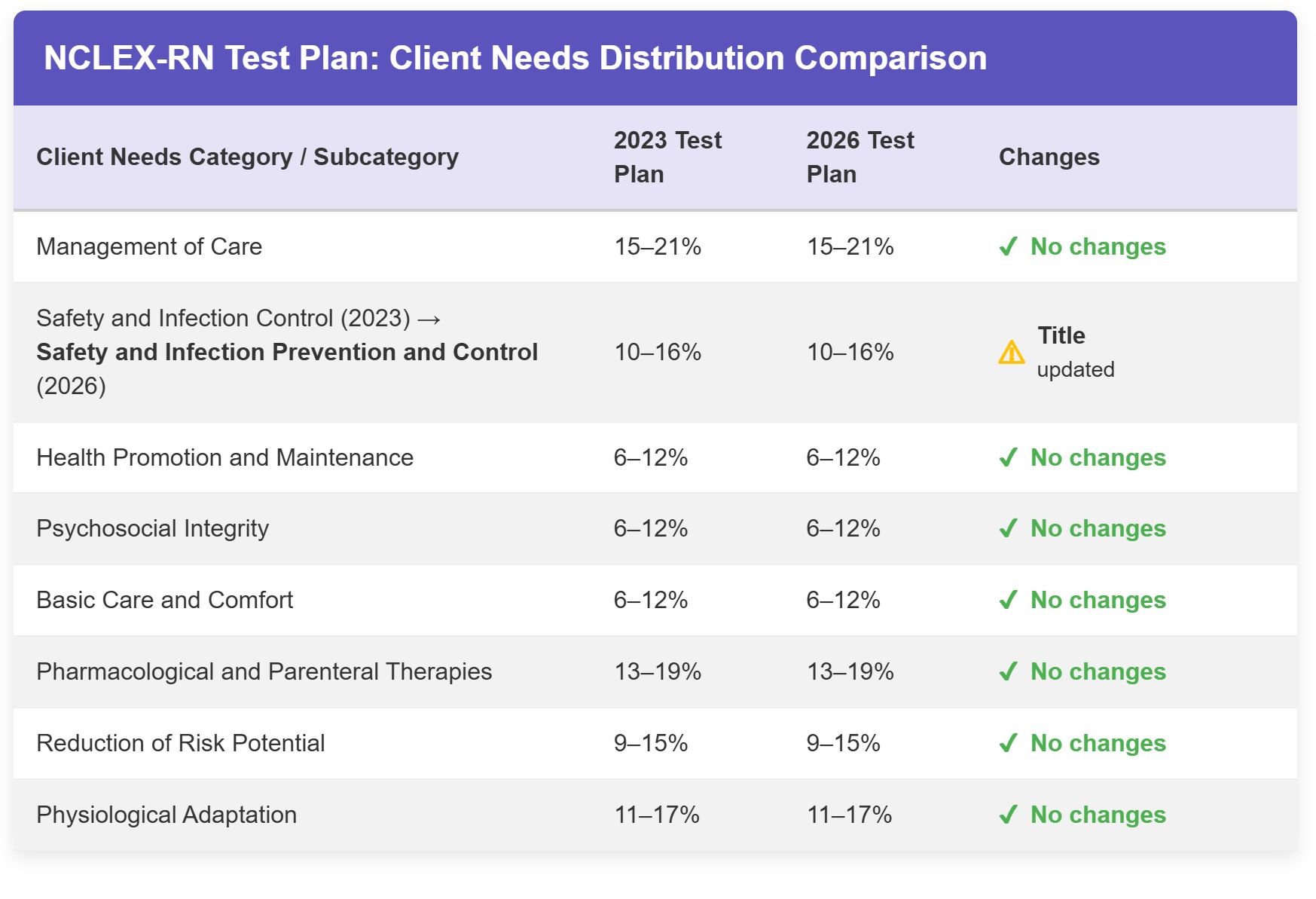
Structure: unchanged. Same Client Needs categories, same weighting ranges, same Clinical Judgment Measurement Model, same item types, same scoring rules, same computer-adaptive format <sup>[3][4]</sup>
What changed: activity statement wording, one renamed category, and new, explicit language on unbiased and equitable care <sup>[5][6]</sup>
What it means for you: this is a refinement, not a redesign but it rewards exactly the skill most candidates are shakiest on: prioritizing when more than one thing is going wrong at once
If you only remember one sentence from this article, make it this one: you are not starting over. You're fine-tuning.
What Hasn't Changed
Before you touch a single flashcard or rewrite a single syllabus, let's talk about everything NCSBN left completely alone. This is where most of your relief should come from.
The Clinical Judgment Measurement Model still runs the whole show
The [Clinical Judgment Measurement Model (CJMM)](https://www.ncsbn.org/exams/clinical-judgment-measurement-model.page) is unchanged. Recognize cues. Analyze data. Prioritize hypotheses. Generate solutions. Take action. Evaluate outcomes. If you've been practicing this loop and if you've worked with a coach who drills it into you you've been training for exactly the exam you're about to take.
The blueprint itself didn't move
Four Client Needs categories. Same percentage ranges. Physiological Integrity is still the largest chunk of content. Item types, the CAT delivery format, and the three scoring rules (0/1, +/–, and rationale scoring) are all unchanged <sup>[3][4]</sup>. If you've been studying against the 2023 blueprint, that work still counts. Every hour of it.
This update cycle is completely normal
NCSBN refreshes the test plan every three years, built on a nationwide practice analysis of newly licensed nurses' first six months on the job <sup>[2]</sup>. The 2026 revision came from the 2024 RN and PN Practice Analyses the same routine process that produced 2023's plan before it. There's no drama in the process. Just new findings.
What Actually Changed
Now, the part that actually matters. NCSBN didn't add new content. They re-described entry-level nursing more precisely, and they tightened the exam's grip on the decisions candidates find hardest: what to act on first, what can wait, and how to respond when more than one client needs you at the same time.
If that sentence makes your stomach drop a little, good. That means you already know where to focus.
1. Activity statements now describe real practice, not just tasks
Activity statements are the competency descriptions behind every category. We pulled this directly from NCSBN's own 2026 RN Test Plan document it's not secondhand:
"Identify and collaborate with multidisciplinary team members when providing client care (e.g., physical therapist, nutritionist, social worker)."
Earlier test plan language asked candidates to collaborate with the team. The 2026 language adds a step before that: identify which team members are even needed. One added verb. That's the whole update in miniature. NCSBN isn't testing whether you know more facts it's testing whether you can reason your way to the right people, the right priority, the right next move.
2. A renamed category, with a real reason behind it
"Safety and Infection Control" is now "Safety and Infection Prevention and Control." Small wording. Real implication: the exam now leans toward catching risk before it happens, not just rewarding the correct response after something's already gone wrong <sup>[5]</sup>.
3. Equity isn't a side unit anymore it's built in
NCSBN's own 2026 test plan adds language directing nurses to support unbiased treatment and equal access to care, regardless of a client's culture, ethnicity, sexual orientation, gender identity, or gender expression <sup>[6]</sup>. For faculty and coaches, that's a clear signal: scenario writing should build diverse client populations and social determinants of health into the everyday case, not save them for one lecture in week six.
4. The language around the exam sounds more like a real hospital
Smaller terminology adjustments across categories move away from outdated or stigmatizing phrasing, toward the language nurses actually use at the bedside today.
How This Shows Up in Case Studies
Multi-client, multi-step case studies are where clinical judgment gets tested for real because they recreate the exact pressure you'll feel on your first real shift. The programs and candidates adapting well aren't starting from zero. They're layering complexity onto what already works:
Adding a second or third client into an existing scenario
Practicing reprioritization mid-case as new data appears
Building delegation decisions into direct care tasks
Simulating a client who begins to deteriorate in real time
Adding interruptions or competing demands mid-scenario
Reassessing the plan of care as new findings emerge
Sequencing interventions by clinical urgency, not textbook order
If your practice questions only ever show you one client with a clean, static ending that's your highest-leverage place to start today. Not next month. Today.
If You're an Internationally Educated Nurse
We coach a lot of internationally educated nurses (IENs) here at UKNurses.net, and we know this exam carries weight beyond the test centre. It's the gate between where you are and the career sometimes the country you've been working toward for years. That pressure is real, and it deserves to be said out loud, not just studied through.
Here's the good news: the exam itself hasn't gotten harder for you specifically. It's the same exam, unchanged in structure, whether you trained in the UK, Ireland, the Philippines, Nigeria, India, or anywhere else. No separate, tougher version exists for IENs.
A few things worth locking in as you prepare:
Credential evaluation still comes first. Most US boards require a credentials evaluation commonly through [TruMerit/CGFNS](https://www.cgfns.org/) before you can even register.
English-proficiency rules haven't moved. IELTS, OET, PTE Academic, and TOEFL iBT remain the common pathways. Several boards still waive the requirement if you trained in an English-medium program (UK, Ireland, Australia, most of Canada).
Canada has its own gate. If you're targeting Canadian licensure, you'll route through the [National Nursing Assessment Service (NNAS)](https://www.nnas.ca/) before your provincial college processes an NCLEX application.
Clinical judgment prep matters more for you, not less. A lot of international nursing programs emphasize procedural accuracy over open-ended prioritization. That's exactly the muscle the 2026 update rewards and exactly the muscle worth building deliberately with a coach, not just a question bank.
If any of this sounds unfamiliar, start here: [OET vs IELTS for NMC Registration in England](https://uknurses.net/blog/oet-vs-ielts-nurses-england-nmc-registration) and [Nursing Qualifications in New Zealand](https://uknurses.net/blog/nursing-qualifications-new-zealand) walk through the same credentialing logic that carries across US, Australian, and New Zealand pathways. And if a computer-adaptive licensure exam still feels unfamiliar territory generally, our [How to Pass the NMC CBT First Time as an International Nurse](https://uknurses.net/blog/how-to-pass-nmc-cbt-first-time-international-nurses) guide covers the same test-day mindset in a different registration system. You've already navigated systems this complex before. You can navigate this one too.OET vs IELTS for NMC Registration in EnglandNursing Qualifications in New ZealandHow to Pass the NMC CBT First Time as an International Nurse
Where to Sit the Exam
You don't have to fly to the US. The NCLEX is delivered exclusively through Pearson VUE, with international test cities including Sydney, Melbourne, Adelaide, and Canberra in Australia, plus dozens of centres across the UK, India, the Philippines, Hong Kong, South Africa, and Japan.
Use the official [NCLEX Testing Locations directory](https://www.nclex.com/testing-locations.page) to find the nearest city, book your appointment, and confirm current international scheduling rules before you commit to a date.
Test-Prep Resources
Coaching gets, you the reasoning skills the delegation calls, the multi-client triage, the "what do I do first" instinct the 2026 update now weights more heavily. Most candidates pair that with a structured question bank. Two of the most widely used:
[Kaplan NCLEX Prep](https://www.kaptest.com/nclex) built around its Decision Tree strategy and readiness testing
[UWorld NCLEX-RN QBank](https://nursing.uworld.com/nclex-rn/) known for rationale-heavy, NGN-style case questions
Neither one replaces a coach walking through your specific reasoning gaps with you. But paired with the right coaching, either one is a solid content-review companion.
Life After Licensure
Here's something worth sitting with: passing the NCLEX isn't the finish line. It's the starting gun.
For a lot of the nurses we coach, licensure NCLEX, NMC, NCNZ, AHPRA, whichever gate you're walking through is a stepping stone toward something bigger. The same progression story we tell in our [NHS Band 5 to Band 6 Nurse Promotion Guide](https://uknurses.net/blog/nhs-band-5-to-band-6-nurse-promotion-guide) our most-read piece, for good reason plays out globally once you're registered and building toward specialization or leadership.NHS Band 5 to Band 6 Nurse Promotion Guide
If you're thinking that far ahead already (and you should be), these schools consistently rank among the strongest in the world for postgraduate nursing study:
United States
[Johns Hopkins School of Nursing](https://nursing.jhu.edu/) Baltimore, MD
[Duke University School of Nursing](https://nursing.duke.edu/) Durham, NC
[University of Pennsylvania School of Nursing](https://www.nursing.upenn.edu/) Philadelphia, PA
[University of Washington School of Nursing](https://nursing.uw.edu/) Seattle, WA
Australia
[University of Sydney Susan Wakil School of Nursing and Midwifery](https://www.sydney.edu.au/medicine-health/schools/susan-wakil-school-of-nursing-and-midwifery.html)
[University of Melbourne Department of Nursing](https://healthsciences.unimelb.edu.au/departments/nursing)
Weighing Australia against the US or NZ before you commit? Our guide on [What ATAR Do You Need to Study Nursing in Australia](https://uknurses.net/blog/what-atar-do-you-need-to-study-nursing-australia) is a good next stop.What ATAR Do You Need to Study Nursing in Australia
Your Self-Audit
Whether you're a student, an IEN prepping solo, or faculty auditing a program run through this before your next test date or cohort:
Are you prioritizing care across multiple clients, not just one scenario at a time?
Are you practicing adapting to changing client conditions in real time?
Are you required to make and justify delegation decisions?
Is reassessment built in as new information emerges mid-case, not just tacked on at the end?
Is clinical judgment something you're developing deliberately not just assuming it'll show up because you know the content?
Are you rehearsing decisions under time pressure, not just reviewing at your own pace?
Can you consistently pick the most urgent action among several reasonable-sounding options?
Does your practice reflect diverse client populations and equity-of-care scenarios?
If two or three of these feel shaky, that's not a red flag. That's just your next study session, already planned for you.
The Bigger Picture
Here's the truth underneath all of this: the 2026 NCLEX Test Plan isn't asking you to become a different kind of nurse. It's asking you to prove, more clearly than ever, the kind of nurse you're already becoming someone who can walk into a room where everything is happening at once and know exactly where to look first.
That's not a scarier exam. That's the exam finally catching up to what good coaching has been teaching all along.
You've done harder things to get here. This is one more step, not a new mountain.
Frequently Asked Questions
When does the 2026 NCLEX Test Plan take effect?
April 1, 2026, for both the NCLEX-RN and NCLEX-PN. If you test before that date, you're assessed under the 2023 test plan <sup>[1]</sup>.
Is the 2026 NCLEX harder than previous versions?
Not by design. Content categories, weighting, item types, and the CAT format are all unchanged. What's different is a sharper emphasis on prioritization, delegation, and multi-client decision-making within the existing Clinical Judgment Measurement Model <sup>[3][5]</sup>.
Do internationally educated nurses take a different version of the NCLEX?
No. You sit the identical NCLEX-RN or NCLEX-PN exam as US-educated candidates. The difference is everything that happens before test day typically a CGFNS/TruMerit evaluation, English-proficiency testing where required, and, for Canada, NNAS review.
Does my program need to rebuild its curriculum for 2026?
Almost certainly not from scratch. Most programs need refinement layering multi-client complexity, delegation decisions, and real-time deterioration into simulations you already have not a brand-new curriculum.
Ready to stop guessing and start training for the exam that's actually in front of you? [Talk to a UKNurses.net coach](https://uknurses.net/) about building case-based, multi-client practice into your next study block.UKNurses.net coach
About the author
UKNurses.net Coaching Team nurse educators and licensure coaches supporting internationally educated nurses through NMC, NCLEX, NCNZ, and AHPRA registration, and helping them keep moving once they're registered. Learn more on our [About page](https://uknurses.net/about).About page
Sources: [1] [NCLEX-RN Test Plan, Effective April 2026 NCSBN/NCLEX.com](https://www.nclex.com/files/2026_RN_Test%20Plan_English-F.pdf) · [2] [NCSBN Resources: 2024 Practice Analyses](https://www.ncsbn.org/resources.page?year=&audience=&topic=nclex-exam&knownet=&type=&page=2) · [3] [2026 NCLEX-RN Test Plan NCSBN Publications](https://www.ncsbn.org/publications/2026-nclex-rn-test-plan) · [4] [2026 NCLEX-PN Test Plan NCSBN Publications](https://ncsbn.org/publications/2026-nclex-pn-test-plan) · [5] NCSBN 2026 test plan category rename, confirmed via NCSBN Annual Meeting 2025 Exams Update and the official 2026 RN Test Plan · [6] Unbiased-care activity statement, quoted directly from the [2026 NCLEX-RN Test Plan PDF NCSBN/NCLEX.com](https://www.nclex.com/files/2026_RN_Test%20Plan_English-F.pdf) · [7] [NCLEX Testing Locations NCLEX.com](https://www.nclex.com/testing-locations.page)