There is a specific kind of quiet that falls over a Pearson VUE test centre the moment the invigilator says, "You may begin."
No ward noise. No bleeping obs machines. No bleep bleep bleep from the nurses' station. Just you, 115 questions, and a clock counting down.
For thousands of nurses making the move to the UK every year through the UK nursing registration process, that moment represents months of preparation, sacrifice, and visa paperwork. The NMC CBT exam is not the hardest thing you have ever done.
But failing it is expensive, time-sensitive, and demoralising in a way that hits different when you have already arranged accommodation in Croydon and told your family you are moving abroad as part of your journey as international nurses entering UK practice.
This guide covers everything you actually need to know about the CBT test for nurses in the UK and how it fits into your wider nursing career journey.
TL;DR (Too Long; Didn't Read)
The NMC CBT is the first hurdle for internationally trained nurses joining the UK register. Two parts, same session: 15 numeracy questions in 30 minutes (need 14/15), then 100 clinical questions in 2.5 hours (need ~68% general, 90% on patient safety).
-
The maths isn't the hard part, it's doing it on a clock instead of on the ward
-
Part B isn't testing your clinical skill, it's testing whether you think like a UK nurse: patient safety first, NMC Code second, MDT third
-
Most fails come from studying for your home system, not the UK one
-
Pass rate sits around 74–76%, so roughly 1 in 4 don't pass first time
-
You get 3 attempts per application, 10 days apart, with resit fees from £50–£83
-
6–8 weeks of structured prep (not just question banks) is what separates first-time passes from resits
Bottom line: It's a structure problem, not a competence problem. You already have the clinical judgement — you just need to show it the way the UK framework expects.
What Is the NMC CBT and Why Does It Exist?
The NMC CBT is Part 1 of the Test of Competence used in the UK nursing registration requirements for international nurses. It is a two-part assessment the Nursing and Midwifery Council uses to confirm that internationally trained nurses are safe to practise within the UK healthcare system.
Part 2 is the OSCE, the practical exam you sit in the UK.
The CBT comes first and can be sat at an authorised Pearson VUE test centre anywhere in the world, making it a key step in the process of how to become a nurse in the UK from abroad.
The NMC introduced it in October 2014 because nursing education differs globally. A nurse trained in Nairobi, Manila, Lagos, or Johannesburg enters the system with a strong clinical background, but shaped by different healthcare structures. The NMC CBT ensures that this knowledge aligns with UK expectations.
This is not a judgment on training quality. It is a standardisation step in the international nurse migration to the UK pathway, no exceptions, no workarounds, no matter how impressive your CV is.
Whether you are applying through Adult Nursing, Mental Health Nursing, Children’s Nursing, or Learning Disability Nursing, the CBT does not change its expectations. The standard is identical. Only your clinical background changes, not the benchmark.
Who Actually Needs to Take It?
You need the CBT if you are an internationally educated nurse applying for initial NMC registration or returning to practice after a significant break from the register.
Before you can book, you need to tick all of these:
-
A valid, unrestricted nursing licence in your home country.
-
A submitted NMC eligibility application.
-
Met the English language requirement, which is IELTS Academic 7.0 overall with no band below 6.5, or OET Grade B.
-
Your Authorisation to Test email from the NMC.
This process sits at the centre of most NHS Band 5 applications for international nurses entering UK practice. If you are not aligned at this stage, nothing downstream fixes it. Not OSCE preparation, not experience, not confidence.
That last one is important. The ATT email is what unlocks your Pearson VUE booking.
The Structure: What You Are Walking Into
Students in a classroom setting
The CBT has two parts, both completed in the same session. Before you even sit down at that Pearson VUE screen, it helps to understand one thing clearly: each part is testing a completely different kind of thinking.
Part A: Numeracy — The Section Nurses Underestimate
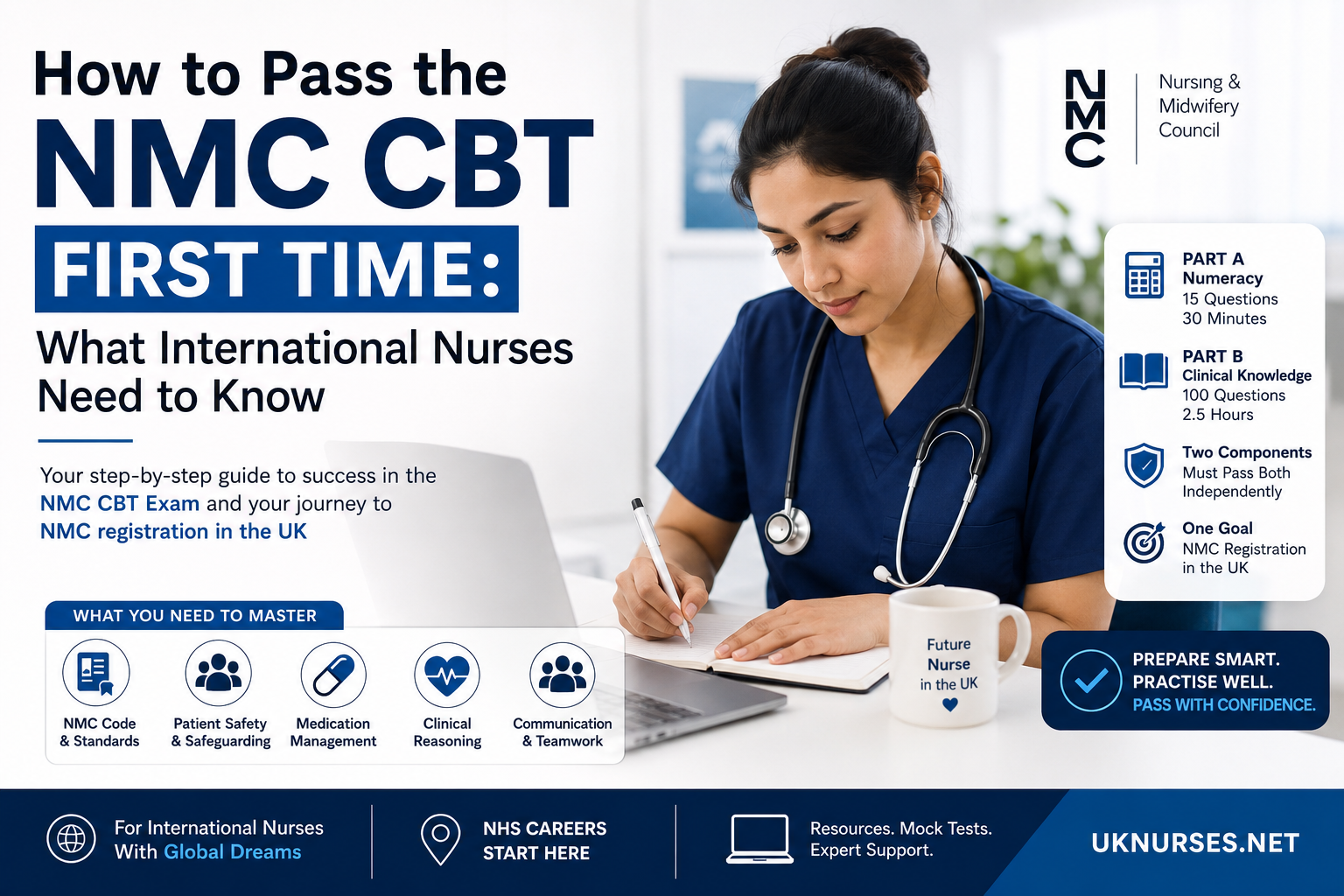
Part A is 15 questions in 30 minutes. You need 14 out of 15 correct, which means your entire buffer is just one question.
This section tests practical clinical calculations used in NHS settings, forming part of the core expectations for the CBT test for nurses UK pathway.
The questions focus on drug dosages, infusion rates, fluid balance, unit conversions, and paediatric dosing if you are sitting the children's nursing version. A built-in calculator is available on the Pearson VUE system, but your phone, personal calculator, and handwritten notes are not allowed.
Part A does not catch nurses out because the maths is complex. Most nurses already perform these calculations on busy wards, often under pressure and without hesitation. The challenge here is not competence, but context.
You move from familiar, fast-paced clinical environments into a quiet screen-based setup, where every calculation is slowed down, timed, and observed by a countdown. That shift alone is enough to disrupt confidence.
And that is where mistakes happen.
The most common error is a simple unit misread under pressure. A question may ask for the volume required for a dose of 5mg/kg, but the nurse reads it as 5mg instead of 5mg/kg. One small detail, completely different answer. It happens often, and it is entirely avoidable.
A practical tip here: practise Part A on a screen, not on paper, for at least two weeks before exam day. The goal is not to “learn” the maths again, but to make the interface feel so familiar that it becomes background noise.
Part B: Clinical Knowledge — Think Like a UK Nurse, Not Like Yourself
Part B is 100 multiple-choice questions across two hours and thirty minutes. You have four options per question and only one correct answer. The full session, including the reading time, runs up to 3 hours, so that initial breathing space is important before the clock starts.
The 100 questions are split into two independent components:
|
Component |
Questions |
Pass Mark |
|
General clinical questions |
80 |
Approximately 68% |
|
Critical patient safety questions |
20 |
90% — at least 18 of 20 correct |
This section is built around UK standards of care, aligned with NHS nursing practice expectations and the NMC Code for nurses working within the UK system.
Both components must be passed independently. A strong performance in general questions cannot compensate for weakness in patient safety. However, there is a practical advantage: if you fail only one component, you only resit that section, not the full exam.
Now the part nobody tells you directly
You may have run wards, managed genuine emergencies, and made clinical decisions under conditions that would make some NHS trusts nervous. The CBT is not questioning any of that.
Instead, it is asking a different question entirely: do you understand how nursing is expected to operate inside a UK professional framework, under the NMC Code, and within NHS structures?
That distinction is everything.
In Part B, the correct answer is almost always the one that prioritises patient safety first, aligns with the NMC Code second, and involves the multidisciplinary team appropriately third.
When two options look equally reasonable, the deciding factor is usually simple: the more patient-centred, consent-aware option is correct. Every time.
For example:
A patient refuses a prescribed medication. In some healthcare systems, the nurse escalates to the doctor and documents the refusal. In the UK CBT, that is not enough on its own. The nurse must also actively respect the patient’s right to refuse, ensure informed consent has been properly discussed, and document the decision clearly. Any option that suggests overriding the refusal to administer medication is incorrect, even if it feels clinically instinctive.
This is not a trap. It is a framework. And once you understand the framework, the questions become far more predictable.
Recognising the right framework on paper is one thing. Knowing it well enough to apply it instantly, under a countdown, when your own clinical instinct is pulling you somewhere else, is another. That is exactly the gap UKNurses' CBT mock exams are built to close, with full timed practice and guidance from nurses who have sat this exact exam.
See how UKNurses CBT preparation works.
Topics To Cover Without Skipping
To perform well in Part B, your preparation should consistently cover:
-
NMC Code and the 6 Cs
-
Relevant NICE guidelines
-
Mental Capacity Act 2005
-
Safeguarding adults and children
-
Infection prevention and control
-
Medication management and the five rights
-
Pressure ulcer assessment using the Waterlow or Braden scale
-
NEWS2 and sepsis recognition
-
Documentation and duty of candour
-
Raising concerns and whistleblowing procedures
The Pass Rate: The Encouraging Bit and the Less Encouraging Bit
The overall CBT pass rate sits at around 74 to 76% across all sittings, based on data submitted to parliamentary committees reviewing the NHS nursing workforce.
Encouraging, right? Until you flip it around and notice that roughly one in four nurses does not pass the first time, which is a very different headline.
The pass mark is not a fixed number either, because the NMC uses the Angoff standard-setting method, which adjusts the threshold based on the difficulty of the specific question set you sit.
In practice it tends to land around 67 to 68% for the general clinical section, although it can vary.
The lesson, then: prepare to score comfortably above the minimum rather than aiming for just enough to technically pass on a good day.
The nurses who struggle tend to share three habits:
-
Poor time management
-
Misreading questions
-
Answering as if they are still working in their home country
The good news is that all three are fixable.
How to Book Your NMC CBT: Step by Step
Booking the CBT is part of the official UK nursing registration process explained by the NMC and Pearson VUE system.
Step 1: Wait for your ATT email from the NMC
Step 2: Register on Pearson VUE
Step 3: Select your CBT test for nurses UK exam slot
Step 4: Pay the fee
This covers both Part A and Part B in the same session.
Remember: Check the NMC or Pearson VUE website before paying because fees can change without much fanfare.
Pearson VUE has centres across:
-
Kenya
-
Nigeria
-
Ghana
-
South Africa
-
Zimbabwe
-
India
-
The Philippines
-
Australia
-
New Zealand and many other countries, so finding one close to you is rarely the problem.
One thing that quietly destroys people is failing to select the correct exam code for their nursing field.
Remember, adult nursing, mental health, learning disability, and children's nursing all have different codes. If you book the wrong one, the NMC will not accept your result, while Pearson VUE will not refund you.
The Four Domains: What the Exam Is Actually Testing
Every Part B question maps to one of four domains, and while you need to know all of them, what matters even more is understanding what each one is actually testing rather than just recognising the name.
-
Professional values covers:
-
NMC Code
-
Patient dignity
-
Confidentiality
-
Consent
-
Safeguarding
-
Duty of candour
Essentially, it asks whether you understand how a UK nurse is expected to behave as a professional and not just as a clinician.
-
Communication and interpersonal skills test how you communicate with patients, families, and the multidisciplinary team, including difficult conversations, accurate documentation, and raising concerns. This is the stuff they do not always teach in nursing school but absolutely test here.
-
Nursing practice and decision-making is the biggest domain, covering assessment, care planning, medications, infection control, deteriorating patients, clinical procedures, and evidence-based practice, which means it deserves the bulk of your revision time.
-
Leadership, management, and teamwork cover delegation, supervision, accountability, and functioning within a UK nursing team, including knowing when to escalate, which in the UK tends to be earlier than you might expect.
These domains apply equally across international nurses entering NHS Band 5 applications. Whether your background is adult nursing or mental health nursing, the CBT does not adjust weighting. It tests consistency in clinical judgement, not speciality experience.
Remember: This is not purely clinical knowledge, because a nurse who can calculate any drug dose to four decimal places but has not read the NMC Code will still fail Part B.
The Truth Why Nurses Fail
They study for their home system because the NMC is not testing whether you are a good nurse by your country's standards. It is testing whether you understand UK nursing standards, and while the two overlap significantly, they are not identical.
They do not practise under actual time pressure. Browsing a question bank with a cup of tea is not exam preparation, whereas completing 15 numeracy questions in 30 minutes on a screen with a countdown is. Do the second thing.
They overthink Part B. When two answers look equally valid, the safer, more patient-centred, more consent-aware option wins, and if you have studied the NMC Code properly, your first instinct is usually right. Trust it.
They miss the qualifiers. Words like "most appropriate," "immediate priority," and "first action" change the entire answer, so read every question at least twice before committing.
They have not actually read the NMC Code. Not skimmed it at 11pm, but genuinely read it, because the code is not background material. It is the foundation of every single Part B question.
A Study Plan That Actually Works: Six to Eight Weeks
Nurses who pass the first time study for six to eight weeks with genuine daily focus and not six weeks of meaning to study but actual structured daily revision.
-
Weeks 1 and 2: Read the NMC Code and work through the four domains, staying away from question banks entirely until you have built the conceptual foundation.
-
Week 3: Daily Part A numeracy practice, specifically fifteen timed questions every day, while identifying which calculation types slow you down so you can address those directly.
-
Weeks 4 and 5: Part B clinical questions at forty to fifty daily, and for every wrong answer, understand why it was wrong rather than just noting what the right answer was.
-
Week 6: Full mock exams under timed conditions, at least three complete sittings, followed by targeted revision in whichever domains the results flag as weak.
-
Week 7 if needed: Further targeted revision based specifically on what the mock exams revealed, not a general repeat of everything.
-
Final week: Light revision only, because cramming at this stage does more harm than good. Confirm your test centre location, confirm your ID situation, and sleep like someone who has prepared properly, because you have.
The NMC published a Test of Competence blueprint on their website that maps topics to domains, and questions marked E are essential, which means every single one of them needs to be covered.
Exam Day: What to Expect
Arrive at least 30 minutes early and bring a government-issued photo ID that matches the name on your booking exactly, with a passport being the safest choice.
Keep in mind: No notes, no phone, and no personal calculator are allowed in, so your bags go in a locker while you get a short tutorial on the interface before the exam begins.
You can flag questions to revisit, and you should use this feature aggressively, because if a question takes more than 90 seconds, the right move is to flag it and move on rather than let it eat into your remaining time. Spending six minutes on one question and then rushing the last fifteen is not a strategy but a panic spiral with extra steps, so come back to flagged questions at the end with whatever time you have left.
Results arrive by email within 48 hours and you can also check your Pearson VUE account, where the result is either 'Pass' or 'Fail' with no question-level breakdown. The NMC does not tell you which questions you got wrong, which is frustrating, but there it is.
If You Do Not Pass
First, breathe, do not panic.
You are allowed up to three attempts per NMC application, with a minimum of 10 days between each one, although if all three are unsuccessful, your application closes and you must wait at least six months before reapplying. This is why the first or second attempt matters as much as it does.
Resit fees are £50 for Part A only, £70 for Part B only, and £83 for both parts together.
Without question-level feedback, the instinct after a fail is to study everything from scratch, but that is not efficient. Instead, think about what felt hardest during the exam, which section you ran out of time on, which domain felt least familiar, and where you hesitated most, then target that specifically rather than redoing everything.
A failed result does not mean you are a poor nurse. It usually means your preparation was aimed at the wrong system, so adjusting it toward UK practice and the NMC Code tends to make the second attempt look very different.
Myths Worth Putting Down
-
You need to memorise every drug calculation formula. You do not, because what you need is to understand the underlying logic, since memorising without understanding collapses the moment a question is phrased slightly differently.
-
The clinical questions are too UK-specific if you have never worked in the UK. The NMC Code and UK clinical standards are publicly available documents, so you do not need NHS ward experience to understand how a UK nurse is expected to respond. You need to read the right materials.
-
If you fail Part A, you fail everything and start again. Not since August 2021, because the parts are now assessed separately, which means failing one only requires resitting that one.
-
You can only sit the CBT before the OSCE. Technically you can sit the OSCE first, and while most nurses sit the CBT first because it can be done outside the UK, arriving in the UK before passing the CBT means you can sit the OSCE first if needed.
-
A high IELTS score means the CBT will be easier. Your English helps you read questions accurately, but it does not replace clinical and professional knowledge, so strong IELTS combined with poor CBT preparation is still a fail.
What Comes Next
Once you pass the CBT, the result is added to your NMC profile and remains valid for two years, within which you must complete the OSCE, a practical assessment done in the UK that tests clinical skills, communication, and professional conduct in simulated ward scenarios.
After passing both, your full Test of Competence result is valid for five years.
The CBT is the first hurdle rather than the only one, but it is the one that sets the tone for everything that follows.
A Word for Nurses Who Qualified a While Ago
If you qualified more than ten years ago and have had breaks from clinical practice, this part is specifically for you.
The CBT does not care how long you have been qualified, because it expects you to demonstrate current clinical knowledge and current understanding of professional standards. If your pharmacology knowledge is based on what was standard in 2009, some of it will be outdated, and that gap will show up in your results.
Before sitting, do an honest self-audit.
-
Are you current on NEWS2?
-
Do you know the current NICE guidance on sepsis recognition?
-
Are you familiar with the duty of candour as it stands in UK law?
These topics come up, and being a very experienced nurse with slightly outdated knowledge is not the same as being prepared for this specific exam.
What the CBT Actually Costs You: Fees, Time, and the Resit Reality
Before you open the Pearson VUE booking page, here is exactly what you are committing to, including what it costs if you need to come back for round two.
|
Sitting |
Parts included |
Time allowed |
Fee |
Type |
|
First sitting (full exam) |
Part A: Numeracy + Part B: Clinical |
3 hours total |
£83 |
First attempt |
|
Part A only (resit) |
Part A: Numeracy only |
30 minutes |
£50 |
Resit |
|
Part B only (resit) |
Part B: Clinical only |
2 hours 30 minutes |
£70 |
Resit |
|
Both parts (resit) |
Part A: Numeracy + Part B: Clinical |
3 hours total |
£83 |
Resit |
|
If all three attempts are used on both parts |
£249 |
Final Thoughts
The CBT is passable. Thousands of internationally trained nurses pass it every year and go on to build genuinely outstanding careers across the NHS, private healthcare, and community nursing in the UK.
The difference between nurses who pass first time and those who resit is not intelligence or clinical experience. It is preparation focused on the right thing: UK nursing standards, the NMC Code, and structured, timed practice under exam conditions.
You already have the clinical judgement. You have run wards, managed emergencies, and made decisions under pressure. What the CBT is testing is whether you can show that judgement inside a UK framework, on a clock, without your phone or your own calculator to fall back on. That is a structure problem, not a competence problem, and structure is something you can train for.
Our CBT preparation at UKNurses is built around exactly that. It covers all four domains, full timed mock exams that replicate the real Pearson VUE interface, daily numeracy drilling, and one-to-one guidance from nurses who have sat this exam themselves and know precisely where it tries to catch you out.
You have already done the hard part of becoming a nurse. Do not let an unfamiliar format be the reason you have to do it twice. Book a free consultation with UKNurses today and walk into that exam having already seen every version of what it is going to ask you.
FAQs: How to Pass the NMC CBT First Time
1. What is the NMC CBT exam?
The NMC CBT (Computer Based Test) is the first stage of the UK Nursing and Midwifery Council registration process. It assesses your theoretical nursing knowledge and ensures you meet UK nursing standards before moving to the OSCE stage.
2. How hard is the NMC CBT exam?
The CBT is not overly difficult, but it is detail-focused. Most candidates struggle not because the content is impossible, but because they underestimate UK-based clinical guidelines and exam-style questions.
3. What topics are covered in the CBT exam?
The exam mainly covers:
-
Nursing procedures and patient care
-
Professional values and ethics
-
Infection prevention and control
-
Safeguarding adults and children
-
Medicines management
-
Clinical decision-making and safety
4. How can I prepare for the CBT exam effectively?
Start by reviewing the NMC blueprints and UK clinical guidelines. Practice questions regularly, focus on understanding why answers are correct, and not just memorising facts. A structured study plan improves retention significantly.
5. How long should I study for the CBT exam?
Most candidates prepare for 4–8 weeks depending on their background. Nurses already familiar with UK-style guidelines may need less time, while others may need more structured preparation.
Sources
-
Nursing and Midwifery Council (NMC) – CBT: Test of Competence 2021
https://www.nmc.org.uk/registration/joining-the-register/toc/toc-nursing-and-midwifery/cbt/
(Nursing and Midwifery Council) -
Pearson VUE – Nursing and Midwifery Council (NMC) Testing
https://www.pearsonvue.com/us/en/nmc.html
(Pearson VUE)
-
Pearson VUE – Official NMC CBT Practice Tests
https://www.pearsonvue.com/us/en/nmc/practicetests.html
(Pearson VUE)
-
NMC Code – Professional standards of practice and behaviour for nurses, midwives and nursing associates
https://www.nmc.org.uk/code/ -
NMC Test of Competence
https://www.nmc.org.uk/registration/joining-the-register/toc/ -
NMC Future Nurse: Standards of proficiency for registered nurses
https://www.nmc.org.uk/standards/standards-for-nurses/standards-of-proficiency-for-registered-nurses/ -
NMC Test of Competence Candidate Information Booklets
https://www.nmc.org.uk/registration/joining-the-register/toc/toc-nursing-and-midwifery/cbt/
-
NICE Guidelines
https://www.nice.org.uk/guidance -
NHS England – National Early Warning Score (NEWS2) information
https://www.england.nhs.uk/ourwork/clinical-policy/sepsis/nationalearlywarningscore/ -
Mental Capacity Act 2005 (UK Government legislation)
https://www.legislation.gov.uk/ukpga/2005/9/contents -
UK Government – Duty of Candour guidance
https://www.gov.uk/government/publications/nhs-provider-duty-of-candour -
NHS Safeguarding guidance
https://www.england.nhs.uk/safeguarding/ -
NMC English language requirements
https://www.nmc.org.uk/registration/joining-the-register/english-language-requirements/
-
NMC Registration process for internationally educated nurses
https://www.nmc.org.uk/registration/joining-the-register/register-nurse-midwife/trained-outside-uk/ -
Pearson VUE NMC exam codes page
https://www.pearsonvue.com/us/en/nmc.html
(Pearson VUE)