How to Become a Nurse with No Healthcare Background: U.S. Nursing Pathways for 2026
The short answer: you do not need a healthcare background to begin a U.S. nursing pathway. Your best route depends on your education, admission rules, cost, and the license you want.
This guide is for: high school and GED students, people with certificates or diplomas in another field, students with college credits, and non-nursing degree holders, plus the families helping them choose.
Not mainly for: already-licensed nurses or internationally educated nurses seeking US license conversion. If that is you, our guide to studying or working abroad as a nurse in 2026 is a better starting point.
Key Takeaways
· You do not need previous healthcare work to begin a U.S. nursing pathway. Your education, prerequisites, admission requirements, budget and end goal matter more.
· ADN and BSN are both mainstream routes to RN licensure. In 2025, associate-degree graduates made up about 46.4% of first-time U.S.-educated NCLEX-RN candidates, while baccalaureate graduates made up about 52.0%.
· If you already hold a bachelor’s degree in another subject, accelerated BSN and entry-level master’s programs may shorten the academic route, but financial aid can work differently.
· There is no single national TEAS cutoff, nursing-school price or admission formula. Always check the rules of the specific program.
· Before paying a deposit, verify state board approval, nursing accreditation where relevant, federal-aid eligibility, recent NCLEX results and the real total cost.
Before we talk about programs, let's talk about you
If you were sitting in my office with your parent, partner, brother or sister, to find your best US nursing pathway, I would start with one message: you do not need a healthcare course before you can begin a nursing pathway in the United States.
Many students arrive with the same worry. One has only a high school diploma. Another completed a certificate in IT, business, hospitality, cosmetology or another field entirely. Someone else has college credits, or a degree that has nothing to do with nursing. Families often ask, "Will all that time be wasted?" or "Do we have to start again from the beginning?"
Usually, the answer is no. However, the right route depends on what you already studied, what each nursing school will accept, how much you can afford, and how quickly you need to qualify.
This guide is meant to help your family have that conversation calmly. It does not tell everyone to choose the nursing pathway. It shows the main routes, questions behind each choice, and the checks you should make before paying an application fee or deposit. If you would rather talk it through with someone who has guided students through this exact decision, our nursing degree support team runs this conversation every week.
1. Start with what you already have
Your old certificate or diploma may not become nursing credit. That does not mean it has no value. College-level English, psychology, statistics or other general education courses may transfer if the nursing school accepts them. Science courses often have time limits, so an old biology or anatomy course may need to be repeated.
Your first practical step is simple: collect every transcript you have and ask two or three nursing schools for a transcript evaluation. Do not rely on a friend's experience. Transfer rules are school-specific.
Here is why this check matters. At UNC Chapel Hill, for example, Anatomy & Physiology and Microbiology must be completed within five years of the application deadline, while Psychology and Statistics have a ten-year limit. That is one school's rule, not a national rule. Another university may use a different time limit entirely. A family should never build a two-year plan around an old course until the target school confirms it still counts.
Note: if you are weighing whether a self-paced provider like Sophia Learning can fill your gen-ed or prerequisite gaps, read our companion guide, Sophia Learning for Nursing in 2026: Transfer Credits, Costs & Schools That Accept Sophia, before you enroll in anything.
Starting point at a glance
· High school diploma or GED: compare ADN and BSN routes. Ask whether the BSN is direct-admit or requires a second nursing application.
· Certificate or vocational diploma in another field: ask whether any college-level general education courses transfer. Do not assume the certificate becomes nursing credit.
· Some college, no degree: request a transcript review. You may already have useful English, psychology, math or statistics credit.
· Associate degree in another subject: general education may transfer, but nursing science prerequisites may still be needed.
· Bachelor's degree in another subject: compare ABSN and entry-level master's options as well as traditional BSN transfer routes.
2. What pathways do US nursing students actually use?
The U.S. does not have one single road to becoming a registered nurse. National licensure data show that two routes dominate.
In 2025, the National Council of State Boards of Nursing (NCSBN) reported 192,916 first time, U.S.-educated candidates taking the NCLEX-RN. Of them, 100,258 came from baccalaureate nursing programs and 89,549 came from associate-degree programs, about 52.0 percent from baccalaureate programs and 46.4 percent from associate programs. Diploma programs made up only a small share.
For families, this matters. An ADN is not an unusual or "less real" route to RN licensure. A BSN is also not the only serious route. Both are mainstream. The better question is which route fits the student's goals, finances, location and admission chances.
First-time U.S.-educated NCLEX-RN candidates, 2025
|
Program type |
Candidates |
Share |
|
Baccalaureate nursing programs (BSN) |
100,258 |
52.0% |
|
Associate-degree nursing programs (ADN) |
89,549 |
46.4% |
|
Diploma programs |
2,671 |
1.4% |
Source: NCSBN, 2025 NCLEX Examination Statistics
3. The Primary U.S. Nursing pathways
ADN: the community-college route
An ADN is often attractive to students who want a lower-cost route to RN licensure. The nursing sequence is commonly described as about two years, but that does not always mean two years from today. Prerequisites, application cycles and waiting for a seat can add time.
Traditional BSN: The university route
A BSN is usually planned as a four-year degree for students entering from high school. However, admission models differ. Purdue University runs a four-year, direct-admit BSN, so you are placed in nursing from day one. Other schools, including UNC Chapel Hill, admit you to the university first, then require a second, competitive application to enter the nursing major. Ask any school directly which model it uses, because it changes your admission risk.
Accelerated BSN (ABSN): For students who already hold a Bachelor's Degree
An accelerated BSN, often called an ABSN, is designed for people whose first bachelor's degree is in another subject. AACN reported 340 accelerated entry-level baccalaureate programs in 2025 and says these pathways commonly take about 11 to 18 months. Schools may count that time differently, so ask whether prerequisites are included in the advertised length. These programs are intense, and working while enrolled can be difficult.
A concrete example can make this easier to picture. Northeastern University advertises an accelerated BSN that can be completed in as few as 16 months after required prerequisites. Programs like this are built for students changing fields, but the advertised program length is not the same as the time from today to RN licensure. A student may still need several prerequisite courses before the nursing sequence begins.
If an in-person cohort is not realistic for you, Capella University runs an online ABSN pathway inside its CCNE-accredited BSN Prelicensure program, combining online coursework with supervised clinical practice and in-person skills labs. It is open to students who already hold a bachelor's degree, but the prelicensure track only runs in select states, so confirm your state is on the current list before you apply.
There is also a money issue families sometimes discover too late. A student who already earned a bachelor's degree is generally no longer eligible for a federal Pell Grant for another undergraduate degree, apart from limited exceptions, per Federal Student Aid's 2026-2027 eligibility rules. An ABSN may therefore save time but require more borrowing or family support. Ask the financial-aid office for a written aid estimate before deciding that the fastest program is automatically the best one. If you are working while you study, ask your employer about tuition assistance too: under IRS Section 127, employers can currently exclude up to $5,250 a year of education assistance from your taxable income, a benefit worth stacking on top of any grant or scholarship.
Entry-level (direct-entry) master's nursing programs
Some universities offer graduate-entry or entry-level master's programs for people who have a non-nursing bachelor's degree. AACN reports that these programs may take about 15 to 36 months. Be careful with the word "master's". Finishing an entry-level master's does not automatically make someone a nurse practitioner or nurse anesthetist. Read the exact program outcome.
For example, Johns Hopkins offers an MSN Entry into Nursing for students who already hold a non-nursing bachelor's degree, while Vanderbilt offers a prelicensure Master of Nursing pathway. These examples show why families should read the outcome carefully. The word "master's" sounds advanced, but the first purpose of these programs is to prepare a non-nurse for RN licensure. Advanced practice roles require additional education, certification and sometimes RN work experience. Our MSN and master's support team can help you map which entry-level route actually leads to your end goal.
LPN/LVN first, then RN
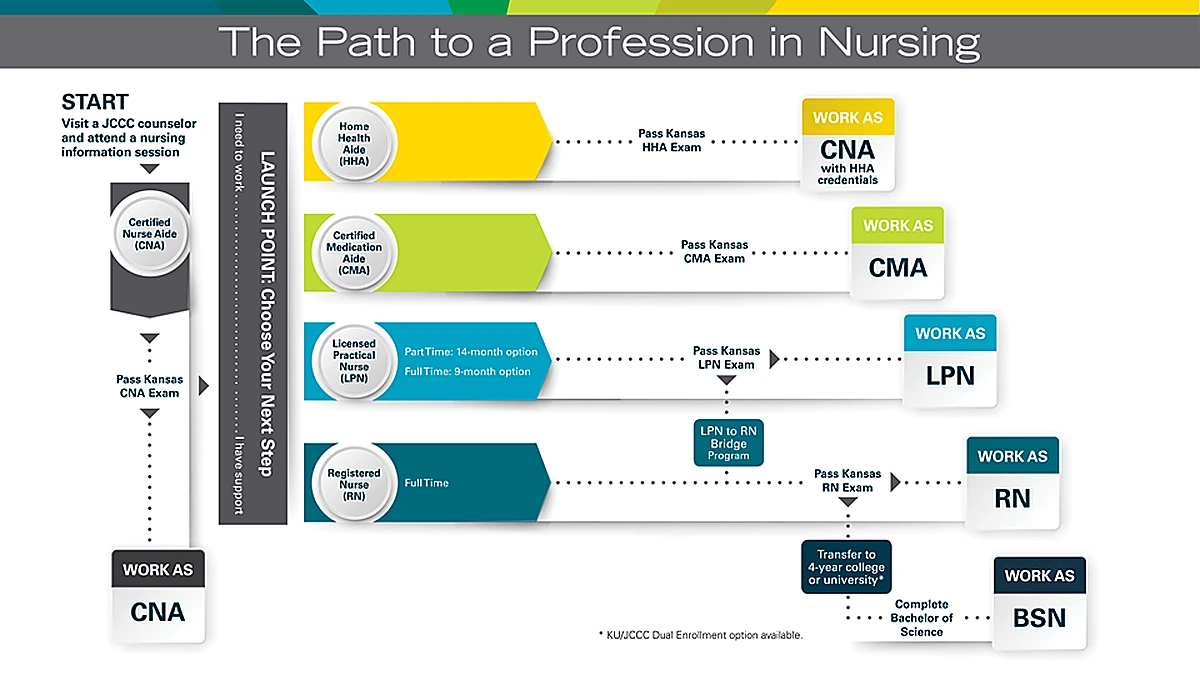
Practical nursing can be a staged route. The Bureau of Labor Statistics describes LPN/LVN programs as typically taking about one year. A student may later enter an LPN-to-RN bridge. This route can make sense when earning sooner is important. However, if RN is the final goal, compare the full time and cost of the staged route with going directly into an RN program.
Apprenticeships and employer support
An apprenticeship is usually not a separate nursing degree. It is a way to combine approved nursing education with paid work or employer support. Programs differ. Some accept beginners; others require you to already be a nursing student or employee. Treat an apprenticeship as a funding and work arrangement, then confirm what nursing degree and license it actually leads to.
Entry rules differ. UVA Health's Earn While You Learn model combines employment support with nursing education. Gadsden State Community College's RN apprenticeship, by contrast, is for students already enrolled in nursing. When you see "earn while you learn", ask whether it helps you enter nursing school or supports you after admission, and what work commitment you will owe afterward.
4. Do not confuse program length with your full journey
When a school says "16-month ABSN" or "two-year ADN", families sometimes hear that as the total time from today to becoming an RN. That can be misleading.
Think about three clocks:
1. Time to become eligible to apply. You may need anatomy, physiology, microbiology, chemistry, statistics or other courses first.
2. Time inside the nursing program. This is the part schools usually advertise.
3. Time from graduation to licensure. After completing an approved program, you still apply to the state nursing board, meet its requirements, and take the NCLEX.
Ask every school, "Based on the courses I already have, what is the realistic time from now until I can graduate?" That question is far more useful than asking only how long the nursing sequence lasts.
5. Talk about the total cost, not just tuition
Cost is one of the hardest family conversations because tuition is only one part of the bill.
For 2025-2026, the College Board reported average published tuition and fees of $4,150 a year for public two-year in-district colleges, $11,950 for public four-year in-state institutions, $31,880 for public four-year out-of-state institutions, and $45,000 for private nonprofit four-year institutions. These are broad college averages, not nursing-program prices.
2025-26 average published tuition and fees by college sector
|
College sector |
Tuition & fees per year |
Full cost of attendance per year |
|
Public two-year, in-district |
$4,150 |
$21,320 |
|
Public four-year, in-state |
$11,950 |
$30,990 |
|
Public four-year, out-of-state |
$31,880 |
$50,920 |
|
Private nonprofit four-year |
$45,000 |
$65,470 |
Source: College Board, Trends in College Pricing and Student Aid 2025.
These are whole-university averages, not nursing-specific figures; nursing programs typically add costs for background checks, uniforms, equipment and clinical travel.
The full cost-of-attendance column shows why tuition alone can be misleading. Once housing, food, books and transportation are included, the real annual cost runs well above the sticker tuition figure in every sector.
When comparing nursing pathways, use this simple formula:
Real family cost = tuition and required fees + books and supplies + clinical travel and other program costs + income the student may lose while studying, minus grants, scholarships and employer support.
When comparing schools, ask for the official cost of attendance and your estimated net price after aid. Then add real family costs: clinical travel, parking, childcare, reduced work hours, uniforms, testing and health or background-check requirements. Lower tuition can still become the more expensive choice if the commute is long or paid work becomes impossible.
Students who already have a bachelor's degree need an extra financial-aid conversation. Federal Pell Grant eligibility is generally aimed at students who have not already earned a bachelor's degree, with limited exceptions. That means an ABSN may be academically fast but financially difficult. Ask the school's financial aid office what aid you personally qualify for before deciding.
Also check the HRSA Nurse Corps Scholarship Program. For 2026-2027, it provides tuition and other support for eligible nursing students in return for service at an eligible shortage facility. The full-time monthly stipend is $1,642 and is taxable. Read the service commitment carefully before accepting an award.
6. Being eligible is not the same as being admitted
A student can meet the minimum requirements and still not receive a nursing seat. That is why I encourage families to think about an admission plan, not one dream school.
AACN reported that 75,255 qualified applications to entry-level baccalaureate nursing programs were not offered admission in 2025. These were applications, not 75,255 different people, because one student may apply to several schools. AACN links the capacity problem to limits such as faculty and clinical placements.
Entrance exams also cause unnecessary panic. ATI, the company that makes the TEAS, says there is no single national passing score. Each nursing school sets its own requirement.
So instead of asking, "What TEAS score is good?” ask the school:
· What is the minimum score?
· How are applicants ranked?
· Do you use overall GPA, science GPA, or both?
· Is there a point system?
· How many times can I apply?
· How often do you admit a new class?
· Do you keep a waitlist, or use competitive selection each cycle?
The goal is to know the rules before you spend months preparing for the wrong target. If your personal statement is the piece standing between you and an interview, our guide on writing a nursing personal statement that gets you an interview covers what admissions committees actually screen for.
7. The questions students are often afraid to ask
"Do I need to become a CNA first?"
Not as a national rule. Some schools may value healthcare experience, but CNA work is not a universal requirement for ADN or BSN admission. If your goal is RN, check the programs you want before adding an extra certificate simply because someone online told you it was required.
"I was weak in science. Does that mean nursing is not for me?"
No, but take the concern seriously. Start with one required science course and see how you perform. Use tutoring early. Nursing school requires steady study habits. Your high school science grade does not have to decide your future, but your preparation now matters.
"Can I work while studying?"
Sometimes. It depends on the program and your family needs. Accelerated programs can be especially demanding. Ask for a real weekly schedule that includes clinical days, labs, travel, study time and early-morning starts. Do not build a budget around an imagined class schedule.
"Can nursing school be fully online?"
Prelicensure nursing cannot be reduced to online lectures. Students need supervised clinical education and usually in-person skills work. If a program markets itself as online or hybrid, ask where labs and clinical placements happen, who arranges them, and how far you may have to travel.
"Am I too old?"
Age by itself is not a reason to rule nursing out, and the workforce data below backs that up. The better questions are about cost, time, family support, health and the number of working years you expect after graduation. A career change at 30, 40 or later deserves a realistic plan, not embarrassment.
"What can an RN earn?"
The Bureau of Labor Statistics reported these national median annual wages for May 2024:
U.S. median annual nursing wages, May 2024
|
Role |
Median annual wage |
|
LPN/LVN |
$62,340 |
|
Registered Nurse (RN) |
$93,600 |
|
Nurse Practitioner |
$129,210 |
|
Nurse Anesthetist |
$223,210 |
Source: US Bureau of Labor Statistics, Occupational Outlook Handbook
These are national medians, not starting salaries or guarantees, and BLS reports RN pay as a single combined category, so it does not publish an official ADN-versus-BSN pay split. Any source claiming an exact ADN-versus-BSN gap is estimating, not quoting BLS. Pay varies by state, employer, shift and experience.
Age is not a barrier either. The median age of the practicing RN workforce in the United States was 50 in 2024, according to NCSBN's National Nursing Workforce Survey, up from 46 in 2022. A career change at 30, 40 or later is entering a workforce that is already this age-diverse, not an unusual exception to it.
After graduation, RN candidates still have to pass the NCLEX-RN and satisfy their state board's licensing requirements. In 2025, first-time U.S.-educated NCLEX-RN candidates had an 86.7 percent pass rate. Repeat candidates performed much lower nationally. NCSBN permits up to eight attempts a year with at least 45 days between attempts, but individual states may impose stricter rules. That is why choosing a program with strong recent NCLEX outcomes matters. If you want a structured way to compare NCLEX prep resources once you get there, our tutors wrote How to Choose an NCLEX-RN or NCLEX-PN Prep Resource: A Tutor's Framework, and you can see what changed for test-takers in our 2026 NCLEX Test Plan Changes guide.
8. Before you pay anyone, verify the program
Before paying a deposit, verify three different things. They are easy to confuse.
Some personal situations deserve an early private conversation. If a student has a criminal history, contact the intended state board before investing heavily in prerequisites; Texas, for example, offers an eligibility review process. Students with disabilities or chronic conditions should ask disability services about reasonable accommodations and essential clinical requirements. Pregnancy is protected under Title IX, although clinical schedules may still need individual planning.
Check 1: state nursing-board approval
NCSBN explains that graduates generally need to come from an approved nursing education program to be eligible for the NCLEX under the U.S. regulatory model. Check the exact campus and program with the state nursing board directory.
Check 2: nursing program accreditation
Organizations such as ACEN and CCNE provide specialized nursing accreditation. This is different from state approval. Ask how the program's accreditation status may affect transfer, future education, employers or your plans.
Check 3: institutional and federal-aid eligibility
This is another separate question. Confirm the school and program through official federal and institutional sources before assuming federal aid will be available.
Also ask for the program's recent first-time NCLEX pass rates and completion information. Do not judge a school from one strong year or a social-media review.
If you may live or work in another state later, check the Nurse Licensure Compact. As of August 2026, 43 jurisdictions participate. Multistate-license eligibility is tied to meeting compact requirements and your primary state of residence, not simply to where you attended nursing school.
9. A family decision should be practical, not rushed
When a family feels stuck between two routes, I suggest sitting at a table and answering six questions together:
1. What is the student's final goal: LPN/LVN, RN, or eventually an advanced nursing role?
2. Which courses already completed will the target schools actually accept?
3. What is the total time from today to graduation, including prerequisites?
4. What is the total family cost after realistic financial aid?
5. Can the student manage the weekly schedule without creating an impossible work, childcare or transport problem?
6. What is Plan B if the first-choice program does not admit the student?
Parents and siblings can help by asking practical questions without choosing the career for the student. A plan can look good on paper and still fail if the student does not want the work or cannot sustain the schedule. Nursing school needs both a workable plan and personal commitment.
10. Your next seven moves
If you are reading this because nursing feels possible but confusing, do not try to solve the entire career today. Do the next seven things:
1. Collect every transcript and certificate.
2. Choose two or three realistic schools in your state or region.
3. Ask each school for a transcript evaluation and a written list of remaining prerequisites.
4. Compare ADN, BSN, and any pathway that applies to your current education.
5. Build a total-cost budget that includes lost work time, transport, books and clinical costs.
6. Verify state approval, accreditation, financial-aid eligibility and recent NCLEX results.
7. Apply with a backup plan instead of depending on one school.
The most important idea I want you to leave my office with is this: a background outside healthcare does not automatically close the door to nursing. Your route may be different from someone else's, and that is normal.
You do not need to know every nursing acronym today. You need to know your starting point, your goal, and your next verified step. Once those three things are clear, the pathway becomes much easier to discuss as a student and as a family. When you want a second pair of eyes on the plan, or help preparing your applications and personal statement once a target school is set, our careers and applications team and registration exam coaches pick up exactly where this guide leaves off.
Frequently Asked Questions
Can I become a nurse without a nursing degree or healthcare background?
Yes. U.S. nursing schools regularly admit high-school graduates, career changers and non-nursing degree holders. National licensure data show ADN and BSN routes are both mainstream, so your background does not have to include healthcare experience before you apply.
Do I need to be a CNA before nursing school?
No, not as a national rule. Some schools value healthcare experience, but CNA work is not a universal requirement for ADN or BSN admission. Check the specific program you want rather than assuming an extra certificate is required.
Is an ADN or a BSN better if I am starting from scratch?
Neither is universally better. In 2025, about 46.4 percent of first-time NCLEX-RN candidates came from ADN programs and 52.0 percent from BSN programs, so both are mainstream routes to RN licensure. The right choice depends on cost, timeline, admission odds and long-term career goals.
What is an accelerated BSN (ABSN) and how long does it take?
An accelerated BSN, or ABSN, is designed for people who already hold a bachelor's degree in another subject. AACN reported 340 accelerated entry-level baccalaureate programs in 2025, commonly taking about 11 to 18 months, though prerequisites can add time before the sequence begins.
Can I become a nurse with a non-nursing bachelor's degree?
Yes. The two main routes are an accelerated BSN (ABSN) or a direct-entry MSN. Both are built for graduates whose first degree is outside nursing, though the ABSN route is generally faster and the MSN route is a graduate-level qualification.
What is a direct-entry MSN, and does it make me a nurse practitioner?
A direct-entry, or entry-level, MSN is a graduate route into RN licensure for people with a non-nursing bachelor's degree, typically taking about 15 to 36 months. Finishing one does not automatically make you a nurse practitioner or nurse anesthetist. Those advanced roles need further education, certification and often RN experience.
How much does nursing school cost in the US in 2026?
For 2025-2026, the College Board reported average published tuition and fees of $4,150 a year at public two-year in-district colleges, $11,950 at public four-year in-state institutions, $31,880 at public four-year out-of-state institutions, and $45,000 at private nonprofit four-year institutions. Add books, clinical travel and lost income to estimate your real family cost.
Is 30, 40, or 50 too old to start nursing school?
No. The median age of the practicing RN workforce in the United States was 50 in 2024, according to NCSBN's National Nursing Workforce Survey, so an already age-diverse profession does not get that way from 22-year-olds alone. Cost, time and income loss are more useful planning questions than your birth year.
Can I get financial aid for nursing school if I already have a bachelor's degree?
Federal Pell Grant eligibility is generally aimed at students who have not already earned a bachelor's degree, with limited exceptions. That means an ABSN or direct-entry MSN can be academically fast but may need more borrowing or family support. Ask the school's financial aid office for a written estimate.
Can nursing school be completed fully online?
No. Prelicensure nursing education always requires supervised clinical education and in-person skills work, even when lectures are delivered online or in a hybrid format. Ask any program where labs and clinical placements happen and how far you may need to travel.
What is the NCLEX-RN pass rate in 2026, and how many times can I retake it?
In 2025, first-time U.S.-educated NCLEX-RN candidates had an 86.7 percent pass rate. NCSBN permits up to eight attempts a year with at least 45 days between attempts, though individual states may set stricter rules.
The bottom line
A background outside healthcare is not a barrier to a US nursing career. ADN, BSN, ABSN, direct-entry MSN, LPN-to-RN and apprenticeship routes each work for a different starting point, timeline and budget. The families who navigate this best are the ones who verify before they pay: transcripts, prerequisites, state approval, accreditation, real cost and recent NCLEX results, in that order.
If you want to run this decision past someone who does it for a living, our nursing degree support team can build a personalised shortlist and a total-cost comparison with you, and our registration exam coaches are ready when you reach the NCLEX stage.
Book a free consultation to talk through your starting point, or explore the full UKNurses resource hub for more guides like this one.
By Kay- Uknurses NCLEX Trainer